French Fries - Definitive Guide
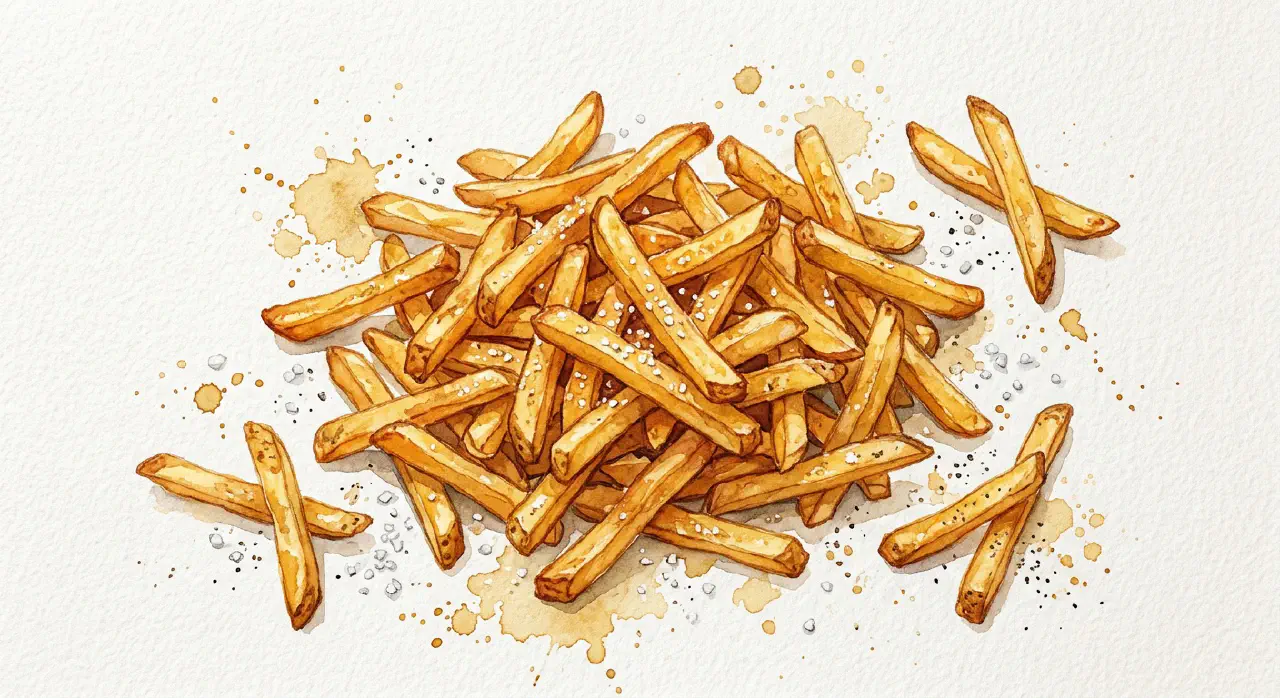
French Fries © kvalifood.com
Few foods are as universally eaten and as technically interesting as the fried potato. A strip of starchy tuber, submerged in hot fat, emerges crisp on the outside and steaming and fluffy within - and the path from field to fryer is governed by chemistry, history, and an ongoing geopolitical argument between Belgium and France. Getting them right at home requires understanding the same variables that govern every great fry: potato variety, moisture, temperature, and timing. This guide covers all of it.
Table of Contents
- 1. Production Methods
- 2. Flavor Chemistry
- 3. Potato Varieties
- 4. History & Origins
- 5. Regional Varieties
- 6. Key Producers and Fast-Food Context
- 7. Nutrition
- Quick Reference
- See Also
1. Production Methods
Home Cooking: The Science of a Good Fry
Potato selection: choose a high-starch, low-moisture (“floury”) variety. Starchy potatoes (Russet Burbank, Maris Piper, Bintje, Agria) gelatinize well and produce a fluffy interior with a crisp exterior. Waxy potatoes (new potatoes, fingerlings) hold together too firmly, stay dense when fried, and produce a soft, somewhat greasy result.
Cutting: uniform thickness is essential for even cooking. The standard for restaurant-style fries is approximately 6-8 mm square; Belgian-style demands 10-13 mm. Inconsistent cuts mean some fries are raw while others are overcooked.
Soaking in cold water: this step removes two things simultaneously - surface starch and reducing sugars. Surface starch, if left on, produces a gummy skin that prevents proper crisping. Reducing sugars (glucose, fructose) accelerate the Maillard reaction so dramatically that the exterior blackens before the interior cooks through. A soak of 30 minutes minimum (ideally 1-2 hours) in cold water addresses both. The water will turn visibly cloudy and starchy.
Drying: after soaking, the potato strips must be thoroughly dried - with a towel, in a salad spinner, or spread on a rack. Residual water hitting hot oil causes violent spattering and introduces steam that lowers the oil temperature, producing soggy results.
Single vs. double fry:
- Single fry (at around 175°C/350°F for the full duration) is faster but produces uneven results: the exterior often overcooks before the interior softens fully.
- Double fry is the professional and home-cook consensus method:
- First fry at 130-160°C (265-320°F) for 5-8 minutes: gelatinizes the starch, cooks the interior fully, begins driving off moisture. The fry will be pale and slightly soft - this is correct.
- Rest on a wire rack for at least 5 minutes (up to several hours or overnight refrigerated). The surface dries further as residual steam escapes.
- Second fry at 180-190°C (355-375°F) for 2-3 minutes: the dried surface crisps rapidly through the Maillard reaction; the already-cooked interior simply heats through.
Oil choices for home frying: neutral oils with high smoke points - refined peanut oil, beef tallow, lard, refined sunflower or canola oil. Avoid unrefined or extra-virgin oils, which smoke at lower temperatures and impart off-flavors.
Salting: always salt immediately after the second fry, while the surface oil is still wet - this makes the salt adhere. Salting raw potato draws water out by osmosis, interfering with drying; salting the oil before frying accelerates oil degradation.
Industrial Production
The frozen french fry - the format used by McDonald’s, Burger King, and most fast-food operations worldwide - goes through a multi-stage factory process:
- Receiving and washing: Russet Burbank potatoes arrive from contracted farms and are washed and inspected for defects, bruising, and sugar content (critical for controlling browning color).
- Peeling: steam peeling (briefly pressurized steam loosens the skin) or abrasive peeling.
- Trimming and defect removal: optical and mechanical sorting removes green, diseased, or hollow sections.
- Cutting: high-pressure water knives cut potatoes into uniform strips at speeds of hundreds of pounds per minute.
- Blanching: strips are passed through a steam or hot-water blancher at approximately 70-90°C for 2-3 minutes. This inactivates enzymes (preventing oxidative browning during storage), gelatinizes surface starch to form a thin shell that limits subsequent oil absorption, and equalizes color across the batch.
- Drying: excess surface water is removed in a forced-air dryer.
- Par-frying: the strips pass through a continuous fryer with vegetable oil at around 175°C for 45-75 seconds - partially cooking the fry and beginning crust formation, but not completing the fry.
- IQF freezing (individually quick frozen): the par-fried strips move immediately to a blast freezer (around −40°C) where they freeze in 8-14 minutes. Freezing individually (not in a block) allows portioning and ensures consistent results.
- Packaging: frozen fries are packed and shipped for storage at −18°C or lower.
At the restaurant: frozen fries are dropped directly into fryers at 175°C for 2.5-3.5 minutes. The par-frying and freezing process means the second fry at the restaurant is the completion fry.
2. Flavor Chemistry
The Maillard Reaction
The golden-brown color and complex toasty, nutty, savory flavors of a well-fried potato are products of the Maillard reaction - a cascade of chemical reactions between amino acids (particularly asparagine in potatoes) and reducing sugars (glucose, fructose) at temperatures above approximately 140°C. The reaction produces hundreds of distinct flavor compounds simultaneously, forming melanoidins (the brown pigments) and volatiles that give fried food its characteristic aroma.
The Maillard reaction is temperature-dependent: it accelerates sharply as temperature rises toward 180°C. This is why the second fry, at higher temperature, produces the crust that the first fry cannot.
Water is the enemy of the Maillard reaction: the surface must be dry (both from soaking and resting) and the temperature must remain above 100°C, otherwise surface steam prevents the reaction from proceeding.
Starch Gelatinization
When potato strips enter hot oil, the water inside the cells heats rapidly. At around 67.5°C, potato starch granules absorb water, swell, and gelatinize - the starch structure opens, becomes viscous, and the cell structure transforms from hard and raw to soft and fluffy. This is what creates the pillowy interior texture. The steam produced by this process also escapes outward through the forming crust, contributing to the characteristic bubbling in hot oil.
Why Soaking Removes Surface Starch (and Why That Matters)
There is a counterintuitive paradox here worth addressing: potato starch on the surface can theoretically form a crisp crust, yet soaking to remove it is universally recommended. The issue is not the starch itself but the sugars released when the potato is cut. These reducing sugars, combined with the dissolved surface starch in the soaking water, drive too-rapid Maillard browning - the exterior blackens before the interior can cook. Removing them resets the reaction rate to a controllable pace.
Acrylamide Formation
Acrylamide is a byproduct of the Maillard reaction formed specifically when the amino acid asparagine reacts with reducing sugars at temperatures above 120°C. Potatoes are naturally high in asparagine. The International Agency for Research on Cancer (IARC) classifies acrylamide as a “Group 2A probable human carcinogen,” and the WHO has identified it as a major concern in cooked foods. However, large epidemiological studies in humans have not found consistent evidence that dietary acrylamide exposure at typical levels increases cancer risk - the classification is based on animal studies at much higher doses.
Do not store raw potatoes in the refrigerator before frying - cold storage rapidly converts starch to reducing sugars, sharply increasing acrylamide precursors and accelerating premature browning.
Reduction methods:
- Soak cut potatoes before frying (removes reducing sugars, the reaction substrate)
- Do not refrigerate raw potatoes before frying
- Avoid overcooking to dark brown; aim for golden
- Use blanching as a pre-treatment (common in industrial processing)
Why Beef Tallow Tastes Different from Vegetable Oil
Beef tallow (rendered beef fat) produces a distinctly different flavor profile from vegetable oils because:
-
Fatty acid composition: tallow is approximately 50% saturated fat (primarily stearic acid) and 40% monounsaturated fat (oleic acid), with minimal polyunsaturated fat (PUFA). Most vegetable frying oils (canola, soybean) are high in PUFA. Saturated and monounsaturated fats are thermally stable and do not undergo significant oxidation during frying. PUFA-rich oils break down at frying temperatures, generating aldehydes and other volatile oxidation products that contribute off-flavors.
-
Flavor compounds carried in the fat: tallow carries fat-soluble flavor compounds derived from beef - primarily lactones, short-chain fatty acids, and other lipid-derived volatiles that impart an umami-adjacent, savory, faintly meaty character. These transfer to the surface of the potato during frying.
-
Smoke point: tallow has a smoke point of approximately 220°C (420°F) - higher than most vegetable oils at comparable refinement levels - meaning it remains stable at frying temperatures and does not generate off-flavors from thermal degradation.
-
Thermal stability: tallow can be reused across multiple frying sessions with minimal quality degradation; PUFA-rich vegetable oils degrade more quickly with each use.
Many customers and food writers who remember McDonald’s pre-1990 fries attribute the flavor difference primarily to the switch from beef tallow to vegetable oil. Chef Julia Child was among those who expressed public disappointment.
The Role of Salt Timing
Salt must always be applied immediately after frying, not before or during:
- Before frying: salt draws water out of the potato by osmosis, interfering with surface drying and preventing proper crust formation; it also accelerates hydrolysis of the frying oil, degrading it faster.
- During frying: same osmotic and oil-degradation problems; also dissolves into oil unevenly.
- After frying: the thin film of hot oil on the just-fried surface acts as an adhesive, holding salt crystals in place. The heat also helps salt dissolve fractionally, ensuring it is tasted immediately on contact rather than sitting on the surface as large crystals.
Fat Absorption
During frying, water inside the potato converts to steam and escapes outward through the forming crust. When the fry is removed from the oil and begins to cool, the internal pressure drops and oil is drawn inward through surface pores - oil absorption occurs primarily at removal and during cooling, not during the fry itself. Factors that increase oil absorption:
- Lower frying temperature (longer fry time, more surface pore time)
- Higher PUFA content in the oil
- Thinner cut (higher surface area to volume ratio)
- Underdried surface before frying
Typical oil uptake in finished fries ranges from roughly 8-14% of total weight for well-made fries, rising to 20-30% or higher for improperly made or oversoaked fries.
Double-frying and the proper dried surface produced by soaking and resting reduce oil uptake because a well-formed crust limits the number and size of surface pores through which oil can enter during cooling.
3. Potato Varieties
The most important physical properties for a frying potato are: high starch content, low reducing sugar content, high dry matter content (low moisture), and long, uniform shape for consistent cutting.
Russet Burbank
The dominant commercial frying potato in North America. Developed in the late 19th century by Luther Burbank from a variety originally bred by an early American grower. Characteristics:
- Dry matter: approximately 20-22%
- Starch content: high - roughly 16-18% of fresh weight
- Reducing sugars: very low when stored correctly (above 7°C/45°F)
- Shape: long, cylindrical, irregular surface; produces long, uniform-length strips
- Used by: McDonald’s, Burger King, virtually all North American industrial processors
- Weakness: reducing sugar content rises significantly if stored in cold conditions (below 7°C), causing premature browning - industrial potatoes are therefore stored at 7-12°C and conditioned before processing
Bintje
A Dutch variety developed by Kornelis Lieuwes de Vries and released in 1910. The standard for Belgian frites for over a century.
- Dry matter: 18-20%
- Starch content: high; floury texture
- Reducing sugars: low
- Flavor: slightly sweet and nutty - imparts flavor to the finished fry beyond generic starch
- Availability: widely grown in the Netherlands, Belgium, Germany, and France; less common in North America
- Weakness: somewhat susceptible to disease; flavor is distinctive enough that off-variety substitutions are detectable
Maris Piper
The dominant variety in British fish-and-chip shops. Bred in 1966 by the Plant Breeding Institute, Cambridge.
- Dry matter: high (comparable to Russet Burbank)
- Starch content: high
- Reducing sugars: very low
- Texture when fried: floury, fluffy interior with good crust formation
- Availability: UK-dominant; rarely available outside Britain and Ireland, requiring substitution in other markets
- Used by: most UK chippies; often specified in British recipe writing as the frying potato
Agria
A German variety increasingly popular in Europe, New Zealand, and Australia as a premium frying potato.
- Dry matter: high - 20-22%
- Starch content: high
- Reducing sugars: very low
- Color when fried: naturally golden-yellow flesh produces an attractive deep yellow fry without requiring added colorants
- Flavor: richer and slightly more buttery than Russet Burbank
- Used by: premium restaurants in Europe and Australasia; increasingly in restaurant fries in the UK as a Maris Piper alternative
Potato Variety Comparison
| Variety | Origin | Dry matter | Best used for | Availability |
|---|---|---|---|---|
| Russet Burbank | USA | 20-22% | All North American frying | North America, global industrial |
| Bintje | Netherlands | 18-20% | Belgian frites | Europe (esp. Netherlands, Belgium) |
| Maris Piper | UK | ~22% | British chips | UK and Ireland |
| Agria | Germany | 20-22% | Premium restaurant fries | Europe, NZ, Australia |
Avoiding Waxy Varieties
Waxy potatoes (Charlotte, Nicola, fingerling types, new potatoes) have low dry matter (often 14-16%), low starch, and high moisture. They hold together during cooking, making them excellent for salads and boiling, but they produce dense, slightly greasy fries without a fluffy interior. They are the wrong tool for this job.
4. History & Origins
The Belgium vs. France Debate
The origin of French fries is one of food history’s longest-running disputes. The Belgian claim rests primarily on a story retold by Belgian journalist Jo Gérard: a 1781 family manuscript supposedly describes peasants in the Meuse valley frying potatoes in lieu of fish when the rivers froze, a practice said to date to before 1680. Food historians reject this claim on two grounds: Gérard never produced the manuscript, and the potato did not arrive in the Meuse region until around 1735, making the 1680 date impossible.
The French counter-claim is better documented. Belgian food historian Pierre Leclercq - himself Belgian - concluded after detailed archival research that “it is clear that fries are of French origin.” He traced the first recorded mention of French fries to a Parisian book from 1775, and identified the first modern-style recipe in a French cookbook from 1795, La cuisinière républicaine. The modern style of fries recognizable today (thin, fried outdoors by street vendors) emerged in Paris around the 1840s-1850s.
The key transmission figure is Frédéric Krieger, a Bavarian musician who learned to cook fries from a roaster on rue Montmartre in Paris in 1842. He took the recipe to Belgium in 1844, where he set up a business called “Fritz” selling la pomme de terre frite à l’instar de Paris - Paris-style fried potatoes. The Belgian fritkot culture therefore derives from a Parisian model carried to Belgium by a Bavarian.
The name “French fries” itself reflects, from the Belgian perspective, what they call “French gastronomic hegemony” - Belgian cuisine was historically subsumed under the French culinary umbrella in English-speaking countries, so anything from the French-speaking world became “French.”
Thomas Jefferson and James Hemings
Thomas Jefferson encountered pommes de terre frites while serving as American minister to France in the 1780s. He returned with a recipe - written in his own hand - for pommes de terre frites à cru en petites tranches (“deep-fried potatoes in small slices”), though his version used rounds rather than sticks. Jefferson served fried potatoes at presidential dinners at the President’s House, which helped introduce the dish to American elite society.
The culinary work behind Jefferson’s table was done largely by his enslaved chef James Hemings, who had trained in France. Food historians increasingly credit Hemings as the practical agent who brought French cooking techniques, including fried potato preparations, to American tables. Jefferson served as the conduit; Hemings was the craftsman.
Global Spread
French fries remained largely a European street food through the 19th century. Their transformation into a global staple had two engines: World War I and fast food.
American soldiers stationed in France and Belgium during World War I encountered frites as a beloved street food and brought enthusiasm for them back home. When they returned, they sought the dish domestically, and the early fast-food industry - White Castle, founded 1921, was among the first - adopted fries as the ideal cheap, quick side dish alongside hamburgers.
The decisive global expansion came with McDonald’s, founded by the McDonald brothers in 1948 and franchised by Ray Kroc from 1954. McDonald’s adopted fries as a core menu item and, through its global expansion from the 1960s onward, installed the concept of the fried potato as an obligatory fast-food side in dozens of countries simultaneously.
5. Regional Varieties
Belgian Frites
The Belgian frite is the benchmark against which other fries are often measured. Key characteristics:
- Cut: thick - typically 10-13 mm square cross-section, significantly wider than American fast-food fries
- Potato: Bintje is the gold standard; a floury, high-starch Dutch variety with 18-20% dry matter content
- Fat: traditionally beef tallow (rendered and filtered beef fat), though some modern fritures use vegetable oil blends; tallow is considered essential by purists
- Technique: mandatory double-fry - first at 140-160°C (285-320°F) to cook the interior through; rested and cooled; second fry at around 180°C (356°F) until golden and crisp
- Service: in a paper cone, with mayonnaise as the default condiment (not ketchup); also served with andalouse sauce, samurai sauce (spiced mayo), and curry ketchup
The fritkot (in Dutch-speaking Flanders) or friterie (in French-speaking Wallonia) is a permanent fixture of Belgian public life - grease-encrusted roadside shacks and market-square stalls serving as community gathering points. Belgium has over 5,000 fritures and produces over 750,000 tons of frozen potato products annually, making it one of the world’s largest per-capita potato processing nations.
American Fast-Food Fries
American fast-food fries represent the industrial standard:
- Cut: thin - typically 6-8 mm, sometimes with skin-on or crinkle-cut variations
- Potato: almost universally Russet Burbank
- Fat: currently vegetable oil blends (canola/soybean); historically beef tallow (see McDonald’s section below)
- Technique: industrially blanched, par-fried, IQF-frozen at the processing facility; thawed and fried once at the restaurant, typically at 175°C (350°F) for 2-3 minutes
- Additives: dextrose (sugar) coating for uniform browning, sodium acid pyrophosphate to prevent graying, dimethylpolysiloxane (anti-foaming agent), natural beef flavor (in McDonald’s US product)
British Chips
British chips are the thick-cut, soft-centered fried potato of the fish-and-chip shop tradition:
- Cut: very thick - often 15-20 mm cross-section, irregular shapes common
- Potato: Maris Piper is the preferred variety in most chippies; King Edward as an alternative
- Fat: historically lard or beef dripping; now more often vegetable oil, though some traditional chippies still use beef dripping
- Technique: often a single long fry at moderate temperature (around 160-175°C) to cook through; the result is soft rather than sharply crisp, with a pale gold exterior rather than a deep amber crust
- Service: wrapped in paper, seasoned with salt and malt vinegar
Spanish Patatas Bravas
A different tradition entirely - the potato is not a side dish here but a tapa in its own right:
- Cut: large, irregular chunks - roughly 3-4 cm
- Technique: partially boiled then fried (or roasted), not double-fried in the Belgian sense
- Sauce: the defining element - a spiced tomato-based “brava” sauce (olive oil, tomato, smoked paprika, cayenne) and/or aioli (garlic mayonnaise); the sauce varies significantly by region and restaurant
- Fat: olive oil is standard
Canadian Poutine
Poutine emerged in the Centre-du-Québec region in the late 1950s. The competing origin claims center on Warwick, Quebec (restaurateur Fernand Lachance of Le Lutin qui rit, around 1957-1962) and Drummondville, Quebec (Jean-Paul Roy, who began serving fries with cheese curds and sauce around 1958). The name may derive from a Québécois slang term meaning “mess.”
Defining characteristics:
- Fries: medium-thick, ideally with some crispness to survive the sauce without turning entirely limp
- Cheese curds: fresh white Quebec cheddar curds (“squeaky cheese”), applied room-temperature so the gravy warms but does not fully melt them - visible, distinct curd texture is essential; shredded cheese is a disqualifying substitution
- Gravy: thin, lightly spiced beef or chicken (or both) gravy poured hot over the curds immediately before serving
- Serving order: fries → curds → hot gravy, so the curds soften slightly without dissolving
Poutine spread from rural Quebec diners to Montreal by the early 1970s, and was national and eventually global by the 1990s through fast-food adaptations (McDonald’s Canada, Harvey’s).
Dutch Patat
In the Netherlands fries are called patat in the north and center, friet in the south. The Dutch are serious fry consumers and have their own tradition:
- Cut: medium-thick, similar to Belgian style
- Fat: historically beef tallow, now largely vegetable oil
- Default condiment: mayonnaise, not ketchup
The most distinctive Dutch preparation is patatje oorlog (“war fries”): fries dressed simultaneously with mayonnaise, a peanut-based satay sauce (a legacy of Dutch colonial Indonesia), and diced raw onions - a combination of contrasting textures and flavors that is either revelatory or alarming depending on expectations.
Peruvian Lomo Saltado
Peru deserves particular attention in any global survey of the fried potato, given that potatoes were first domesticated in the Andean highlands (around Lake Titicaca) more than 10,000 years ago. Peru has over 4,000 native potato varieties.
The most prominent Peruvian dish featuring French fries is lomo saltado - a stir-fry of marinated beef strips, onions, and tomatoes, with French fries folded into or served alongside the wok-fried meat. The fries are not a side dish here; they are part of the composition, absorbing the cooking juices. The dish emerged from the chifa tradition - Chinese-Peruvian fusion cuisine developed by Chinese immigrants in the 19th century - and is now a mainstream Peruvian staple.
Salchipapa is a street-food tradition: thin-sliced pan-fried sausage (salchicha) served with French fries and various condiments, a popular fast-food format from roadside vendors.
Regional Varieties Comparison
| Style | Cut thickness | Potato | Fat | Technique | Default condiment |
|---|---|---|---|---|---|
| Belgian frites | 10-13 mm | Bintje | Beef tallow | Double-fry (140°C → 180°C) | Mayonnaise |
| American fast food | 6-8 mm | Russet Burbank | Canola/soybean blend | Par-fried frozen → single finish fry | Ketchup |
| British chips | 15-20 mm | Maris Piper | Vegetable oil (or beef dripping) | Single long fry at moderate temp | Malt vinegar, salt |
| Spanish patatas bravas | 30-40 mm chunks | Varies | Olive oil | Par-boiled then fried/roasted | Brava sauce, aioli |
| Canadian poutine | Medium | Varies | Vegetable oil | Single or double-fry | Cheese curds + gravy |
| Dutch patat | Medium | Varies | Vegetable oil | Double-fry | Mayonnaise, satay sauce |
| Peruvian lomo saltado | Thin strips | Native varieties | Vegetable oil | Single fry | Integrated into stir-fry |
6. Key Producers and Fast-Food Context
McDonald’s: The Industrial Pivot
McDonald’s french fries are the best-documented industrial fry in history, and their evolution tracks the broader history of American fast food and nutrition politics.
Original formula (1949-1990): McDonald’s fries were cooked in a proprietary blend of 93% beef tallow and 7% cottonseed oil, developed by Ray Kroc and his suppliers. This blend - sometimes called “Formula 47” - was kept secret and was responsible for the distinctive flavor that defined McDonald’s fries through the 1950s-1980s. The tallow was rendered, filtered, and delivered to restaurants as a solid block; restaurants melted it fresh daily.
The Simplot partnership (1967): In 1967, Kroc struck a handshake deal with J.R. “Jack” Simplot, an Idaho potato magnate who had pioneered IQF frozen french fries. Simplot convinced Kroc that frozen fries could deliver consistency, overcome summer supply shortages of Russet Burbank, and reduce per-restaurant labor costs (restaurant workers no longer needed to peel, cut, and prep fresh potatoes). By 1972, all McDonald’s restaurants had transitioned to frozen fries. The Simplot Company today supplies roughly one-third of all french fries sold in the United States, serving McDonald’s, Burger King, Wendy’s, KFC, and others.
The 1990 switch: Phil Sokolof, a Nebraska businessman who suffered a heart attack in 1966 and became an anti-saturated-fat activist, ran full-page advertisements in major newspapers throughout the late 1980s accusing McDonald’s of contributing to heart disease through beef tallow. In 1990, McDonald’s announced it would switch from beef tallow to vegetable oil. The initial replacement was partially hydrogenated vegetable oil - which, as was not yet widely understood, introduced trans fats that turned out to be more metabolically harmful than saturated fat.
Trans fat correction (2008): In 2002, researchers and advocates began publicizing the dangers of trans fats. McDonald’s faced lawsuits and public pressure. By 2008, the company had fully eliminated trans fats from its US and Canadian frying oil.
Current formula: McDonald’s US fries are fried in a blend of canola oil and soybean oil. The ingredient list for US McDonald’s fries includes: potatoes, vegetable oil (canola oil, corn oil, soybean oil, hydrogenated soybean oil), natural beef flavor (contains wheat and milk derivatives), dextrose, sodium acid pyrophosphate (to maintain color), citric acid (to preserve freshness), dimethylpolysiloxane (anti-foaming agent). The “natural beef flavor” - which contains milk and wheat derivatives - is the primary carrier of the beef-adjacent flavor in US fries and is the reason they are not vegan or suitable for those with wheat or dairy allergies.
In-N-Out Burger
In-N-Out is the most prominent American chain maintaining a genuine fresh-cut fry program. Whole Russet potatoes are hand-cut in each restaurant from potatoes delivered from contracted California farms. The potatoes go from cutting board to fryer almost immediately - there is no soaking, blanching, or resting step. They are fried once in pure sunflower oil.
The result is honest and potato-flavored but has attracted criticism for being too soft and lacking the crisp crust that double-frying and soaking would produce. In-N-Out fries frequently rank poorly in fast-food comparisons despite the chain’s overall devoted following. The chain offers “well-done” fries - an extended fry that produces a drier, crispier result - as a standard secret menu customization.
Five Guys
Five Guys also uses fresh-cut, never-frozen fries, but employs a more rigorous technique:
- Potatoes are sourced from specific growing regions (historically Idaho and the Pacific Northwest) with cool nights that produce denser, higher-starch tubers
- Potatoes are cut and soaked in water in each restaurant
- Fries are blanched briefly in hot water (roughly 3 minutes) before frying - this pre-cooks the starch and reduces browning variability
- Fries are then double-fried in peanut oil
- Result: consistently ranked among the best fast-food fries in comparative reviews
Five Guys uses a signature “overfill” service: when you order fries, the server fills the cup, then scoops a second load into the bag, so excess fries scatter in the bottom. This is a deliberate policy, not an accident.
Belgian Fritkot Culture
The fritkot (Dutch) / friterie (French) is a Belgian institution without equivalent elsewhere. These are permanent or semi-permanent fry stands - often custom-built wood or metal structures, sometimes elaborate - located in market squares, road junctions, and town centers across the country. The Belgian Frituur Network has documented over 5,000 operating stands. In 2014, UNESCO recognized the Belgian fritkot as an item of intangible cultural heritage.
Each fritkot typically serves frites, a range of fried snacks (croquettes, bitterballen, fricandelle sausages), and a long menu of sauces. Communal standing tables surround the stand; eating is social and unhurried.
7. Nutrition
Calories Per Serving
| Format | Serving | Calories | Fat | Sodium |
|---|---|---|---|---|
| McDonald’s small fries (US) | 71 g | 220 kcal | 10 g | 180 mg |
| McDonald’s medium fries (US) | 117 g | 320 kcal | 15 g | 400 mg |
| McDonald’s large fries (US) | 154 g | 490 kcal | 23 g | 400 mg |
| Five Guys regular fries | ~411 g | 953 kcal | 41 g | 962 mg |
| Homemade double-fried (tallow) | 150 g | ~400-450 kcal | ~20-25 g | depends on salting |
| Oven-baked at home | 150 g | ~180-220 kcal | ~4-6 g | depends on seasoning |
| Air-fried at home | 150 g | ~160-180 kcal | ~3-5 g | depends on seasoning |
Glycemic Index
Plain boiled potatoes have a glycemic index (GI) of approximately 50-70 depending on variety and preparation. French fries typically register at GI 63-75. Industrial and fast-food fries are at the higher end of this range because:
- The skin (which contains most of the fiber) is removed
- Dextrose coatings are added industrially
- The starch is already partially gelatinized during par-frying, making it more rapidly digestible
- Added sugars in industrial processing further accelerate postprandial blood glucose
For context, white bread has a GI of approximately 70-75; French fries are broadly comparable.
Acrylamide as a Health Concern
Acrylamide concentrations in commercially prepared French fries typically range from 100 to over 1,000 µg/kg, with average values in studies around 300-500 µg/kg. Darker-colored fries contain more acrylamide.
The IARC “Group 2A probable carcinogen” classification is based on animal studies at doses orders of magnitude higher than typical human dietary exposure. Major human epidemiological studies (reviewed systematically through 2022) have not found consistent evidence that dietary acrylamide at realistic intake levels increases cancer risk in humans. The American Cancer Society and NCI note the uncertainty and recommend reasonable mitigation (don’t overcook to black; vary diet) without recommending elimination.
Fat Absorption Rates
The amount of oil absorbed during frying is the primary variable in caloric density. A raw potato strip has a fat content of approximately 0.1%. A well-made finished fry contains approximately 8-14% fat by weight. An overfried or improperly made fry can reach 20% or higher.
Oil uptake occurs primarily at the moment of removal from the fryer and during subsequent cooling, not during the fry itself. This is why draining on a wire rack (rather than paper towel trapping) and serving immediately minimizes perceived greasiness.
Quick Reference
| Question | Answer |
|---|---|
| Best potato variety? | Russet Burbank (NA), Bintje (Belgium), Maris Piper (UK), Agria (Europe/Australasia) |
| Avoid which potatoes? | Waxy varieties: fingerlings, new potatoes, Charlotte, Nicola |
| Why soak in cold water? | Removes surface starch and reducing sugars; prevents premature exterior browning |
| Double-fry temperatures? | First fry: 130-160°C; rest; second fry: 180-190°C |
| When to salt? | Immediately after removing from oil, never before |
| Best fat for flavor? | Beef tallow; neutral alternative: refined peanut oil |
| Why store raw potatoes above 7°C? | Cold storage converts starch to reducing sugars, increasing acrylamide and premature browning |
| True origin country? | Most likely France - documented Parisian recipes from 1775/1795; the Belgian 1680 claim is historically impossible |
| Why do pre-1990 McDonald’s fries taste different? | 93% beef tallow formula replaced with vegetable oil in 1990 |
| Acrylamide risk? | IARC Group 2A probable carcinogen; no consistent human epidemiological evidence at dietary levels |
| Oil absorption: when does it happen? | Primarily at removal and during cooling, not during frying |
| GI of fast-food fries? | 63-75 - comparable to white bread |
See Also
- French Fries - Home Cook Guide - practical step-by-step method
- Soy Sauce and Tamari - condiment pairings and umami seasoning
- Fish Sauce - parallels in flavor science and the Maillard reaction
Sources
- French fries - Wikipedia
- The Origin of French Fries: Are They French or Belgian? - History Cooperative
- The uncertain origin of fries - Navefri-Unafri (Belgian Fry Federation)
- Thomas Jefferson: Life, Liberty, and French Fries - Journal of the American Revolution
- 4 Foods Jefferson Helped Popularize in America - Monticello
- James Hemings Brought America Its Favorite Foods - Institute of Culinary Education
- In Belgium, the Fries Are Never Wimpy - TASTE
- Authentic Belgian Fries: Culture, Tradition & Perfect Recipe - doineurope
- Frites, Chips, and More: French Fries Around the World - Dictionary.com
- The Double-Fry Method: Unlocking the Secret to Perfect Fries - eathealthy365
- French fries made golden and crisp in your own kitchen - ThermoWorks
- McDonald’s french fries - Wikipedia
- The art and science of fry production - Potato News Today
- Simplot’s french fry deal with McDonald’s was key for company, Idaho - Potato News Today
- J. R. Simplot - Wikipedia
- Maillard Reaction - Wikipedia
- Acrylamide is formed in the Maillard reaction - Nature
- Causal factors concerning the texture of French fries manufactured at industrial scale - PMC
- Beef tallow french fries vs. oil-fried: Which tastes better? - Washington Post
- Complete Beef Tallow vs Vegetable Oil Guide - Seed Oil Scout
- Russet Burbank - Wikipedia
- Maris Piper - Wikipedia
- Uncovering the Secret to Perfect Belgian Fries - TheFlexKitchen
- Here’s What McDonald’s French Fries Contained In 1955 Vs 2025 - The Takeout
- The Truth About In-N-Out Fries - Mashed
- The Real Reason Five Guys’ Fries Taste So Good - Mashed
- How The Five Guys French Fries Get Made - Food Republic
- Poutine - Wikipedia
- History of Poutine - The Canadian Encyclopedia
- Lomo saltado - Wikipedia
- The fascinating history behind Peru’s humble potato - Trafalgar
- The Right Time To Salt Homemade French Fries - Tasting Table
- Should you Rinse or Soak Potatoes Before Frying? - FoodCrumbles
- French Fries: Calories, Nutrition and Health Risks - NutriScan
- French fries - Glycemic Index, Glycemic load, Nutrition Facts
- Acrylamide and Cancer Risk - American Cancer Society
- Acrylamide and Cancer Risk - National Cancer Institute
- Dietary Acrylamide Exposure and Cancer Risk: A Systematic Approach - PMC
- Effects of deep-fat frying process on the oil quality during French fries preparation - PMC
- Understanding oil absorption during deep-fat frying - PubMed
- A Brief History of French Fries as the Ultimate Side - Pitco