Steak - Cooking Methods Guide
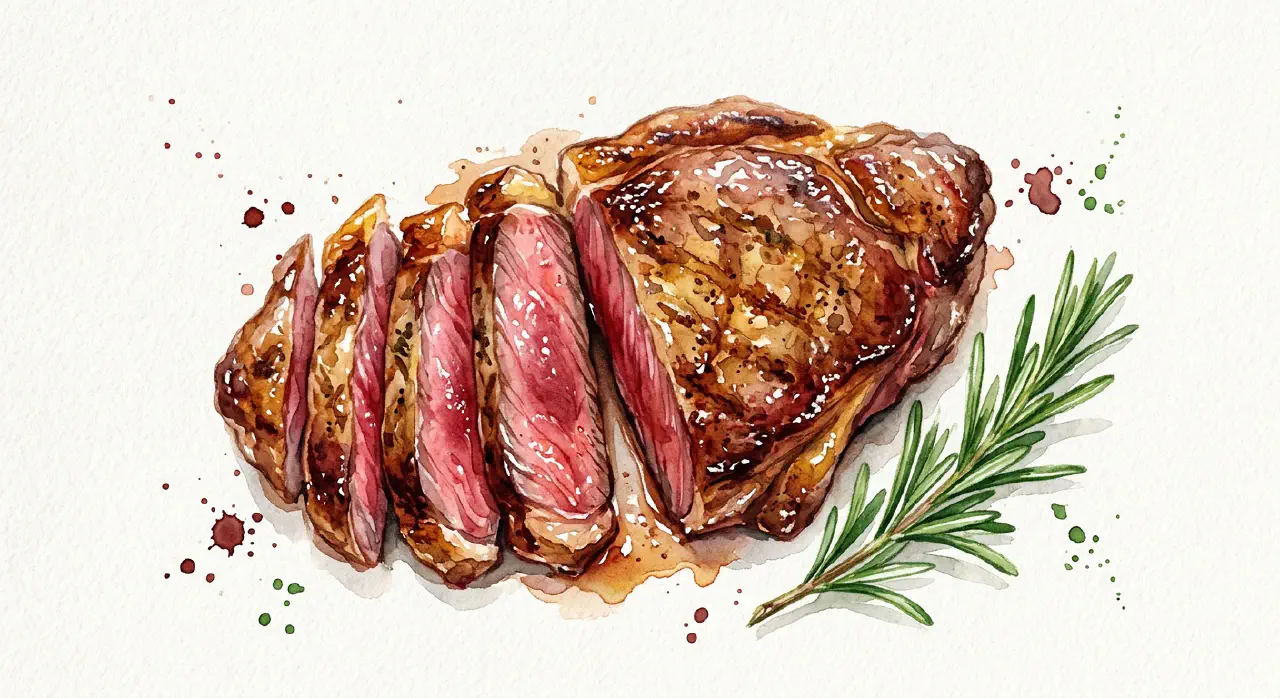
Steak © kvalifood.com
The steak is the simplest test of a cook’s judgment: a single cut of muscle, a heat source, and a decision about timing. Yet no other preparation generates more opinion, more debate, or more consistent failure in domestic kitchens. The method chosen determines the character of the crust, the gradient of doneness from edge to center, the fat rendering, and ultimately the flavor. Each technique is a different answer to the same question - how to apply energy to beef - and each imposes its own tradeoffs between precision, convenience, flavor, and equipment. Understanding them together is more useful than mastering any one in isolation.
1. Methods at a Glance
| Method | Heat source | Surface temp | Best cuts | Crust quality | Difficulty |
|---|---|---|---|---|---|
| Pan-sear | Conduction (skillet) | 450-550 °F (232-288 °C) | Ribeye, strip, filet | Excellent | Low |
| Grilling | Radiant + convection | 400-650 °F (204-343 °C) | Ribeye, strip, flank | Excellent | Medium |
| Reverse sear | Convection then conduction | 275 °F (135 °C) - 500 °F+ (260 °C+) | Thick ribeye, strip | Excellent | Medium |
| Sous vide + sear | Water conduction + conduction | 130-140 °F (54-60 °C) water | All premium cuts | Good (requires sear) | Medium |
| Broiling | Radiant (overhead) | 500-550 °F (260-288 °C) | Strip, sirloin, flank | Good | Low |
| Smoking | Convection + radiant | 210-250 °F (99-121 °C) | Thick steaks | Fair (sear needed) | High |
| Salt crust | Conduction (oven) | 400-450 °F (204-232 °C) | Thick, premium cuts | Minimal (sealed) | Medium |
| Deep frying | Conduction (oil) | 350-375 °F (177-191 °C) | Thin cuts, tenderized | Very good | Medium |
| Butter basting | Conduction + convection | 120 °F (49 °C) + finish sear | Filet, ribeye cap | Fair-Good | High |
| Flat top / plancha | Conduction (flat iron) | 450-700 °F (232-371 °C) | Most cuts | Excellent | Low |
2. Doneness and Internal Temperature
Internal temperature is the only reliable measure of doneness. Color, texture, and timing are guides; a thermometer is the standard.
| Doneness | Pull temperature | Rest temperature | Center appearance | Texture |
|---|---|---|---|---|
| Rare | 115-120 °F (46-49 °C) | 125 °F (52 °C) | Cool, bright red | Very soft, yielding |
| Medium-rare | 125-130 °F (52-54 °C) | 130-135 °F (54-57 °C) | Warm red to pink-red | Tender, slight resistance |
| Medium | 135-140 °F (57-60 °C) | 140-145 °F (60-63 °C) | Hot pink throughout | Firmer, slightly drier |
| Medium-well | 145-150 °F (63-66 °C) | 150-155 °F (66-68 °C) | Thin pink line | Firm, noticeably drier |
| Well-done | 155 °F+ (68 °C+) | 160 °F+ (71 °C+) | No pink, grey-brown | Stiff, significant moisture loss |
Pull 5-10 °F (3-6 °C) before the target temperature. Carryover cooking - residual heat continuing to raise the core temperature after the steak leaves the heat - is real and meaningful. High-heat methods (grilling, broiling) produce the largest carryover rise, sometimes 10-15 °F (6-8 °C) on a thick steak. Low-heat methods (smoking, reverse sear oven phase) produce 3-5 °F (2-3 °C).
Medium-rare - the range of 130-135 °F (54-57 °C) at rest - is the near-universal culinary standard for most premium cuts. At this temperature, collagen in the muscle has begun to soften, intramuscular fat (marbling) has partially rendered and basted the fibers from within, and the proteins have set enough to hold structure without squeezing out significant moisture. Above 160 °F (71 °C), actin proteins denature irreversibly, causing dramatic moisture loss; steaks above this point are fundamentally different products.
3. The Maillard Reaction
Every crust on every steak is produced by a single class of chemical reactions: the Maillard reaction, named for French chemist Louis-Camille Maillard, who described it in 1912. It is a cascade of reactions between amino acids (from proteins) and reducing sugars in the presence of heat, producing hundreds of distinct flavor compounds - pyrazines, furans, thiophenes, melanoidins - responsible for the brown color, the savory aroma, and the textural contrast of crust versus interior.
Temperature requirements:
- Reaction begins around 140 °F (60 °C) - detectable browning starts
- Rapid progression between 280-330 °F (140-165 °C)
- Peak efficiency at 330-390 °F (165-200 °C)
- Above 390 °F (200 °C), compounds begin to burn; bitterness increases
The dry surface is non-negotiable. Water on the steak surface must evaporate before the surface temperature can rise above 212 °F (100 °C) - the boiling point of water. A wet surface steams before it sears, producing grey, soft exteriors rather than crust. Patting the steak thoroughly dry with paper towels immediately before cooking is the single most effective step most home cooks skip.
Salting timing affects surface moisture: salt applied less than 30 minutes before cooking draws moisture to the surface via osmosis and does not allow time for it to be reabsorbed, producing a wetter surface. Salt applied 45 minutes or more in advance gives time for the brine to be reabsorbed, leaving the surface drier and improving Maillard performance. Dry-brining overnight in the refrigerator - uncovered - produces the driest, crustiest exterior of all dry-surface preparation methods.
Why sous vide always requires a searing step: the water bath environment keeps the meat surface wet and at temperatures well below the Maillard threshold throughout cooking. No Maillard reaction occurs until the steak is removed, dried, and placed on a ripping-hot surface.
4. Pan-Searing
Pan-searing is the default indoor method for premium steaks: fast, controllable, and capable of producing a crust comparable to any other technique when executed correctly.
Equipment
Cast iron excels due to its exceptional heat retention. Once at temperature, it does not cool significantly when a cold steak is placed on it, maintaining the surface temperature required for continuous Maillard reaction. Its oven-compatibility at any temperature makes it ideal for finishing thick steaks.
Carbon steel behaves similarly to cast iron but is lighter, heats faster, and is preferred in professional kitchens.
Stainless steel heats and cools more rapidly, making it harder to maintain a consistent searing temperature when the steak is added. It does, however, produce superior fond (browned residue) for pan sauce development, which explains its prevalence in restaurant kitchens.
Technique
- Pat the steak completely dry. Season with salt (at least 45 minutes in advance, ideally overnight).
- Preheat the pan over medium heat for 3-4 minutes, then increase to high for 2 minutes. Alternatively, heat in a 500 °F (260 °C) oven for 30 minutes then transfer to the burner.
- Add a high-smoke-point oil (refined avocado, grapeseed, or clarified butter). When it begins to smoke, add the steak.
- Sear undisturbed for 2-3 minutes per side for a 1-inch steak, or use the frequent-flip method - flipping every 30-45 seconds - which builds crust incrementally while keeping the interior cooler.
- In the final minute, add whole butter, crushed garlic, and thyme; tilt the pan and spoon the foaming butter over the steak continuously (arrosage). This adds flavor and helps set the crust on the top surface.
- Pull at the target pull temperature; rest.
Best cuts
Ribeye, New York strip, filet mignon, flat iron, bavette. Cuts of 1-1.5 inches are optimal; thinner cuts overcook before achieving crust, thicker cuts are better served by reverse sear or sous vide.
Limitations
High smoke production requires strong ventilation. The method produces uneven edge-to-edge doneness on cuts thicker than 1.5 inches - the outer centimeter will be well past medium before the core reaches medium-rare.
5. Grilling
Grilling exposes the steak directly to radiant heat from burning fuel and convective heat from hot air, while simultaneously adding compounds from combustion. The result is the most complex flavor profile of any steak cooking method - and the most variable.
Charcoal vs. gas
Charcoal burns hotter than gas (home charcoal grills can reach 700 °F+ at grate level, 100-200 °F hotter than most gas grills), and the burning of wood and charcoal releases guaiacol and other phenolic compounds that deposit on the steak surface as smoke, producing the characteristic smoky, bacon-adjacent flavor that gas cannot replicate. Lump charcoal burns hotter and cleaner than briquettes; briquettes are more consistent in temperature.
Gas offers convenience, rapid startup, and predictable temperature control, but struggles to reach the surface temperatures necessary for the deepest sears without expensive high-BTU burners. The flavor of a gas-grilled steak is clean beef without smoke character.
Two-zone fire
The most important structural principle in grilling: establish two heat zones - one directly over the coals or burners (direct heat, 450-650 °F / 232-343 °C) and one to the side with no heat beneath (indirect heat, 250-350 °F / 121-177 °C). Sear over direct heat to develop crust, then move to indirect to bring the interior to temperature without burning the exterior. For thin steaks (under 1 inch), direct heat alone suffices.
Technique
- Build a two-zone fire. Clean and oil the grates thoroughly - a clean, oiled grate transfers less heat to the steak bottom and prevents sticking.
- Pat dry, season.
- Sear over direct heat, 2-4 minutes per side depending on thickness, rotating 45° halfway through for crosshatch marks.
- Move to indirect heat if needed to reach target internal temperature.
- Rest.
Grill marks vs. even crust
Grill marks are cosmetically satisfying but represent uneven browning - only the bars of the grill contact the steak, leaving the areas between them uncrusted. A flat top or cast iron produces a more complete, more flavorful crust. The choice is one of aesthetics versus coverage.
Best cuts
New York strip and ribeye are the canonical grilling steaks - their marbling renders rapidly over high heat. Skirt steak, flank steak, and hanger steak benefit from quick, extremely high-heat grilling and should be served no more than medium-rare, sliced thinly across the grain. Filet mignon is prone to drying out on a grill; compensate with frequent basting or shorter cook times.
6. Reverse Sear
The reverse sear inverts the traditional sequence: cook low and slow in the oven first, then sear at high heat to finish. Proposed and popularized by J. Kenji López-Alt in the early 2010s, it is now the preferred method for thick premium steaks in serious home kitchens.
Rationale
Conventional sear-first methods apply intense surface heat before the interior is up to temperature, creating a pronounced gradient: well-done band at the edges, perfect center, grey ring between. The reverse sear minimizes this gradient. Slow oven heat raises the interior temperature uniformly, and because the oven phase does not trigger the Maillard reaction (surface never reaches the required temperatures in a 250-275 °F (120-135 °C) oven), all browning is reserved for the final sear, which needs only 60-90 seconds per side on a ripping-hot surface.
Technique
- Season the steak generously, preferably overnight in the refrigerator (uncovered).
- Place on a wire rack over a sheet pan. Place in a 250-275 °F (120-135 °C) oven.
- Cook until the internal temperature reaches 10-15 °F (6-8 °C) below the target pull temperature (approximately 115-120 °F (46-49 °C) for medium-rare target of 130-135 °F (54-57 °C) at rest). This takes 20-40 minutes depending on thickness.
- Remove and rest for 5 minutes at room temperature. The surface will dry out further during this rest, improving the subsequent sear.
- Sear in a cast iron or carbon steel pan preheated to maximum heat, with a high-smoke-point oil, for 60-90 seconds per side. Add butter, garlic, and herbs and baste briefly.
- Serve immediately - no additional rest needed, as the steak has already rested.
The steak does not need to come to room temperature before starting. The oven brings it up gently regardless of starting temperature.
Best cuts
Any steak of 1.5 inches or thicker benefits dramatically. Ribeye, strip, and filet mignon are all well-served. Tomahawk and bone-in ribeye (cowboy steak) are almost exclusively best prepared this way given their mass.
Limitations
Requires both an oven and a very hot skillet. Total time is 35-60 minutes, not suited to quick weeknight cooking. Below 1.25 inches, the benefit is less pronounced and a simple pan-sear is more practical.
7. Sous Vide
Sous vide (French: “under vacuum”) cooks the steak in a precisely temperature-controlled water bath sealed in a bag, producing perfectly uniform edge-to-edge doneness that no other method can match. Popularized in restaurant kitchens throughout the 1970s-1990s and accessible to home cooks from the 2010s via affordable immersion circulators (Anova, Joule, etc.).
Mechanism
The water bath is held at exactly the target final temperature - 130 °F (54 °C) for medium-rare. Because the steak cannot exceed the bath temperature, it is literally impossible to overcook; it simply reaches equilibrium and holds. Proteins denature uniformly throughout the cut. Fat renders slowly. The result is tender, juicy, edge-to-edge even doneness.
Temperature and time
| Doneness | Water bath temp | Minimum time | Maximum time |
|---|---|---|---|
| Rare | 120-125 °F (49-52 °C) | 1 hour | 2.5 hours |
| Medium-rare | 129-130 °F (54 °C) | 1 hour | 4 hours |
| Medium | 140 °F (60 °C) | 1 hour | 4 hours |
| Medium-well | 150 °F (66 °C) | 1 hour | 3 hours |
Beyond the maximum times listed, texture begins to degrade: proteins continue to denature, and the steak takes on a soft, almost mushy quality that some find unpleasant.
Technique
- Season the steak with salt, pepper, and optional aromatics (thyme, rosemary, garlic). Vacuum-seal or use the water-displacement method with a zip-lock bag.
- Submerge in the preheated water bath for the target duration.
- Remove from the bag. Discard any accumulated juices - these are dilute and do not improve a pan sauce.
- Pat completely dry with paper towels. Any surface moisture will prevent crust formation.
- Sear in a ripping-hot skillet (cast iron or carbon steel) with high-smoke-point oil for 30-60 seconds per side. The goal is maximum crust in minimum time, because the interior is already at temperature and any additional heat risks overcooking it.
- Serve immediately.
Best cuts
Any premium cut benefits. Sous vide particularly excels at thick or uneven cuts - tomahawk, bone-in ribeye, filet mignon - where conventional methods struggle to produce even doneness. It is also ideal for less expensive secondary cuts (flat iron, bavette, tri-tip) that benefit from extended low-temperature cooking to soften connective tissue without the interior overcooking.
Limitations
Requires an immersion circulator (and ideally a vacuum sealer). The process takes a minimum of 1 hour plus searing time. The crust from sous vide + sear, while good, rarely matches the depth of crust achievable with a conventional high-heat sear from a fully dry, room-temperature surface because the bag environment keeps the steak moist throughout.
8. Broiling
Broiling applies overhead radiant heat from the oven’s broiler element - functionally an upside-down grill. The heat source is fixed; the only control variable is the distance between the steak and the element.
Technique
- Position the oven rack so the steak sits 3-4 inches from the broiler element. Closer increases browning speed and risk of burning; farther reduces surface temperature and sear quality.
- Preheat the broiler on high for at least 10 minutes. Preheat a heavy oven-safe pan (cast iron, broiler pan) at the same time.
- Pat dry, season, and place on the hot pan.
- Broil 4-6 minutes per side for a 1-inch steak, monitoring closely - broiler temperatures vary widely between ovens and elements.
- Rest.
Limitations
Broiling is the least reliable of the common methods. Home broiler elements are highly variable in power and evenness. Distance control is critical but imprecise. The method produces an excellent crust when conditions are right but punishes inattention immediately - from properly seared to charred takes seconds under an active broiler. It is best treated as a last resort when no other method is available rather than a primary technique.
Best cuts
Thinner steaks - under 1 inch - are better suited to broiling. Thick steaks can be started in a 300 °F (149 °C) oven until 10 °F (6 °C) below target temperature, then broiled briefly to develop the crust, approximating the reverse sear method.
9. Smoking
Smoking a steak applies low, indirect heat alongside wood smoke for an extended period - a technique borrowed from traditional barbecue. The result is a steak with deep smoke character, but the technique requires a finishing sear to develop a meaningful crust.
Wood selection
| Wood | Flavor profile | Notes |
|---|---|---|
| Hickory | Strong, bacon-like | Classic American BBQ pairing |
| Oak | Bold, earthy, balanced | Neutral choice for beef |
| Cherry | Mild, slightly sweet | Adds color and subtle sweetness |
| Pecan | Moderate, nutty | Milder than hickory |
| Mesquite | Intense, sharp | Easily overpowers; use sparingly |
Technique
- Set up the smoker at 225 °F (107 °C). Establish smoke from the chosen wood.
- Season the steak simply - salt and pepper only. Sugary rubs caramelize and burn during the subsequent searing step.
- Smoke until the internal temperature reaches 10-15 °F (6-8 °C) below target (approximately 115 °F (46 °C) for medium-rare).
- Transfer to a hot cast iron pan or very hot grill and sear 60-90 seconds per side to develop the crust (reverse sear completion).
- Rest.
To increase smoke penetration, some practitioners freeze the steak for 20-30 minutes before smoking. The cold surface creates a thermal lag that keeps the steak in the smoke zone longer before the interior rises.
Limitations
Extended smoking risks over-smoking and drying the exterior. Smoking is time-intensive and equipment-dependent. For most steaks, the smoking window is narrower than for roasts - steaks reach their pull temperature within 45-90 minutes at 225 °F, limiting smoke exposure.
10. Salt Crust
The salt crust method encases the steak entirely in a thick shell of coarse salt mixed with water (and sometimes egg whites), then bakes it in the oven. The salt acts as an insulating, moisture-retaining cocoon.
Mechanism
Wet salt compacted around the steak forms a rigid shell that:
- Regulates heat transfer, conducting it slowly and evenly
- Traps steam from the steak’s surface moisture within the crust
- Seasons gently - despite the quantity of salt used, the steak absorbs relatively little; the crust is not a direct sodium delivery vehicle
Technique
- Mix 3 cups kosher salt with enough water to achieve a wet-sand consistency (some recipes add egg whites for structural integrity).
- Lay a thick base of the salt mixture on a sheet pan. Place the steak on it.
- Pack remaining salt mixture over and around the steak until completely covered with no gaps. Compress firmly.
- Bake at 425 °F (218 °C) until a probe thermometer inserted through the crust reads the target pull temperature.
- Crack away and remove the salt crust at the table. Brush off any adhered salt.
Limitations
The salt crust method produces no surface crust - the Maillard reaction cannot occur inside a sealed, humid environment. The steak’s exterior will be pale and soft. This is a moisture-preservation technique rather than a browning technique. It requires significant salt quantity and table-side cracking, which is a service element rather than a practical cooking advantage.
11. Deep Frying
Deep frying submerges the steak in hot oil - 360-375 °F (182-191 °C) - cooking it through rapid conductive heat transfer and simultaneously browning the exterior via the Maillard reaction. The method is uncommon for premium steaks but produces a distinctive result.
Physics
Oil transfers heat roughly 20-25x more efficiently than air, meaning immersion cooking is far faster than oven roasting. The oil temperature drops when the cold steak enters it; maintaining oil volume large enough to minimize this temperature drop is critical. A 5-6 quart pot of oil will drop significantly less than 2 quarts when a steak is added.
Technique
- Choose an oil with a high smoke point: refined peanut, refined avocado, or lard. Heat to 370 °F (188 °C).
- Pat the steak completely dry (wet surfaces cause violent oil splatter).
- Lower the steak carefully into the oil - do not drop it.
- Fry without moving: 2-3 minutes for a 1-inch steak targeting medium-rare. Adjust time for thickness and desired doneness.
- Remove to a wire rack; rest.
Best cuts
Thin steaks (under 1 inch) cook through before the exterior over-browns. Cube steak, thinly cut sirloin, and breaded variations (chicken-fried steak) are the most common applications. Deep frying a 2-inch ribeye produces a well-done interior with a good exterior - the thermal physics do not favor thick cuts.
12. Butter Basting
Butter basting - arrosage in classical French technique - combines pan-searing with continuous application of foaming hot butter over the steak’s surface. It is a finishing technique rather than a standalone method and is frequently combined with pan-searing or reverse sear.
Technique
- Sear the steak on the first side as normal. Flip.
- Add 2-4 tablespoons unsalted butter, 2-3 crushed garlic cloves (unpeeled or split), and woody herbs (thyme, rosemary) to the pan.
- Tilt the pan toward you so butter pools at the lower edge. Using a large spoon, continuously scoop the foaming butter over the steak’s top surface.
- Baste for 2-3 minutes, or until the interior reaches the pull temperature.
- Rest.
Effect
The hot butter (130-180 °F / 54-82 °C) does not produce significant additional Maillard reaction on its own but:
- Transfers heat evenly to the top surface, helping cook it from above while the bottom sears from below
- Introduces butterfat flavors and Maillard compounds from the butter’s own browning (beurre noisette stage)
- Deposits aromatic compounds from garlic and herbs onto the surface
Butter confit (also called butter poaching) is a lower-temperature variant: the steak is cooked entirely submerged in barely-bubbling butter held at 150-160 °F (66-71 °C), reaching target temperature slowly before a brief searing finish. The result is extraordinarily tender and rich, suited to filet mignon and premium tenderloin preparations.
13. Flat Top and Plancha
A flat top griddle or plancha - a flat iron surface heated from below - produces the most uniform crust of any cooking surface. Without grill bars to interrupt contact, the entire steak bottom contacts the hot metal continuously, maximizing Maillard reaction coverage.
Flat top vs. plancha
Flat top griddles (Blackstone, Camp Chef) reach maximum temperatures of 500-575 °F (260-302 °C). They are fueled by propane and distribute heat relatively evenly across their cooking surface, though corners and edges are often cooler.
Planchas - a term from Spanish and French culinary tradition - typically refer to thicker steel or cast iron plates that can reach 600-700 °F (316-371 °C) and hold heat more consistently. Commercial planchas are essential equipment in high-volume steakhouse kitchens.
Technique
- Preheat the flat top or plancha on high for 15 minutes minimum. The surface must be uniformly hot.
- Apply a thin layer of high-smoke-point oil immediately before cooking.
- Pat steaks dry, season, place on the surface, and press gently to ensure full contact.
- Do not move the steak until the first side releases cleanly from the surface and a crust has formed - approximately 2-3 minutes.
- Flip and repeat. Finish to target internal temperature.
Advantage over grill for crust
Where a grill produces grill marks and unbrowned gaps, a flat top produces a uniform, continuous crust across the entire contact surface. In blind tastings, cooks consistently rate flat-top seared steaks as having more crust flavor, not less, than grill-marked equivalents of the same thickness.
14. Resting and Carryover Cooking
Why resting matters
Cooking contracts muscle fibers, squeezing moisture toward the steak’s center. Immediately cutting a steak releases this pressurized liquid as a flood of juice onto the cutting board. Resting allows muscle proteins to relax and reabsorb the displaced moisture, distributing it evenly throughout the meat. The practical difference in moisture retention between resting 0 minutes and resting 5 minutes is substantial and measurable.
Carryover cooking
The steak’s interior continues to rise in temperature after removal from heat. The magnitude depends on:
- Heat source temperature: Higher heat sources produce more stored thermal energy in the steak’s exterior, driving larger carryover rises.
- Steak thickness and mass: Thicker steaks retain more heat and produce more carryover.
- Resting environment: Resting under a loose foil tent slows heat loss and increases carryover slightly.
| Method | Typical carryover rise |
|---|---|
| High-heat grill / broiler | 8-15 °F (4-8 °C) |
| Pan-sear | 5-10 °F (3-6 °C) |
| Reverse sear (searing phase) | 3-5 °F (2-3 °C) |
| Sous vide (searing phase) | 2-4 °F (1-2 °C) |
| Low-temperature oven / smoker | 3-5 °F (2-3 °C) |
Resting protocol
- Rest on a wire rack, not a plate, to prevent steam from softening the bottom crust.
- Cover loosely with foil - tight covering traps steam and degrades the crust.
- Rest 5-10 minutes for steaks under 1.5 inches; 10 minutes for thicker cuts.
- Steaks completed via reverse sear or sous vide have already rested during the low-temperature phase and require only a brief 2-3 minute rest after the final sear.
Quick Reference
| Question | Answer |
|---|---|
| Best all-purpose method? | Pan-sear in cast iron - reliable, fast, excellent crust |
| Best method for thick steaks? | Reverse sear or sous vide |
| Best method for flavor? | Charcoal grill (smoke compounds) |
| Best method for precision? | Sous vide |
| Best indoor method? | Pan-sear; broiling as fallback |
| Target internal temp for medium-rare? | 130-135 °F (54-57 °C) at rest (pull at 120-125 °F / 49-52 °C) |
| Essential prep step? | Pat surface completely dry before cooking |
| Salt timing? | 45 min minimum; overnight dry-brine preferred |
| Minimum rest time? | 5 minutes for most steaks |
| Why sear sous vide steaks separately? | Maillard reaction cannot occur in water |
| Charcoal or gas for grilling? | Charcoal - higher heat and smoke flavor |
| Best cut for pan-searing? | Ribeye or New York strip |
| What is arrosage? | Continuous butter basting while tilting the pan |
| Does a salt crust make the steak salty? | No - it insulates and retains moisture, not a direct seasoning |
See Also
- Steak - Home Cook Guide - practical home cook overview of the three essential methods
Sources
- WebstaurantStore - Different Ways to Cook Steak
- My Chicago Steak - Best Steak Cooking Methods Ranked
- Anova Culinary - Sous Vide Steak Guide
- Jessica Gavin - How to Reverse Sear a Steak
- ThermoWorks - Carryover Cooking: What Happens After You Cook?
- The Flying Butcher - Understanding the Maillard Reaction for Grilling
- America’s Test Kitchen - The Best Way to Broil Steaks in the Oven
- Jerkyholic - Smoked Steak Guide
- Over The Fire Cooking - Butter Steak Methods
- The Flat Top King - Cooking Steak on a Griddle
- Steak School - Why You Should Rest Your Steak After Cooking
- My Chicago Steak - Charcoal vs Gas Grills
- Nexgrill - Direct vs Indirect Heat
- CyCookery - How to Cook Steak in a Deep Fryer