Danish Pork Roast with Crispy Crackling
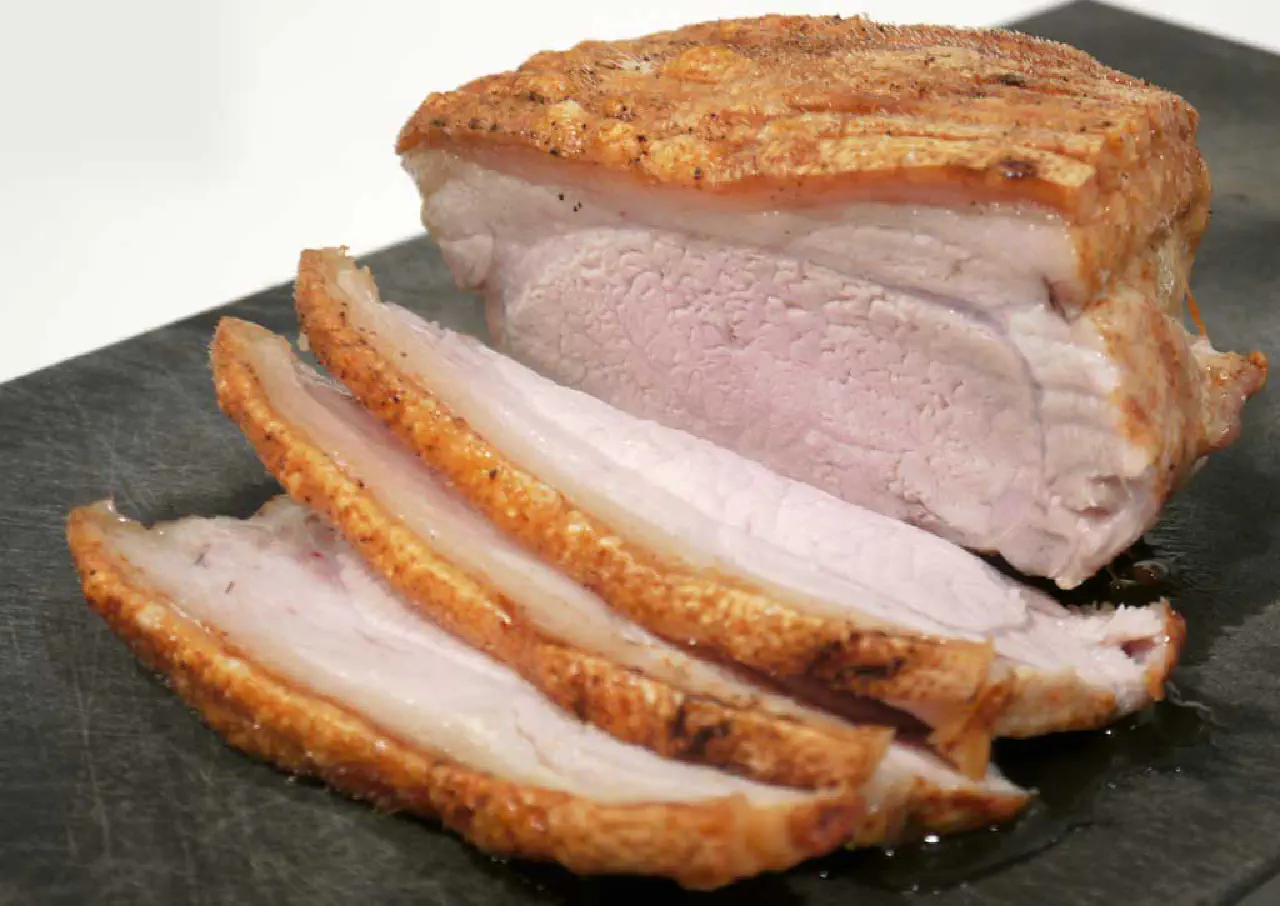
Danish Pork Roast with Crispy Crackling © kvalifood.com
Recipe with video — Pork roast is good, but the holy grail of pork roast is getting the crackling crispy. Most people struggle with it. And when you finally do get the crackling right, the meat is completely tough. Here is a recipe that covers the tricks for both juicy meat and crispy crackling.
Ingredients
- 1 pork roast (200 g per person)
- salt
- pepper
Method
Pork roast is more of a process than a recipe, so I’ll write this a bit differently than usual.
The Crackling
When you think about it, it makes sense that crispy crackling needs to be dry. If there is water in the crackling when it is done, it will at best be a little chewy. Not crispy.
Ideally a day before you plan to eat, there are 4 steps to carry out to dry out the crackling before it goes in the oven.
- Dry the crackling with a cloth, kitchen paper, or a napkin — especially if it is a vacuum-packed roast sitting in juices. In the video below I skip this step, as the roast was dry to begin with.
- Score it properly! The scores from the butcher are only a guide and are usually rushed. You need to cut all the way down to the meat between every single crackling strip. Otherwise the water cannot evaporate from the crackling in the oven.
- Salt thoroughly between the crackling strips — between every single one. The salt softens the crackling and draws water out of it through osmosis. Most of the salt runs off again during roasting, so the roast will not end up oversalted.
- Leave the roast to dry in the fridge for a day. Or as long as you can manage. The longer, the better the crackling! If you have less than 4 hours, you can leave it out on the kitchen counter instead. That should not cause any food safety problems.
The crackling only becomes truly crispy and bubbly if it is cooked at a temperature above 435°F (225°C)! There is no point putting your roast in a 340°F (170°C) oven and expecting crispy crackling.
When roasting, it is important that the crackling lies level. Since most pork roasts are not the same thickness at all ends and edges, the trick is to put some foil, or some vegetables, under the thinnest part so the crackling is completely flat. Otherwise you risk the highest point being burnt black while the lowest is still pale and flabby.
The Meat
There are basically two cuts used for pork roast, which is part of why it can be tricky to get right. The “fine” cut is the loin roast (kamsteg). The “cheaper” cuts are spare rib roast and neck fillet — referred to here simply as spare rib roast, as it is the most common cut.
The easiest to make with crispy crackling is the spare rib roast.
The best way to tell them apart is to think of the loin roast as “red meat” and the spare rib roast as “brisket or shank” — if it were beef.
But it is not beef, so slightly different rules apply.
Spare Rib Roast
Put in the oven at 390°F (200°C); when it is light brown, turn down to 350°F (175°C). Roast for 1½ to 2 hours until the meat is good and tender and the crackling is crispy. (Neck fillet typically needs 2–3 hours.)
Spare rib roast needs to cook long enough that the crackling will definitely turn crispy. It is also not a problem if the meat gets quite hot. Spare rib roast is a “tough” cut with plenty of fat and connective tissue. It can take a lot.
Loin Roast
The loin roast should be cooked at 300°F (150°C) until it reaches an internal temperature of between 140°F (60°C) and 150°F (65°C), depending on how pink you like it. Yes — pork is fine to eat pink. You can go up to 165°F (75°C), but I think that is killing the poor animal a second time.
It usually takes about an hour… or two. But it depends heavily on the oven temperature and the thickness of the meat, so it is impossible to say exactly.
The most important thing with loin roast is that the internal temperature must not go above 150°F (65°C). The meat will dry out! If you take it out at 145°F (63°C), the hot outer layer of the roast will carry-over cook the interior to 150°F (65°C) after about 5 minutes.
If you want it pink, take it out at 135°F (58°C) and let it just reach 140°F (60°C).
The meat is now as it should be. Now we just need to deal with the crackling.
Crispy crackling with a grill element
If your oven has a grill element, that is by far the easiest method — and it is not cheating, it is just applied physics!
Take the meat out to cool down a little, and leave the oven door open. The meat can rest for up to half an hour without any problem.
Turn on the grill element and when it is glowing red, put the pork roast back in the oven, 2–4 inches (5–10 cm) from the grill element — depending on the height of the roast and where your roasting pan can be placed.
Make sure all the crackling is equally close to the grill. Take it out when it is done — it should be easy to tell by looking at the crackling.
Move the roast around if some of the crackling is finishing before the rest.
Crispy crackling without a grill element
Take the roast out and let it rest until about 20 minutes before eating. Food safety guidelines say it should not sit at room temperature for more than 4 hours.
This is not because the meat benefits from resting — it is so the roast can cool down, so we can give it a blast of high heat to make the crackling crispy without going above 150°F (65°C) inside.
It also frees up the oven for something else in the meantime — which is especially practical on Christmas Eve when you also need to get a duck or two in the oven.
If it needs to sit for a while, cover it with foil. As long as it has not been chilled, it will not taste reheated.
Turn the oven to 480°F (250°C) and roast it again until you have crispy crackling. If your oven has a top heat setting, use it. The hotter it is at the top near the crackling, the better.
Alternative without grill element
Cut the crackling off and roast it separately in the oven at 480°F (250°C) until crispy. That is not cheating either — whatever anyone says.
Notes
Slow-roasted loin roast: you can also put your roast in the oven at 210°F (100°C) until it reaches 120°F (50°C) internally, then turn up to 480°F (250°C) until the crackling is crispy or the internal temperature reaches a maximum of 145°F (63°C) — whichever comes first. Probably the temperature. But it takes much longer and the oven is tied up the whole time, and it does not turn out dramatically better.
Try it on a day when nothing else needs to go in the oven. It probably takes 2–4 hours.
Remember you can always use the grill to rescue the crackling.
You can also season the roast with allspice, cloves, and bay leaves.
See Also
Danish Meatballs (Frikadeller)