Garam Masala - Definitive Guide
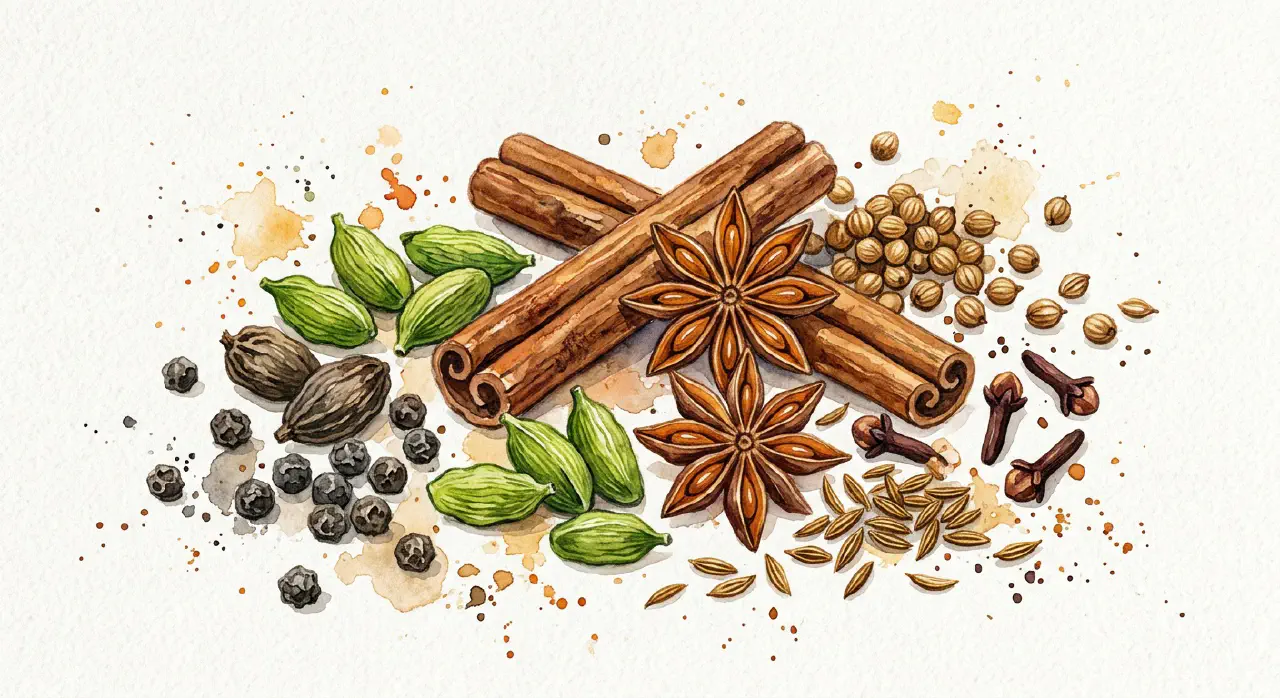
Garam Masala © kvalifood.com
Garam masala is not a recipe but a philosophy: a blend of warming spices assembled according to region, season, household, and occasion, with no single canonical formula and no authoritative body to define one. The name derives from Persian - garm (hot, warm) combined with masaleh (spices) - and points toward its Ayurvedic logic: these are spices chosen not merely for flavor but for thermal potency, understood to stoke digestive fire and warm the body from within. What makes garam masala fascinating is precisely its instability: the same name covers a delicate Bengali trinity of cardamom, cinnamon, and cloves and a complex Kashmiri blend of a dozen roasted aromatics, and both are correct. This guide covers composition, technique, regional diversity, and the chemistry that governs when and how to use it.
1. Culinary Applications
When to Add
The dominant rule is to add garam masala near the end of cooking - in the final 5 minutes of a curry or dal, or as a finishing sprinkle after plating. The reason is chemical: the blend’s most important aromatic compounds are volatile and degrade under sustained heat. Keeping them out of sustained high heat preserves the floral, camphor, and cinnamaldehyde notes that define the blend’s character.
Most commercial blends are already partially degraded by the time they reach the kitchen. Adding them early sacrifices whatever volatile aromatics remain.
This rule has exceptions. A split addition - a small amount bloomed in oil at the start to build base flavor, and a finishing amount added at the end for aroma - is a legitimate technique. Garam masala also works well in marinades and dry rubs for grilled and roasted meats, where it is applied raw and penetrates before heat is applied.
How Much to Use
- Finishing a curry or dal for 4: 1/4 to 1/2 teaspoon added off heat or in the final minutes
- During cooking for a curry for 4–6: 1–2 teaspoons total
- Homemade vs. store-bought: freshly ground garam masala is significantly more potent. If a recipe calls for 1 teaspoon of commercial blend, use 1/2 to 3/4 teaspoon of freshly made.
Traditional Dishes
- North Indian: finishes chicken curry, lamb rogan josh, dal makhani, palak paneer, aloo gobi, biryani, korma, nihari, keema
- Mughlai: foundational to the entire tradition - korma, qorma, shahi dishes
- Pakistani: heavy use in biryani and meat preparations; Shan-style blends are formulated specifically for these applications
- Bengali: the three-spice blend (cardamom, cinnamon, cloves) finishes rice dishes, sweet preparations, and some meat curries; used more sparingly than North Indian blends
Western Applications
Garam masala transfers readily to non-South Asian cooking as a warming aromatic:
- Roasted vegetables: toss cauliflower, squash, carrots, or potatoes with oil and garam masala before roasting - adds earthy warmth without chili heat
- Spice rubs: pork ribs, lamb shoulder, chicken thighs - blends particularly well with brown sugar and black pepper
- Soups and stews: 1/2 teaspoon added in the final minutes of a lentil soup or root vegetable stew
- Holiday baking: gingerbread, pumpkin pie, spiced cookies - the cardamom-cinnamon-clove profile overlaps with pumpkin pie spice; use at half the quantity
- Chocolate: cinnamaldehyde and cardamom’s cineole layer well against cocoa’s bitterness
Substitutions
| Substitute | Ratio | Notes |
|---|---|---|
| Curry powder | 1:1 | Contains turmeric - yellows the dish; earthier, less floral; add at start of cooking |
| DIY approximation | 1:1 | Equal parts cumin + coriander + cardamom + pinch of cinnamon and cloves |
| Ras el hanout | 1:1 | Works for tagines, roasted vegetables, North African applications |
| Baharat | 1:1 | Middle Eastern blend (pepper, cumin, cinnamon, cloves); good for savory dishes |
| Pumpkin pie spice | 1:1 | Only for sweet/baking applications - lacks cumin and coriander |
2. Production Methods
Home Toasting and Grinding
Homemade garam masala is meaningfully better than almost any commercial alternative. The reason is not mystique but process: commercial blends skip toasting, which is the step that releases and transforms a large portion of flavor complexity.
Equipment needed: heavy dry skillet (cast iron or stainless), spice grinder or dedicated coffee grinder, airtight jar.
- Start with whole spices: pre-ground spices have already lost most of their volatile compounds.
- Toast over low-medium heat, stirring constantly, until fragrant - approximately 3–5 minutes. Do not brown; the goal is releasing essential oils and triggering light Maillard browning on the surface of the spice, not charring.
- Toast denser spices first: cinnamon sticks, black cardamom, cloves can take slightly longer. Add lighter spices (green cardamom, bay) toward the end.
- Nutmeg exception: too hard and dense to toast effectively. Add freshly grated raw nutmeg after grinding the other spices, or grate directly into the finished powder.
- Cool completely before grinding: residual heat in a grinder causes clumping and begins evaporating the just-released volatiles. Spread on a plate; allow 10–15 minutes.
- Grind to a fine powder. Sieve if uniformity matters for a specific application.
- Store in an airtight glass jar away from heat and light.
Use within 6 weeks for peak aroma. The blend remains usable for up to 6 months but loses intensity progressively.
Industrial Production
Commercial blends typically use pre-ground spices that have already lost a significant share of their volatile compounds before blending. No toasting step occurs. The result is a more consistent, shelf-stable product with less aromatic intensity.
Adulteration is a documented problem in unregulated loose markets. A 2023 FSSAI audit found that major packaged brands (MDH, Everest, Shan) all passed adulteration testing, while loose market samples showed high rates of synthetic colorants (metanil yellow, sudan III) and fillers. Buy sealed, branded product from reputable suppliers when not making your own.
Red flags on labels: “spice fillers,” maltodextrin, anti-caking agents. Authentic garam masala contains only spices.
Shelf Life
| Form | Peak flavor | Maximum usable |
|---|---|---|
| Whole spices (untoasted) | 1–2 years | 2+ years |
| Freshly ground blend | First few days | 3–6 months |
| Quality commercial blend (sealed) | At purchase | ~1 year (degraded flavor) |
Storage: airtight glass or metal container, cool and dark location, away from the stove. Light degrades volatile compounds faster than heat. Freezing can extend shelf life of a ground blend to up to 1 year.
3. Flavor Chemistry
Key Volatile Compounds
Each core spice contributes a distinct chemical signature:
| Spice | Primary compound(s) | Character |
|---|---|---|
| Cinnamon / cassia | Cinnamaldehyde | Warm, sweet; heat-sensitive - degrades to benzaldehyde above ~60°C |
| Cloves | Eugenol | Intensely warming, slightly numbing; relatively heat-stable; antioxidant - protects cinnamaldehyde from heat degradation |
| Green cardamom | 1,8-Cineole (15–49%), alpha-terpinyl acetate (30–61%), linalool | Cool eucalyptus freshness (cineole), floral/woody (terpinyl acetate), subtle floral undertone (linalool) |
| Cumin | Cuminaldehyde | Earthy, pungent, savory - loses 40% of volatile oils within 6 months of grinding |
| Black pepper | Piperine | Pungent heat; heat-stable to ~176°C; losses of 16–34% under pressure cooking |
| Nutmeg / mace | Myristicin, safrole, terpenes | Warm, sweet, resinous; mace (the aril) is more delicate and floral than nutmeg |
| Coriander | Linalool, geraniol | Citrusy, slightly floral |
Toasting and the Maillard Reaction
Dry-roasting whole spices does two things simultaneously:
- Releases essential oils trapped within cell walls: heat ruptures oil-containing structures, intensifying immediate aroma and making compounds more accessible during grinding
- Triggers the Maillard reaction: amino acids in the spice material react with reducing sugars above approximately 140°C, generating Strecker aldehydes, furans, and pyrazines - nutty, caramel-like, roasted aroma compounds that are entirely absent in untoasted blends
This is the central chemical argument for toasting at home: the Maillard-derived compounds from roasting are a separate layer of flavor from the innate volatile profile of the spices, and commercial blends contain none of them.
Why Late Addition Preserves Flavor
The most volatile aromatics in garam masala - cinnamaldehyde, linalool, terpinyl acetate, cineole - begin evaporating at cooking temperatures. Sustained simmering at 100°C drives them off continuously. Adding garam masala in the final 5 minutes, or after removing from heat, retains the greatest proportion of these compounds. Piperine (black pepper’s heat compound) is the exception - it is heat-stable and is not meaningfully affected by cooking duration.
4. Key Ingredients
The Core Spices
Most garam masala recipes draw from this set, though no blend uses all of them and proportions vary widely:
- Green cardamom (Elettaria cardamomum): floral, complex top note; native to southern India; the most aromatic and expensive common ingredient
- Black cardamom (Amomum subulatum): smoky, camphor-like; grown in the Eastern Himalayas; used in Kashmiri and some North Indian blends
- Cinnamon (Cinnamomum verum) or cassia (C. aromaticum): warm, sweet; true cinnamon (Ceylon) is more delicate and expensive; cassia is more common in commercial blends
- Cloves (Syzygium aromaticum): from the Maluku Islands, Indonesia; intensely warming; used sparingly
- Cumin (Cuminum cyminum): earthy, savory backbone; with coriander, forms the largest proportion of most blends
- Coriander (Coriandrum sativum): citrusy, warm; works with cumin as the base layer
- Black pepper (Piper nigrum): pungent heat and depth; native to the Malabar coast, Kerala
- Nutmeg / mace (Myristica fragrans): from the Banda Islands; nutmeg is the seed, mace is the aril - both warming and resinous; mace is more delicate
- Bay leaf (Cinnamomum tamala - Indian bay / tej patta): more cinnamon-like than Mediterranean bay (Laurus nobilis); often used whole in cooking and ground into some blends
- Kala jeera (black cumin / Bunium persicum): a distinct species from regular cumin; more intensely aromatic, slightly bitter; grows in Kashmir and Central Asia
Of the common garam masala spices, only black pepper and cardamom are native to India. Cinnamon is from Sri Lanka; cloves, nutmeg, and mace from the Spice Islands of Eastern Indonesia; black cardamom from the Eastern Himalayas. Historical trade network availability shaped which regional blends incorporated which spices.
Why There Is No Single Recipe
The composition of garam masala is explicitly not standardized. Regional availability, Ayurvedic principles (which spices are classified as heating), climate (heating spices more prevalent in northern winter-cold regions), and individual household tradition all shape the blend. Proportions rely on andaz - the intuitive, eyeballed estimate of an experienced cook - rather than codified formulas.
5. Regional Varieties
North India (General)
The most familiar international version. Core spices: cinnamon, cloves, cumin, green cardamom, black pepper, coriander, bay leaf. Sometimes includes star anise. Heavy on cardamom and cloves relative to southern blends. Used primarily as a finishing spice for curries, dals, and rice dishes.
Kashmiri Garam Masala
The most distinctive of the regional variants - more aromatic, floral, and warming than the North Indian standard. Key differentiators:
- Kala jeera (black cumin, Bunium persicum): grows in abundance in Kashmir; more intensely aromatic than regular cumin
- More fennel seeds and dried ginger
- Higher proportions of mace and nutmeg
- Dried rose petals in some traditional versions
- Black cardamom alongside green
A documented Kashmiri recipe: 4 cinnamon sticks, 4 tbsp black cumin seeds, 2–3 bay leaves, 2 tbsp green cardamom, 4 tbsp black peppercorns, 1/2 tbsp cloves, 1 tbsp fennel seeds, 1 tsp mace, pinch nutmeg. Dry-roasted 6–8 minutes.
Bengali Garam Masala
Minimalist: cardamom, cinnamon, and cloves only - the classic Bengali trinity. Sometimes tej patta (Indian bay leaf) is added as a fourth element. The result is sweeter and more fragrant than North Indian blends, without the earthy cumin-coriander base. Often added whole to hot oil at the start of a dish, or freshly ground at the finish. Used more sparingly and in a narrower range of dishes.
Bengali panch phoron: a completely different concept - five whole seeds (fenugreek, nigella, cumin, black mustard, fennel) tempered in mustard oil at the start of cooking. Not a warming aromatic blend; functionally and philosophically distinct from garam masala.
Awadhi (Lucknow)
The courtly Mughlai tradition of Lucknow incorporates aromatic ingredients not found in standard blends: betel root and vetiver root (khas), chosen for both fragrance and their Ayurvedic digestive properties. The resulting blend is distinctly more perfumed and less spicy-hot than everyday North Indian garam masala.
Maharashtrian - Goda Masala
Maharashtra uses goda masala (“sweet masala” - goda means sweet in Marathi) rather than standard garam masala. Distinguishing ingredients not found in North Indian blends:
- Dagad phool (stone flower / kalpasi, a culinary lichen): smoky, earthy, slightly astringent
- Dry coconut (khopra)
- Sesame seeds and poppy seeds
- Cassia buds
- Dried red chiles
The flavor profile is sweet-spicy and aromatic, distinctly different from North Indian garam masala. Maharashtra also has kala masala - a darker, more intensely roasted version of goda masala.
Chettinad (Tamil Nadu)
Not called garam masala. The Chettinad masala uses spices unavailable in North Indian blends:
- Kalpasi (stone flower): smoky, earthy
- Marathi moggu (kapok buds): sweet floral note
- Generous black pepper, star anise, fennel, dried coconut, dried red chiles
Known for fiery heat and aromatic depth; one of the most complex regional spice traditions in India.
South India (General)
South Indian cooking uses conceptually different tempering agents rather than garam masala as the North understands it: curry leaves, mustard seeds, asafoetida, dried red chiles, fenugreek. Sambar masala is the more representative South Indian blend. Kerala garam masala (Eastern brand being the regional standard) leans toward black pepper, fennel, star anise, mace.
Regional Variety Comparison
| Region | Key distinguishing spices | Character |
|---|---|---|
| North India | Cardamom, cloves, cumin, coriander, cinnamon | Warming, balanced, versatile |
| Kashmir | Black cumin (kala jeera), fennel, extra mace/nutmeg, sometimes rose | Floral, aromatic, more complex |
| Bengal | Cardamom, cinnamon, cloves only | Sweet, fragrant, minimalist |
| Awadh (Lucknow) | Betel root, vetiver root | Perfumed, courtly, digestive |
| Maharashtra | Stone flower, dry coconut, sesame, cassia buds | Sweet-spicy, deep, regional |
| Chettinad | Stone flower, kapok buds, heavy black pepper | Fiery, smoky, uniquely aromatic |
| Kerala | More black pepper, fennel, star anise | Peppery, anise-forward |
| Pakistan | Intense green cardamom, clove-forward, high-grade black pepper | Sharp, aromatic, meat-focused |
6. Key Brands
South Asian Market
| Brand | Origin | Profile | Notes |
|---|---|---|---|
| MDH (Mahashian Di Hatti) | Delhi, est. 1919 | Balanced - cinnamon, cardamom, cloves; withstands longer cooking | Dominant in North American Indian restaurants; passed 2023 FSSAI adulteration testing |
| Everest | Mumbai, est. 1966 | Bolder and more layered; higher black pepper; star anise as signature addition; pungent and complex | Holds up better in long-simmered dishes (nihari, rich meat curries) |
| Shan | Pakistan, est. 1981 | Sharpest and most aromatic; intense green cardamom and clove; clean medicinal heat | Only major brand that publishes origin details for key spice components; formulated for biryani and meat dishes |
| Badshah | Mumbai, est. 1958 | Rajwadi Garam Masala flagship; Maharashtra-adjacent | In-house QC laboratory; available in US, UK, Middle East, NZ, Singapore |
| Eastern | Kerala, est. 1983 | South Indian profile: cinnamon, cardamom, cloves, dried ginger, black pepper, cumin | Widely available through Kerala-focused diaspora retailers |
Western Premium / Artisan
| Brand | Origin | Profile | Notes |
|---|---|---|---|
| Diaspora Co. | San Francisco | 12 single-origin spices from 58 small regenerative farms in India and Sri Lanka; intensely fresh | Pays ~4x premium to farm partners; $14 (47g) / $42 (chef tin); significantly more expensive than commercial |
| Burlap & Barrel | New York, est. 2016 | “Cardoz Legacy” garam masala - cinnamon, cardamom, cloves, mace, star anise; developed with chef Floyd Cardoz | Public benefit corporation; $1/jar donated to charity; single-origin sourcing |
| La Boîte | New York | French-inflected luxury blends in decorative tins | Chef-oriented; high-end market positioning |
When to Buy Pre-Made vs. Grind Fresh
Pre-made is acceptable for: everyday weeknight cooking; dishes with long cook times where some aromatic loss is acceptable; when a quality, recently-opened branded product is used.
Grind fresh for: special occasion dishes (biryani, korma); when garam masala is a primary flavor (not background); finishing dishes, raitas, chutneys; any situation where maximum aroma is the goal. The Maillard-generated compounds from toasting are entirely absent in commercial blends and cannot be replicated by late addition.
7. History & Origins
Ancient and Pre-Mughal Roots
The conceptual origins of garam masala lie in Ayurveda, the classical Indian medical system, which classifies all substances by thermal potency (virya): ushna (heating) or sheetal (cooling). Spices now associated with garam masala - pepper, cardamom, cinnamon, cloves - were long classified as heating, believed to enhance agni (digestive fire), promote circulation, and counteract cold and kapha imbalances.
The earliest documentary evidence of complex multi-spice blends comes from the Ni’matnama, a Persian-language cookbook compiled at the court of Ghiyath Shah, Sultan of Malwa, between 1495 and 1505 - predating the Mughal Empire and describing spice blends recognizable as precursors to garam masala.
Texts from the 11th and 12th centuries mention spice combinations that qualify as ancient predecessors, though the term garam masala itself is not documented in these sources.
Etymology
The name derives from Persian: “garm” (hot, warm) + “masaleh” (ingredients, spices). The Persian etymology reflects the significant Persian cultural influence during the Mughal period and the parallel tradition of Unani medicine - the Islamic medical system brought by Persian physicians to Mughal courts - which uses the concept of taseer (thermal potency) paralleling Ayurveda’s ushna/sheetal classification.
Mughal Period
Elaborate multi-spice blends became a hallmark of Mughal court cuisine in the 16th and 17th centuries. The inclusion of premium exotica - cinnamon from Sri Lanka, cloves and nutmeg from the Spice Islands of Indonesia, cardamom from the Western Ghats - reflected both the Mughal trade networks and the association of complex spicing with aristocratic and imperial tables.
Food historians note a contested question: whether Indian garam masala influenced Persian and Central Asian cuisine during the Mughal period, or whether the Persian court tradition influenced Indian practice. The Mughal court had Persian chefs alongside Indian ones, and the exchange ran in both directions.
Colonial Period and Global Spread
During the British colonial period, British administrators encountered the diversity of Indian spiced cooking and attempted to reduce it to a single, exportable formula. Curry powder was the result - the first commercial version sold by Sorlie’s Perfumery in London in 1784, and the product that defined how most of the English-speaking world understood Indian food for the next two centuries. Garam masala itself remained a regional household practice, not standardized or exported.
Post-WWII South Asian diaspora communities in the UK, North America, East Africa, and the Caribbean brought garam masala into global kitchens. Commercial brands (MDH, Shan) entered diaspora markets by the 1970s–1990s. A 21st-century wave of artisan Western brands - Burlap & Barrel (2016), Diaspora Co. (2017) - repatriated authentic sourcing and single-origin transparency to the Western premium market.
8. Nutrition
Garam Masala Does Not Contain Turmeric
This is the most important nutritional clarification: traditional garam masala does not contain turmeric. It is brown, not yellow. Any anti-inflammatory claims associated with curcumin - turmeric’s bioactive compound - do not apply to standard garam masala. (Curry powder typically does contain turmeric; this is a primary distinction between the two blends.)
Per-Teaspoon Profile
A 1 teaspoon (≈2–3g) serving contains approximately:
- Calories: ~7–13 kcal
- Carbohydrates: ~1–3g
- Protein: ~0.3–1g
- Fat: ~0.3–0.5g
The practical nutritional impact of a typical cooking serving is modest. Garam masala is used in quantities of 1/4 to 1 teaspoon per dish - not a meaningful caloric or macronutrient contribution.
Antioxidant Content
Individual spice components have exceptionally high ORAC values per 100g - ground cloves rank among the highest antioxidant-dense foods by this measure, and cinnamon is similarly high. However, these figures are per 100g, not per teaspoon. A half-teaspoon serving (≈1.5g) represents 1.5% of those values - real but not large in absolute per-serving terms.
Bioactive Properties of Key Spices
Individual spice components have documented bioactive effects at pharmacological doses:
- Cinnamaldehyde (cinnamon): anti-inflammatory, lipid-lowering, anti-diabetic activity in studies
- Piperine (black pepper): blocks pro-inflammatory signals in immune cells; enhances bioavailability of other compounds
- Eugenol (cloves): antioxidant, anti-inflammatory, antimicrobial
- Linalool (coriander, cardamom): anti-inflammatory, shown to reduce inflammation markers in animal studies
Garam masala should be understood as a flavoring agent with incidental bioactive benefits at realistic serving sizes - not a medicinal supplement. The doses at which clinically significant effects are observed in studies are significantly higher than any cooking quantity.
Quick Reference
| Question | Answer |
|---|---|
| When to add to a dish? | In the final 5 minutes or after removing from heat; volatile aromatics degrade under sustained heat |
| How much for a curry serving 4? | 1/4–1/2 tsp as a finisher; 1–2 tsp total if also adding during cooking |
| Does it contain turmeric? | No - traditional garam masala is brown, not yellow; that is curry powder |
| Why toast whole spices before grinding? | Releases essential oils and triggers the Maillard reaction, generating flavor compounds entirely absent in untoasted commercial blends |
| Shelf life of homemade blend? | Peak aroma for ~6 weeks; usable for up to 6 months |
| Best commercial brand for everyday use? | MDH (balanced, widely available); Everest (bolder, better for long braises); Shan (sharpest, biryani-focused) |
| Best artisan brand? | Diaspora Co. (single-origin, most aromatic) or Burlap & Barrel (Cardoz Legacy) |
| Bengali garam masala: what is it? | Just cardamom, cinnamon, and cloves - minimalist and fragrant, no cumin or coriander base |
| What is panch phoron? | A completely different Bengali blend - five whole seeds (fenugreek, nigella, cumin, mustard, fennel) tempered in oil; not a warming aromatic blend |
| Is garam masala the same everywhere? | No - there is no canonical recipe; North Indian, Kashmiri, Bengali, Maharashtrian, and Chettinad blends differ substantially |
| Origin? | Rooted in Ayurveda; formalized in Mughal court cuisine from the 16th century onward; the term is Persian |
See Also
- Fish Sauce - Definitive Guide - parallels in flavor science and volatile compound management
- French Fries - Definitive Guide - Maillard reaction in a different context
Sources
- Garam masala - Wikipedia
- Through Balance and Multiplicity: the Making of Garam Masala - Diaspora Co.
- Diaspora Co. Garam Masala - product page
- Cooking with Garam Masala - Spiceography
- What Is Garam Masala - MasterClass
- Detailed Guide to 5 Top Indian Garam Masalas - Gulf News
- Regional Masalas of India - Hospitality Institute
- Complete Garam Masala Guide - Tasty and Zesty
- How to Make Bengali Garam Masala - Spicing Your Life
- Panch Phoron - Veg Recipes of India
- Kashmiri Garam Masala - Mamta’s Kitchen
- Kashmiri Masala Spice Mix - Archana’s Kitchen
- Goda and Kala Masala - Home Kouzina
- Goda Masala Recipe - Veg Recipes of India
- Best Garam Masala Brand - Spice.Alibaba
- MDH vs Everest vs Shan Compared - Alibaba
- Badshah Masala - official site
- Floyd Cardoz Masalas - Burlap & Barrel
- DTC Spice Brand Review - Reviewed.com
- History of Garam Masala - Premium Spices NZ
- History of Curry Powder - Premium Spices NZ
- Punjabi Garam Masala - En Route Indian History
- Spice and Herb Fraud - PMC
- Maillard Reaction Review - PMC
- Cardamom Essential Oil Profile - Frontiers in Food Science
- Piperine Degradation Kinetics - ScienceDirect
- Cinnamaldehyde Heat Stability - Tandfonline
- Cinnamaldehyde - PubChem
- The Science of Spices - KBM Foods
- Toasting Spices - RawSpiceBar
- Garam Masala Shelf Life - Texas Real Food
- Garam Masala Substitutes - Spice Cravings
- Garam Masala Substitutes - Frontier Co-op
- Garam Masala - Precision Nutrition
- Garam Masala Health Benefits - Dr. Axe
- Virya and Vipaka - Ayurvedic Eating
- Curry Powder vs Garam Masala - Taste of the Place
- Curry Powder vs Garam Masala - Hela Spice
- Garam Masala Recipe - Feasting at Home
- USDA ORAC Database