Pre-Ferments: The Baker's Secret Weapon for Extraordinary Bread
Pre-Ferments: The Baker’s Secret Weapon for Extraordinary Bread © kvalifood.com
Why Pre-Ferments Matter
If there is one technique that separates ordinary bread from extraordinary bread, it is the use of pre-ferments. A pre-ferment is, at its core, a piece of dough that has been fermented in advance and then added to a new batch of dough as part of a building process. This seemingly simple idea - mixing some flour, water, and a small amount of yeast a day ahead - is one of the most powerful tools a baker has for coaxing depth, complexity, and character out of grain.
The logic behind pre-ferments rests on a fundamental principle of bread baking: the flavor of bread comes from the grain, not from the yeast. Yeast is a means to an end. It should not draw attention to itself, but rather to the wheat it is helping to transform. The baker’s maxim, then, is to use only as much yeast as is necessary to get the job done, minimizing the flavor of the yeast and maximizing the flavor of the grain. Pre-ferments are a way to honor that maxim. By stretching fermentation across many hours - often overnight - they allow enzymes in the flour to slowly break apart complex starch molecules and release the natural sugars trapped inside. This process, which Reinhart calls “sugar breakout,” is the real key to evoking the fullness of flavor from wheat.
In practical terms, pre-ferments create superior bread because they are a way to manipulate time. They stretch it, so that the chemical activity happening at the cellular level - enzymes converting starch into simpler sugars, yeast producing flavorful byproducts, organic acids developing - can fulfill its mission before the bread ever reaches the oven.
Direct Dough vs. Indirect Dough: The Two Paths
Before diving into the specific types of pre-ferments, it helps to understand the two broad approaches to mixing bread dough.
Direct dough (also called straight dough) is mixed in a single session with no pre-ferment. All the ingredients go in at once, and the dough is fermented, shaped, proofed, and baked in one continuous process. This method works well for enriched breads - sandwich loaves, cheese breads, flavored doughs - where much of the flavor comes from added ingredients like butter, sugar, eggs, or spices rather than from the grain itself. Direct-dough recipes typically call for enough yeast to accomplish full leavening in a minimal amount of time.
Indirect dough is built in two or more stages, using one of several types of pre-fermented dough. The indirect method is particularly effective for lean breads where the flavor must come almost entirely from the wheat: French bread, whole-grain loaves, and rye bread all benefit enormously from the extended fermentation that pre-ferments provide. The additional time makes these breads more digestible and draws out flavors that no amount of added ingredients could replicate.
The Four Types of Pre-Ferments
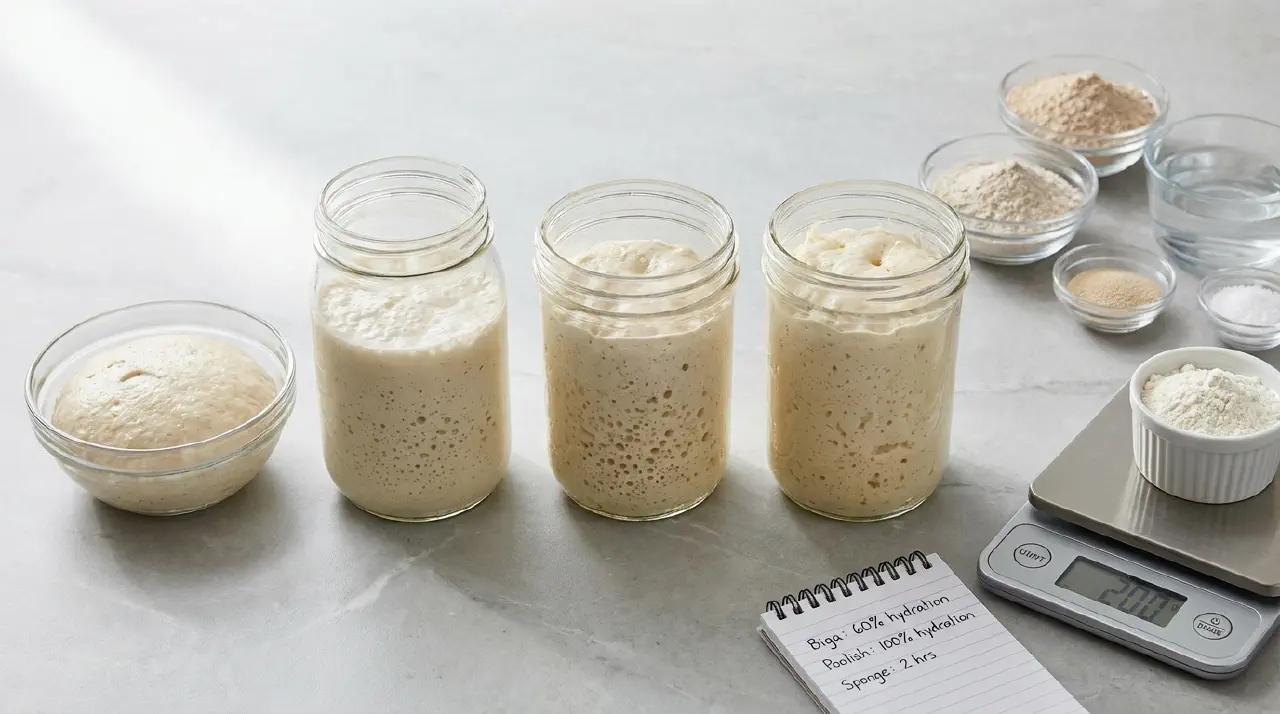
Reinhart identifies four commonly used types of pre-fermented dough, which can be grouped into two categories based on their consistency: firm (dry) pre-ferments and wet (sponge) pre-ferments.
Firm Pre-Ferments
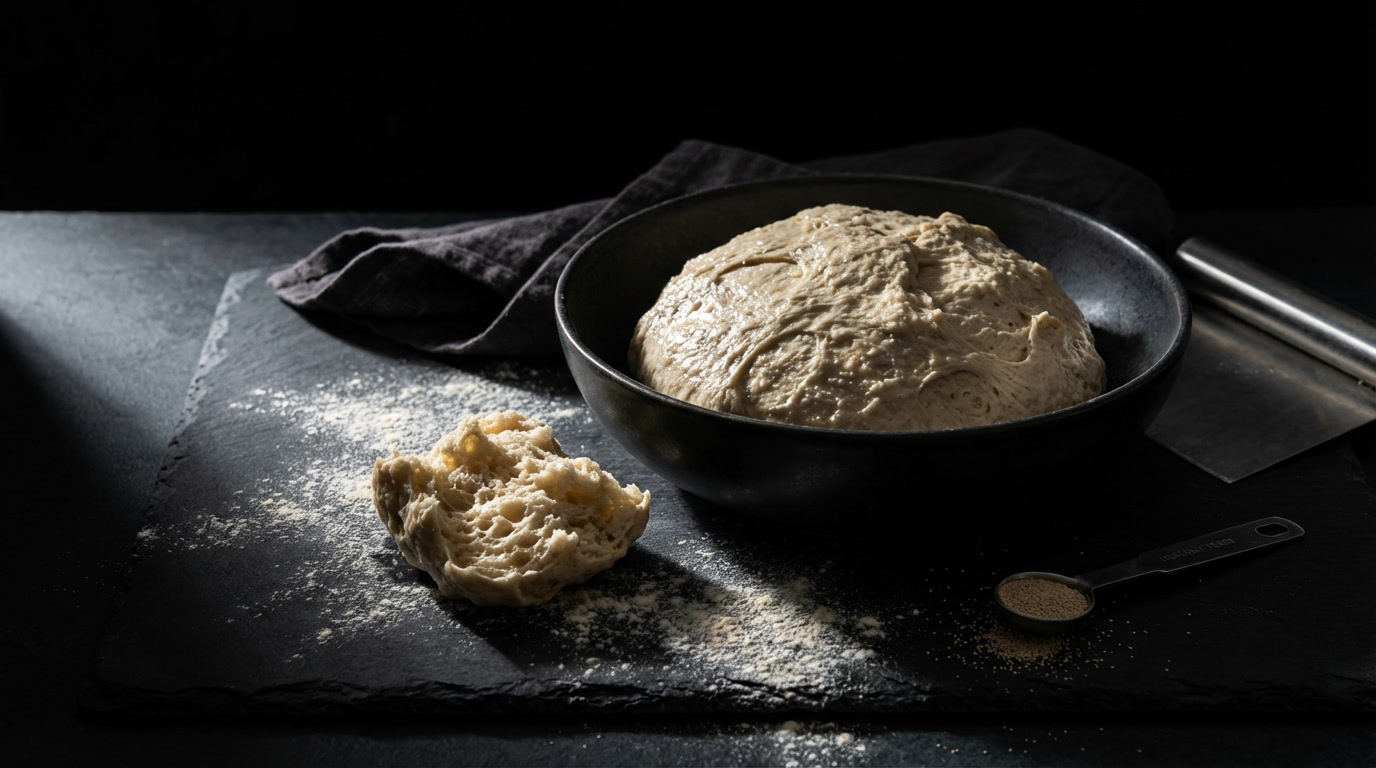
Pâte Fermentée - This is the French name for pre-fermented, or “old,” dough. It is the most intuitive of the pre-ferments: you simply save a piece of dough from one batch, after its primary fermentation, and add it to the next day’s batch. Alternatively, you can make a piece of French bread dough specifically to serve as tomorrow’s pre-ferment. Adding pâte fermentée to a newly mixed dough has the effect of immediately aging it, lending it the maturity and depth of flavor that only time can produce. This technique has long been used in bakeries to improve simple lean breads.
What distinguishes pâte fermentée from the other pre-ferments is that it is a complete bread dough - it contains flour, water, yeast, and salt. Its baker’s percentage formula is roughly 100% bread flour, 1.9% salt, 0.55% instant yeast, and approximately 65% water, yielding a dough that looks and feels like standard French bread dough. It can be kept in the refrigerator for up to three days or frozen in an airtight bag for about three months.
Biga - The Italian cousin of pâte fermentée, a biga differs in one critical respect: it contains no salt. This seemingly small distinction has a meaningful consequence. Salt acts as a yeast inhibitor, making fermentation more difficult (which is precisely why it works as a preservative in other foods). In the absence of salt, the yeast has no restrictions in its quest to digest all available sugar, so very little yeast is needed - as little as 0.5% fresh yeast relative to the flour weight. A biga is also made specifically to serve as a pre-ferment, whereas pâte fermentée can simply be a leftover piece of finished dough.
The baker’s percentage for a biga is approximately 100% bread flour, 0.49% instant yeast, and 66.7% water. Like pâte fermentée, it feels like a standard firm bread dough: soft, pliable, tacky but not sticky. It ferments at room temperature for two to four hours until it nearly doubles in size, then is refrigerated overnight to develop even deeper flavor.
It is worth noting that in Italy, nearly every pre-ferment - including wild-yeast or sourdough starters - is called a biga. When following Italian recipes from other sources, it pays to check exactly what type of “biga” is called for.
Wet Pre-Ferments
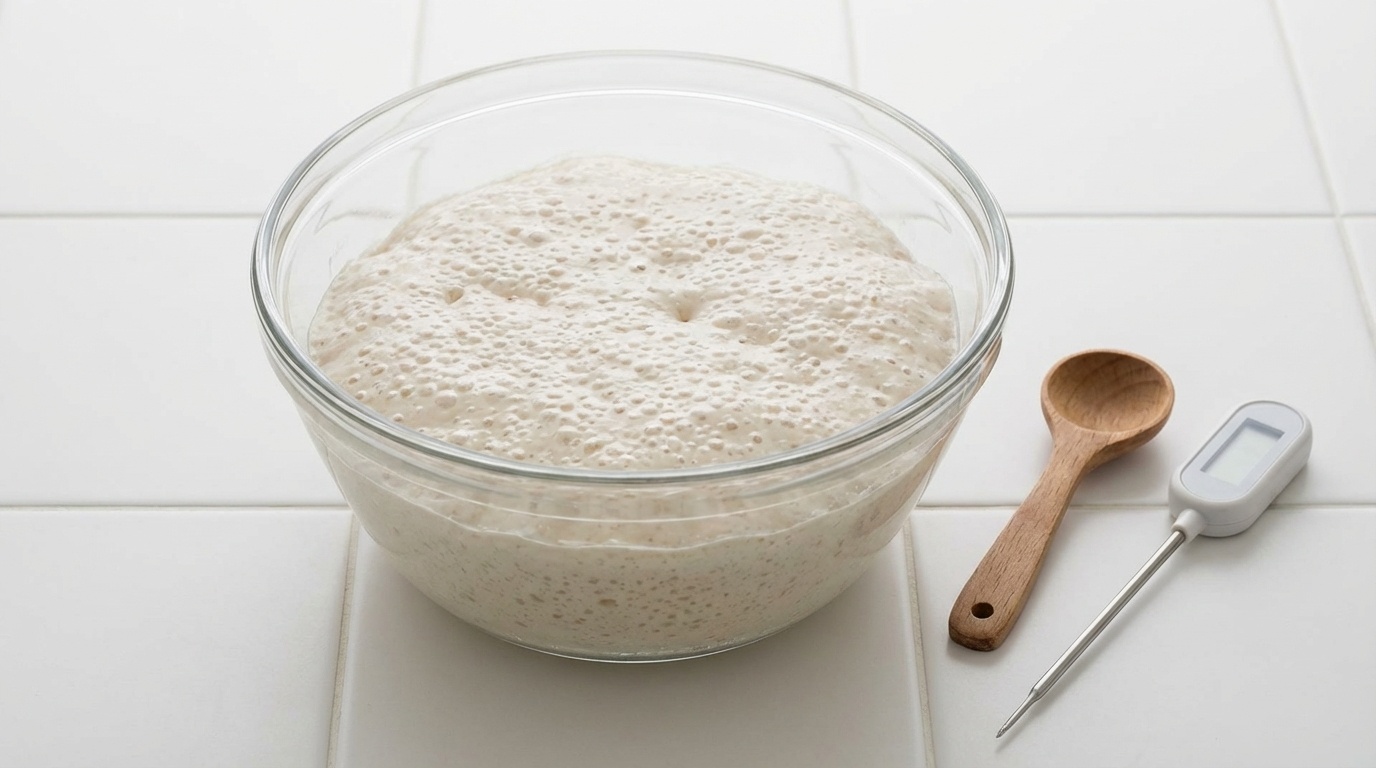
Poolish - The name was coined by the French to honor the Polish bakers who, centuries ago, taught them this technique for improving bread. A poolish is a wet sponge made with equal weights of water and flour, no salt, and a very small amount of yeast - only about 0.25% fresh yeast relative to flour, even less than a biga. At roughly 107% hydration, it looks like very thick pancake batter: soft, sticky, and bubbly.
Because a wet sponge offers far less resistance to fermentation than firm dough does, the yeast has an easy time converting the available sugars into carbon dioxide and ethanol. A little yeast goes a long way, and a long, slow fermentation ensues. This slow pace is precisely what makes poolish so effective - the extended time allows enzymes to do their work thoroughly, producing remarkable flavor development. When a poolish is used as a pre-ferment, it is usually necessary to add more yeast during the mixing of the final dough to complete the leavening.
The poolish baguette, pioneered by Bernard Ganachaud in early-1960s Paris, became so celebrated that the Coupe du Monde bread competition (the so-called “Bread Olympics”) now requires the poolish method for its baguette category. Poolish is easy and inexpensive to make, and since the flour and water weigh the same, it can be mixed with nothing more than a spoon.
Regular Sponge (Levain Levure) - A regular sponge is usually faster than a poolish because it front-loads all or most of the yeast into the sponge itself. This kind of sponge, often used in whole-grain and rich breads, improves the flavor and digestibility of the grain, but in less time than a poolish. The flavor improvement is not as dramatic as in the slower pre-ferments, but the trade-off is speed: the final mixing can often be done approximately one hour after the sponge is made. For bakers who want some of the benefits of a pre-ferment without the overnight wait, the regular sponge is a practical compromise.
A Special Case: The Soaker
While not technically a fermented dough, the soaker deserves mention as a close relative of the pre-ferment family. A soaker is a non-yeasted ingredient - usually a coarsely milled whole grain like cornmeal, rye meal, or cracked wheat - that has been soaked overnight in water or milk. Its purpose is to activate the enzymes in the grain and break out some of the trapped sugars from the starches, while also softening the coarse grain. Although little or no actual fermentation takes place, a soaker’s effect on the final dough is dramatic, contributing sweetness, tenderness, and depth.
The Science: Enzymes and Sugar Breakout
The question at the heart of all pre-ferment techniques is: why does extended fermentation improve flavor?
The answer lies in the realm of enzymes and the concept of sugar breakout. Flour naturally contains enzymes - primarily amylase - that break down complex starch molecules into simpler sugars. Given enough time, these enzymes convert starch into maltose and other sugars that the yeast can feed on and that our palates can taste. This is the fundamental mechanism by which great bread achieves its sweetness and complexity without any added sugar.
In a direct-dough method with a large quantity of yeast and a short fermentation, the enzymes simply do not have enough time to do their work thoroughly. The bread may rise adequately, but the flavor remains one-dimensional. By contrast, pre-ferments stretch the fermentation window from a few hours to twelve, eighteen, or even twenty-four hours. During this extended period, the enzymes steadily liberate sugar from the starch, the yeast produces a broader spectrum of flavorful byproducts (including ethanol and organic acids), and the overall character of the dough deepens.
This is also why Reinhart emphasizes using as little yeast as possible: less yeast means slower fermentation, which means more time for enzyme activity, which means more flavor from the grain. The pre-ferment is the vehicle that makes this slow approach practical within a baker’s schedule.
Interchangeability and the Baker’s Choice
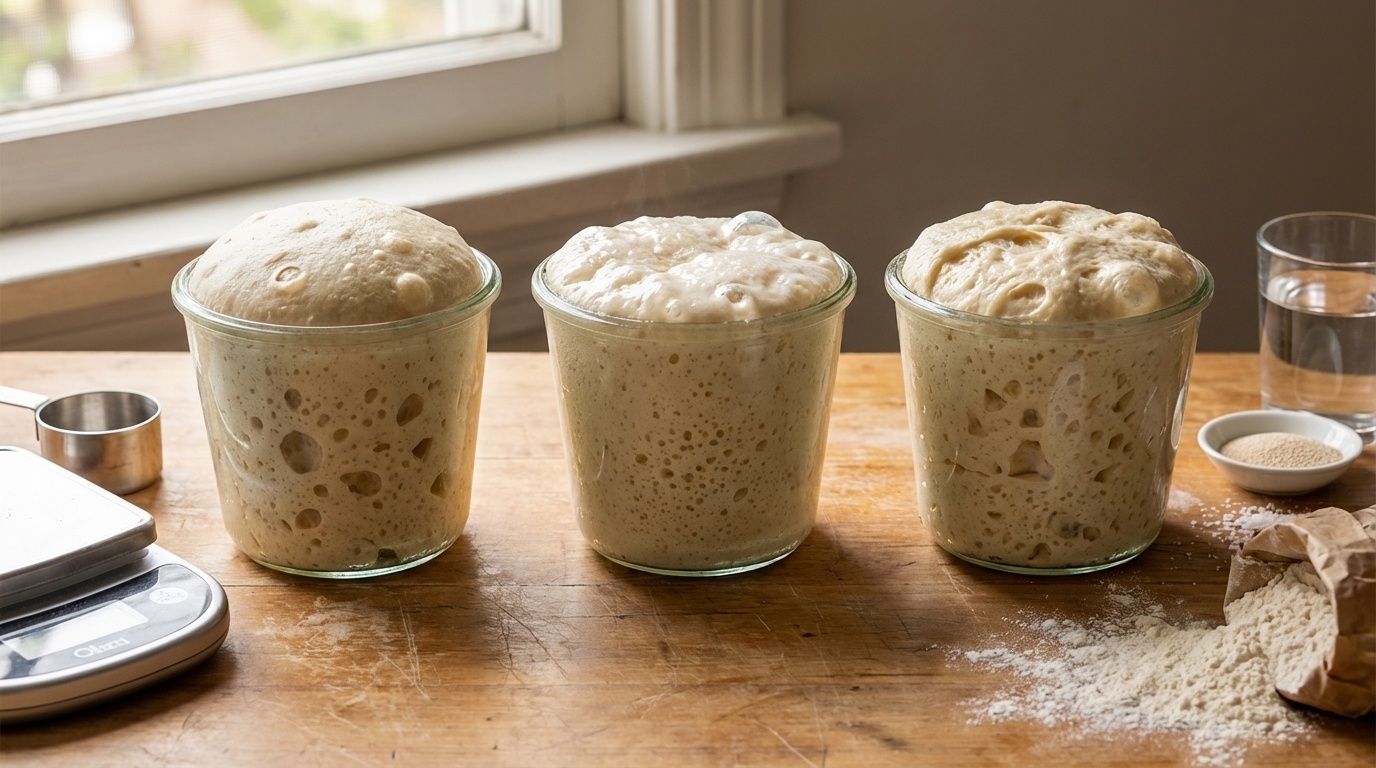
One of the most liberating aspects of pre-ferments is their interchangeability. A poolish and a biga can generally be substituted for one another in a recipe, as long as you adjust the water content in the final dough to compensate for the difference in hydration. The same applies to wet starters (barms) and firm wild-yeast starters. Such substitutions will result in different flavor profiles and textures in the final bread - a poolish may yield a slightly more open crumb and milder tang, while a biga may contribute more structure - but both will produce excellent results.
Reinhart encourages experimentation. In his sourdough formulas, he sometimes uses a wet starter to make a firm starter and then the final dough, and other times uses the wet starter to build the final dough directly. The point is that once you understand the principles behind pre-ferments, you gain the freedom to adapt them to your own preferences and schedule.
A practical note on storage: all three major pre-ferments (pâte fermentée, poolish, and biga) can be refrigerated for up to three days and frozen for approximately three months. While they can be used as soon as they have fermented, Reinhart consistently recommends giving them an overnight retarding in the refrigerator, as this additional cold fermentation seems to bring out even more flavor.
The Pre-Ferment Formulas at a Glance
Pâte Fermentée
| Ingredient | Baker’s % | Example Batch |
|---|---|---|
| Bread flour (blend of AP and bread) | 100% | 10 oz |
| Salt | 1.9% | ¾ tsp |
| Instant yeast | 0.55% | ½ tsp |
| Water | ~65% | 6–7 oz |
Mix, knead 4–6 minutes until soft and pliable, ferment at room temperature for 1 hour, then refrigerate overnight.
Poolish
| Ingredient | Baker’s % | Example Batch |
|---|---|---|
| Bread flour | 100% | 11.25 oz |
| Water | 107% | 12 oz |
| Instant yeast | 0.27% | ¼ tsp |
Stir together until all flour is hydrated (thick pancake batter consistency), ferment at room temperature for 3–4 hours until bubbly and foamy, then refrigerate.
Biga
| Ingredient | Baker’s % | Example Batch |
|---|---|---|
| Bread flour | 100% | 11.25 oz |
| Instant yeast | 0.49% | ½ tsp |
| Water | ~67% | 7–8 oz |
Mix, knead 4–6 minutes until soft and pliable, ferment at room temperature for 2–4 hours until nearly doubled, then refrigerate overnight.
Pre-Ferments in the Wild-Yeast World
The principles behind commercial-yeast pre-ferments extend naturally into the world of sourdough (wild-yeast) baking. Whether called sourdough starter, levain, barm, desem, mother, or chef, these are all variations of pre-ferments leavened by wild yeast rather than commercial yeast.
Wild-yeast breads involve a secondary fermentation - bacterial - that adds another dimension of flavor. Lactobacillus and acetobacillus organisms create lactic and acetic acids as they feed on enzyme-released sugars, producing the complex sour flavors we associate with sourdough. San Francisco sourdough, for instance, owes its distinctive character to a local bacterium, Lactobacillus sanfrancisco, that gives the bread a different quality than wild-yeast breads made anywhere else in the world.
Wild-yeast starters can be maintained as either wet sponges (similar in texture to a poolish) or firm doughs (similar to a biga). Professional bakers sometimes prefer firm starters because they are easier to handle in large quantities, while home bakers often gravitate toward wet sponges for their simplicity. The texture of the starter can even influence the flavor profile: acetic bacteria tend to thrive in the firmer, drier environment of a firm starter, while lactic bacteria prefer the wetter sponge of the barm method.
Reinhart’s system uses a three-build method - from seed culture to barm (mother starter) to firm starter to final dough - though he acknowledges that every bakery has its own valid system, from simple two-build approaches to elaborate six-build elaborations.
The Bigger Picture: Manipulating Time
At the highest level, all of these techniques - pâte fermentée, biga, poolish, sponge, soaker, sourdough starter - are different expressions of the same idea: using fermentation to manipulate time. Time is the baker’s greatest ally and most important variable. Every decision about which pre-ferment to use, how much of it to include, and how long to let it develop is ultimately a decision about how much time to give the enzymes, yeast, and bacteria to do their transformative work.
Reinhart’s breads typically call for generous amounts of pre-ferment - often between 40% and 170% of the total flour weight in the final dough. In his ciabatta, for example, the pre-ferment accounts for 165–180% of the final flour, which he describes as the “magic amount” for achieving the open, flavorful crumb that defines the best versions of that bread.
Modern bakers have an advantage that their predecessors did not: refrigeration. The ability to slow fermentation through cold temperatures gives today’s bakers a wider margin of error and far more flexibility in scheduling. Cold retarding allows the baker to call the shots about when to proceed to the next stage of the twelve-stage bread-making process, turning what was once a demanding, clock-driven craft into something more forgiving and adaptable.
Putting It into Practice
For bakers just beginning to explore pre-ferments, the path forward is straightforward:
Start with pâte fermentée if you want the simplest entry point - just make a batch of French bread dough a day ahead and refrigerate it. The next day, tear it into pieces and add it to your new dough. The improvement in flavor will be immediate and unmistakable.
Graduate to poolish when you are ready for a slightly more specialized approach. Its equal-weight flour-and-water ratio makes it almost impossible to get wrong, and the long, slow fermentation it enables can be revelatory, especially for baguettes and other lean breads.
Experiment with biga for Italian-style breads, where its firm texture and salt-free composition can coax remarkable sweetness from the grain.
And when you are ready for the deepest exploration, venture into wild-yeast starters, where the interplay of yeast fermentation, bacterial fermentation, and enzyme activity creates flavors of almost limitless complexity.
Throughout all of this, remember the principle that ties every pre-ferment together: they exist to give time to the grain, to allow the wheat to reveal the fullness of its flavor. As Reinhart writes, the creation of pre-fermented dough is one of the baker’s most effective tools for manipulating time, and a pre-ferment’s main purpose is to improve flavor and structure.
May your crust be crisp and your bread always rise.
See Also
Basic Sourdough Bread