Casatiello
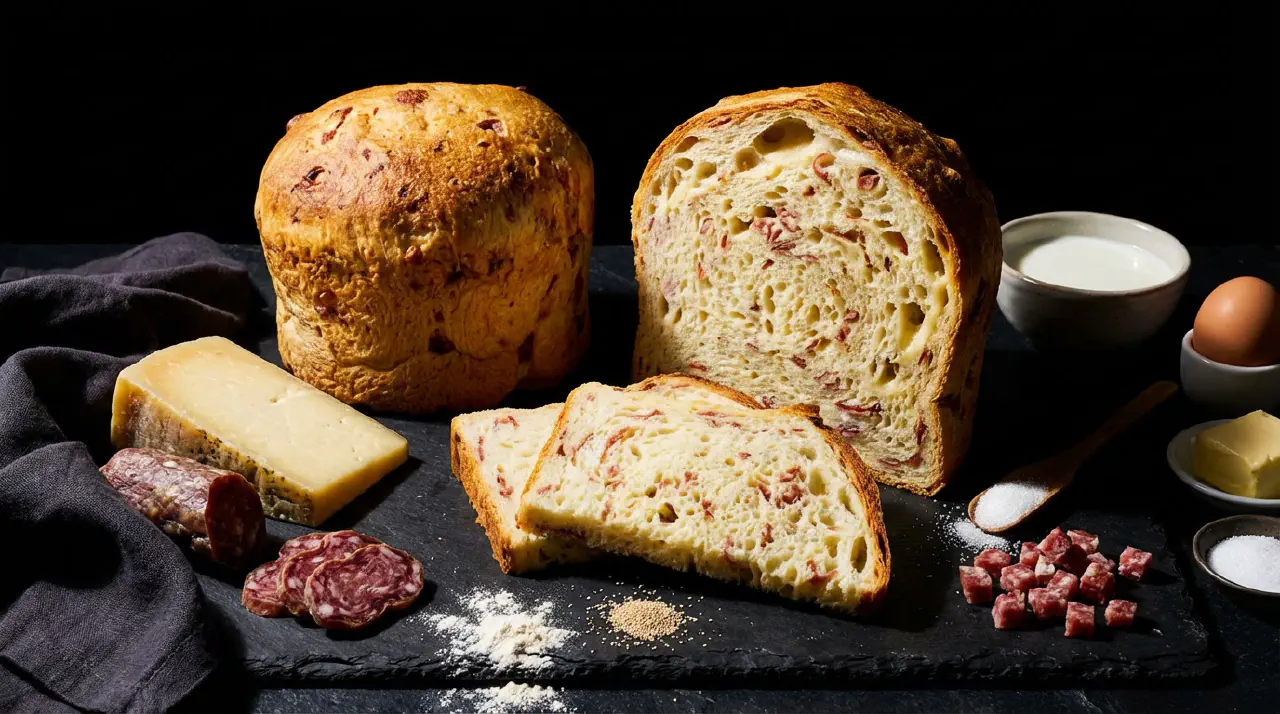
Casatiello © kvalifood.com
A rich Italian brioche elaboration loaded with cheese and cured meat, creating savory pockets of flavor. Warm slices have creamy melted cheese; cool slices taste like sandwiches. Can be baked in paper bags, loaf pans, or panettone molds.
Ingredients
Makes 1 large loaf or 2 small loaves
Sponge
- 65 g unbleached bread flour
- 1 tbsp (.33 oz) instant yeast
- 230 g whole milk or buttermilk, lukewarm (90–100°F (32–38°C))
Dough
- 4 oz dry-cured Italian salami or other meat, diced into small cubes
- 450 g unbleached bread flour
- 1 tsp (.25 oz) salt
- 1 tbsp (.5 oz) granulated sugar
- 95 g large eggs, slightly beaten
- 170 g unsalted butter, room temperature
- 170 g coarsely shredded or grated provolone or other cheese
Directions
To make the sponge, stir together the flour and yeast in a bowl. Whisk in the milk to make a pancakelike batter. Cover with plastic wrap and ferment at room temperature for 1 hour. The sponge will foam and bubble and should collapse when you tap the bowl.
While the sponge is fermenting, dice the salami into small cubes and sauté it lightly in a frying pan to crisp it slightly. (Alternatively, cook and crumble bacon, sauté fresh sausage or salami substitutes until crisp, and save any rendered fat.)
To make the dough, in a mixing bowl, stir together the flour, salt, and sugar. Add the eggs and sponge and mix until all ingredients form a coarse ball. If there is any loose flour, dribble in a small amount of water or milk to gather it into the dough. Stir for about 1 minute, then let the dough rest for 10 minutes to allow gluten to develop.
Divide the butter into 4 pieces. Begin working the butter into the dough one piece at a time, stirring vigorously. The dough will be soft but not a batter. Continue mixing, switching to your hands if needed (but keep them floured), working the dough into a smooth, tacky mass. It will take about 12 minutes. (In an electric mixer, scrape down the bowl and switch to the dough hook after 4 minutes. The dough will change from sticky to tacky and eventually clear the sides of the bowl. If not, sprinkle in more flour until it forms a ball.)
When the dough is smooth, add the meat pieces and knead until evenly distributed. Then gently knead in the cheese until it too is evenly distributed. The dough will be soft and stretchy, very tacky but not sticky. If it is sticky, sprinkle in more flour until it firms. Lightly oil a large bowl and transfer the dough, rolling it to coat with oil. Cover with plastic wrap.
Ferment at room temperature for about 90 minutes, or until the dough increases in size by at least 1½ times.
Remove the dough from the bowl and leave as 1 piece for 1 large loaf or divide into 2 pieces for smaller loaves. The loaves may be baked in white or brown sandwich-sized paper bags set in metal cans just large enough to hold them (such as a no. 10 can or coffee can), in loaf pans, or in panettone molds.
If baking in bags, generously spray the inside of 1 or 2 small paper bags with spray oil. Lightly dust your hands and the dough with flour and shape into a boule. Place the dough in the prepared bag and roll the top of the bag back to make a collar about 2 inches above the dough. Place the bag in a metal can. If baking in pans, mist one 9 by 5-inch or two 8½ by 4½-inch pans with spray oil. Shape the dough into 1 or 2 loaves and place in the pans. Mist the top with spray oil and loosely cover the bags or pans with plastic wrap or a towel.
Proof for 60 or 90 minutes, or until the dough just reaches to the top of the bags or just crests to the top of the pans.
Preheat the oven to 350°F (175°C), setting the rack in the lower third of the oven.
Place the cans or pans with the dough in the oven and bake for 20 minutes, then rotate 180 degrees. If baking in cans, reduce the oven temperature to 325°F (do not reduce if using regular bread pans). Bake for an additional 20 to 30 minutes for bread pans or about 40 minutes for cans, or until the center registers 185–190°F (85–88°C). The dough will be golden brown on top and sides, and the cheese will ooze out into crisp little brown pockets. The bread will rise just above the top of the bags.
When done, remove from the oven and transfer to a cooling rack. If baking in bread pans, remove the bread from the pans; if in bags, remove the bags from the cans and either remove the bread from the bags or cut slits to allow steam to escape. Cool for at least 1 hour before slicing.
Notes
- Cheese choices: Use a good melting cheese with distinctive flavor, such as Swiss, Gouda, or Cheddar. Avoid mozzarella or Jack alone as they are bland, and hard cheeses like Parmesan because they are too salty and don’t melt well. If using mozzarella or Jack, blend with grated hard cheese for better results.
- Meat options: Italian salami and pepperoni are ideal as flavor intensifies during cooking. Cooked and crumbled bacon, pancetta, crisped chorizo, Italian sausage, or other flavorful cured meats work well. For vegetarian versions, use smoked tofu cut into bits. Lightly sauté before adding to develop flavor.
- Timing: This is a fast sponge and the entire bread can be made in about 5 hours from start to finish. The dough can also be made a day ahead, shaped, and baked the following day like brioche, but it must be chilled immediately after mixing to avoid overfermenting.
- Milk variation: The formula calls for whole milk, but buttermilk can be substituted for a slightly acidic flavor.
- Butter reduction: You can cut the butter in half if desired, but you may need to increase the milk slightly to achieve proper consistency.
- Flavor intensity: Rendered fat from sautéed meats can be added to the dough as a substitute for an equal part of the butter for even more flavor.
See Also
Anadama Bread
100 Percent Sourdough Rye Bread
Basic Sourdough Bread