Ciabatta
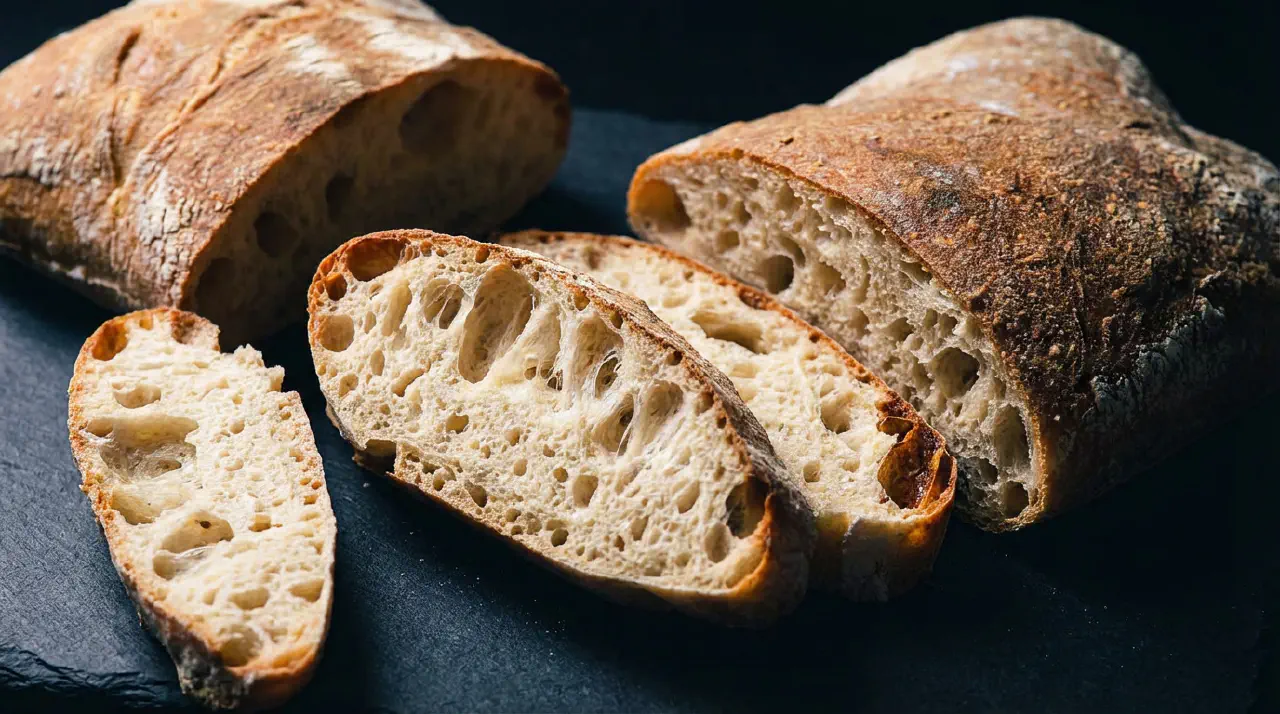
Ciabatta © kvalifood.com
An Italian rustic bread with a slack, wet dough that yields large shiny holes and a chewy, amorphous crumb. The name means “slipper” in Italian, referencing its flat shape. Works beautifully for sandwiches or as a base for variations.
Ingredients
Makes 2 1-pound loaves or 3 smaller loaves
Poolish Version
- 640 g poolish (prepared in advance)
- 380 g unbleached bread flour
- 1¾ tsp (0.44 oz) salt
- 1½ tsp (0.17 oz) instant yeast
- 6 tbsp to ¾ cup (3-6 oz) water, lukewarm (90°-100°F (38°C))
- Semolina flour or cornmeal, for dusting
Biga Version
- 450 g biga (prepared in advance)
- 260 g unbleached bread flour
- 1½ tsp (0.37 oz) salt
- 1½ tsp (0.17 oz) instant yeast
- 200–260 g water, lukewarm (90°-100°F (38°C))
- 55 g olive oil (optional)
- Semolina flour or cornmeal, for dusting
Directions
Poolish Version
Remove the poolish from the refrigerator 1 hour before making the dough to bring it to room temperature.
Stir together flour, salt, and yeast in a 4-quart bowl. Add the poolish and 6 tbsp water. Mix with a large metal spoon until the ingredients form a sticky ball. If loose flour remains, add the additional water as needed. If mixing by hand, repeatedly dip one hand or the spoon into cold water and use it like a dough hook, working the dough vigorously into a smooth mass while rotating the bowl. Do this for 5-7 minutes. The dough should clear the bowl sides but stick to the bottom. If using a mixer, mix on medium speed with the paddle for 5-7 minutes, then switch to the dough hook for the final 2 minutes.
Sprinkle flour on the counter to make a 8-inch square bed. Using a bowl scraper, transfer the sticky dough to the flour bed. Mist the top with oil, dust with flour, and loosely cover with plastic wrap or a plastic bag.
Let rest for 30 minutes. Perform a stretch-and-fold: Dust the top liberally with flour, patting into a rectangle. Wait 2 minutes. Coat your hands with flour, lift the dough from each end, stretch it to twice its size, then fold over itself letter-style to return to rectangular shape. Mist with oil, dust with flour, and cover. Let rest another 30 minutes and repeat the stretch-and-fold one more time.
Allow the covered dough to ferment on the counter for 1½ to 2 hours. It should swell but not necessarily double in size.
Set up a couche (a floured cloth). Carefully remove the plastic from the dough. Using a pastry scraper dipped in water, divide the dough into 2 or 3 rectangles without degassing. Sprinkle generously with flour and, using the scraper to lift, roll each piece in the loose flour to coat.
Lay the loaves on the cloth and gently fold each piece, left to right, letter-style, into an oblong about 6 inches long. Bunch the cloth between pieces to provide support.
Proof for 45-60 minutes at room temperature until noticeably swelled.
Prepare the oven for hearth baking with an empty steam pan in place. Preheat to 500°F (260°C).
Generously dust a peel or the back of a sheet pan with semolina flour. Very gently transfer the dough pieces to the peel or pan using the pastry scraper. Lift the dough from each end and tug to a length of 9-12 inches. If the dough bulges too high in the middle, gently dimple it down with fingertips. Slide the loaves onto the baking stone (or bake directly on the sheet pan). Pour 1 cup hot water into the steam pan and close the door. After 30 seconds, open the door, spray the oven side walls with water, and close. Repeat twice more at 30-second intervals. After the final spray, turn the oven to 450°F (230°C) and bake for 10 minutes. Rotate the loaves 180 degrees if needed and continue baking for 5-10 more minutes until done. The bread should register 205°F (96°C) in the center and be golden in color.
Transfer the bread to a cooling rack and cool for at least 45 minutes before slicing.
Biga Version
Remove the biga from the refrigerator 1 hour before making dough. Cut it into about 10 small pieces with a pastry scraper or serrated knife. Cover with a towel or plastic wrap and let sit for 1 hour.
Stir together flour, salt, and yeast. Add the biga pieces, ¾ cup plus 2 tbsp water, and oil if using. Mix with a large metal spoon until a sticky ball forms. If loose flour remains, add the additional water as needed. Proceed as described in the poolish version from the stretch-and-fold stage forward.
Notes
- Poolish vs. Biga: Both methods yield comparable results. Poolish is a liquid pre-ferment; biga is stiff. Use whichever fits your schedule.
- High hydration: The wetter the dough, the larger the holes. As you grow comfortable, consider increasing hydration for even better structure and crumb.
- Wet-dough handling: Dip hands or tools in cold water rather than flour to handle the sticky dough and develop gluten without toughening.
- Stretch-and-fold: This technique strengthens the gluten, which is where those characteristic large holes come from. Be patient and repeat.
- Enriched variations: Add ¼ cup olive oil and/or substitute whole milk or buttermilk for water to make a softer, more tender crumb.
- Flavored versions: Add sautéed mushrooms and garlic during the stretch-and-fold stage for mushroom ciabatta, or fold in shredded cheese for cheese ciabatta, or caramelized onions with fresh herbs.
See Also
100 Percent Sourdough Rye Bread
Basic Sourdough Bread
Anadama Bread