Gulab Jamun
Prep 55 min Total 8 hr 55 min
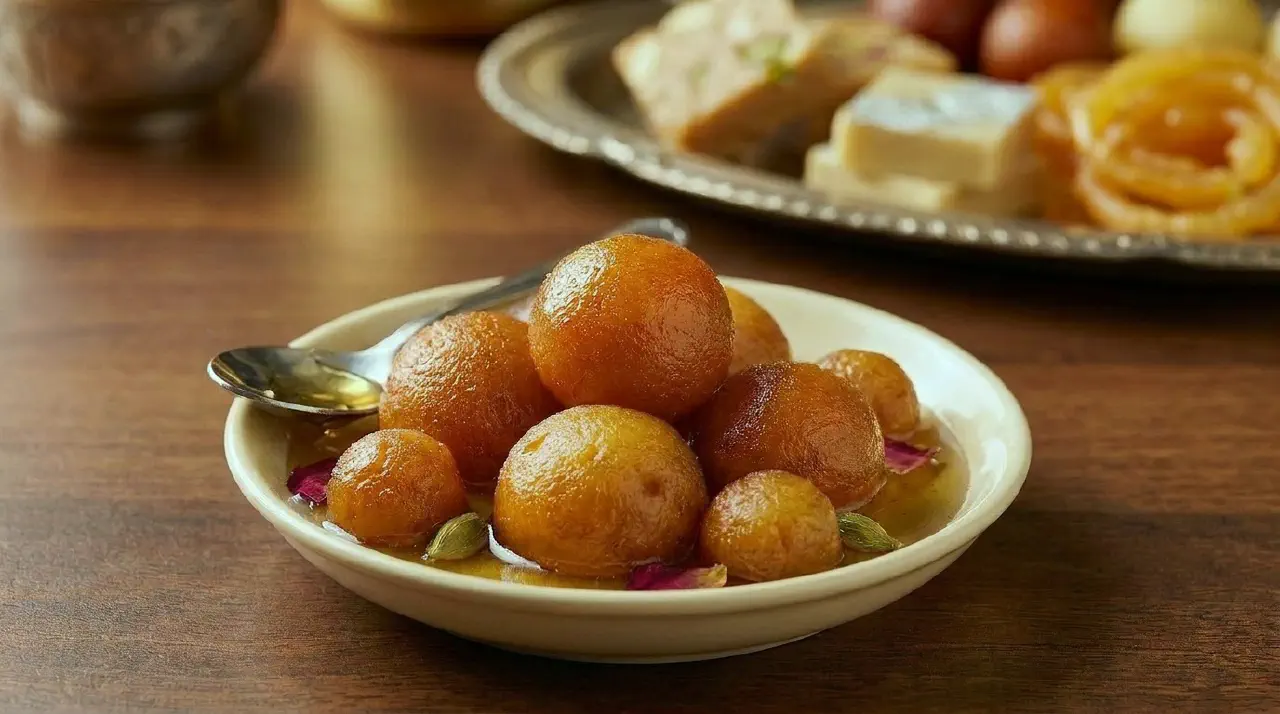
Gulab jamun is a North Indian dessert with Mughal-era roots, eaten at Diwali, Eid, weddings, and other celebrations across the subcontinent. The name comes from Persian and Urdu: gulab means rosewater, jamun refers to a dark berry the balls are said to resemble. Homemade fresh cheese is mixed with semolina, shaped into balls, deep-fried, and placed in a spiced sugar syrup. They belong to the same family as rasgulla and kala jamun - small soft balls that soak up syrup and become a mix of crisp and spongy.
The fresh cheese, also known as paneer, is made by heating milk and curdling it with lemon juice. The curds must be pressed overnight so they are dry enough to hold their shape with the semolina. If the mixture is too wet, the balls will fall apart in the oil.
The syrup is spiced with cardamom, cloves, and rosewater. It needs to be warm when the balls go in so they have time to absorb the flavour. Serve as a dessert after a spiced meal – they are sweet enough to stand alone but also go well with a cup of strong tea.
Ingredients
Serves 4–6
- 1 l milk
- 8 tbsp lemon juice
- 125 g semolina
- vegetable oil, for deep-frying
Syrup
- 300 ml water
- 5 cardamom pods
- 5 cloves
- 250 g sugar
- 2 tsp rose water
Directions
Fresh Cheese (the day before)
Pour the milk into a heavy-bottomed pot and heat over medium heat, stirring regularly so it does not catch.
When the milk is just about to boil, add the lemon juice. Stir and let it cook for 5–10 minutes. The milk will separate into white curds and yellowish whey.
Remove from the heat and leave to cool. Skim off as much of the whey as you can with a spoon.
Line a fine-mesh sieve or large colander with muslin or cheesecloth and pour in the curds. Gather the corners and tie them into a bag.
Place the bag back in the sieve, set the sieve over a bowl, and weigh it down with something heavy – a pot of water works well. Refrigerate overnight so all the whey is pressed out.
Balls
Remove the fresh cheese from the cloth the next day. It should be firm and dry.
Put the cheese in a bowl with the semolina. Knead with your hands for 5–10 minutes until you have a smooth, even dough. The longer you knead, the more uniform the balls will be.
Divide the dough into 15 equal pieces and roll each one into a smooth ball between your palms. Make sure there are no cracks, or the balls will split in the oil.
Frying
Pour oil into a heavy-bottomed pot or deep-fryer so there is at least 5 cm of oil in the bottom. Heat to 160°C (320°F) – the oil is ready when a ball begins to sizzle and slowly rises when dropped in.
Fry the balls in batches of 4–5 at a time so the temperature does not drop. Turn them gently so they colour evenly on all sides. This takes 4–6 minutes per batch.
Lift the balls out with a slotted spoon and drain on absorbent paper. Keep warm while you make the syrup.
Syrup
Put the water, cardamom pods, and cloves in a wide pan and bring to the boil.
Reduce the heat and add the sugar. Stir until the sugar has completely dissolved.
Increase the heat to medium-high and let the syrup boil without stirring until it starts to thicken slightly, 5–8 minutes.
Remove from the heat, leave to cool for a couple of minutes, then stir in the rosewater.
Place the warm balls in the warm syrup and serve immediately. The balls will soak up the syrup as they sit.
Notes
Active time 30 minutes plus overnight resting. Cooking and frying time 25 minutes.
The fresh cheese can be made up to two days ahead and kept in the fridge.
The balls taste best on the day they are fried. If you have leftovers, store the balls and syrup separately and reheat them together before serving.
Rosewater is available from Indian and Middle Eastern shops. It has a strong flavour – start with 1 tsp and taste before adding more if you are unsure.
See Also
Green Chutney