Fish
Fish
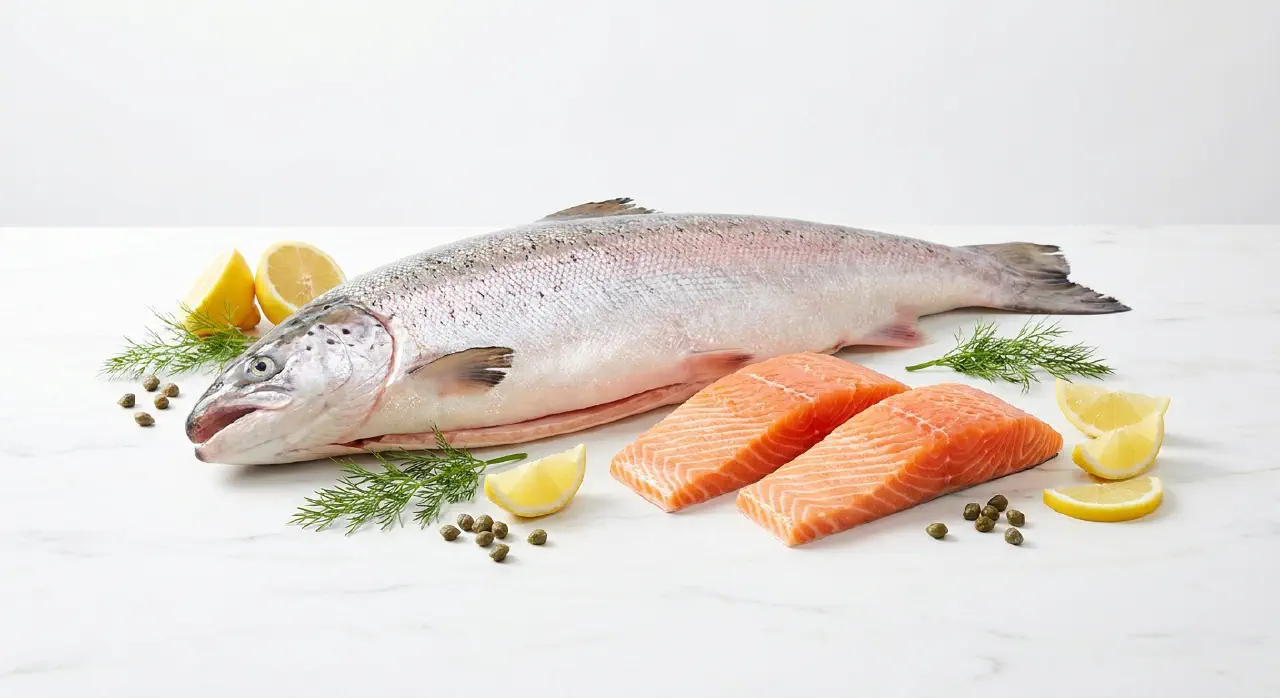
Fish is fundamentally different from land animal meat — not just milder or more delicate, but structurally and chemically distinct in ways that demand different cooking logic. Water’s buoyancy means fish never needed the heavy skeletal support and tough connective tissue that gravity imposes on land animals. The result is pale, translucent flesh with weak collagen and a layered muscle architecture unlike anything on land.
Muscle Structure: Myotomes and Flaking
Fish muscle is organized into thin sheets called myotomes — each roughly the width of a fish scale — separated by thin connective tissue layers (myosepta). A cod-sized fish has about 50 of these sheets nested in complex W-shaped folds along its length. When the collagen in myosepta dissolves during cooking (at just 120–130°F / 50–55°C), the sheets separate into the characteristic “flakes” of cooked fish. Each flake is a complete myotome. This is completely unlike land animal muscle, where fibers run continuously through unified muscles.