Meat
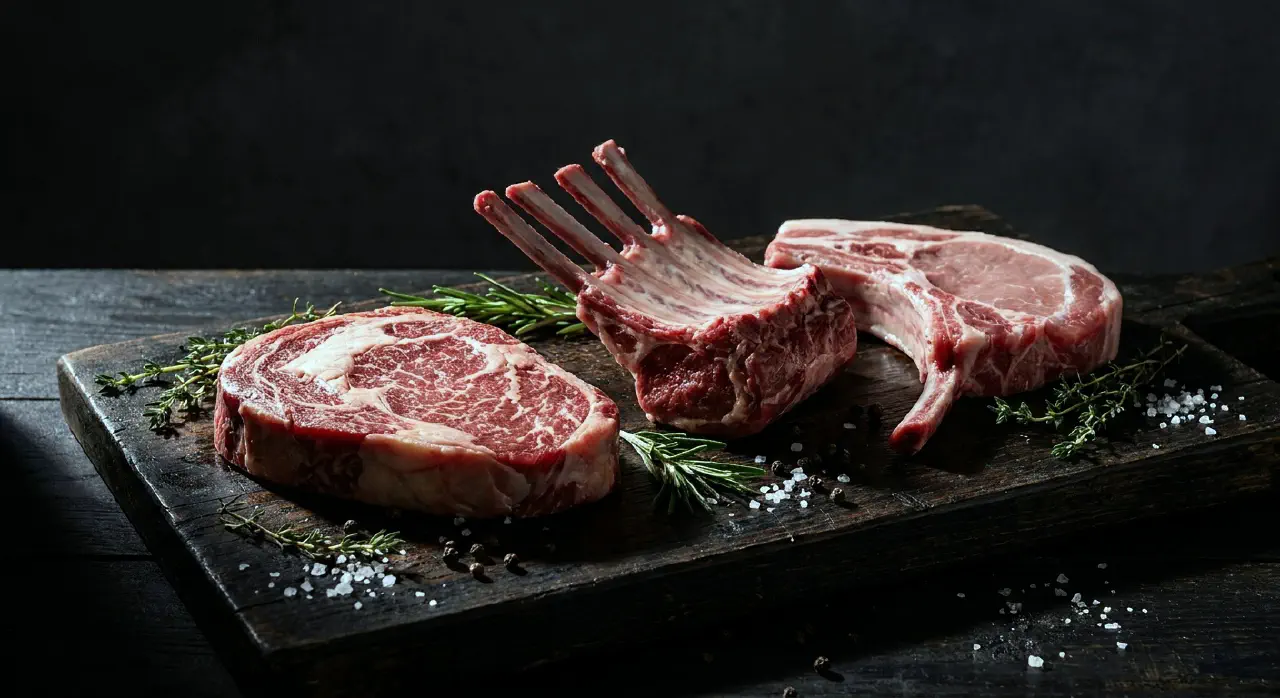
Meat is three tissues woven together: muscle fibers (the protein), connective tissue (the structural harness), and fat (the lubricant). Understanding how each responds to heat - they don’t agree - is the key to cooking any piece of meat well. Lean meat is ~75% water, ~20% protein, and ~3% fat. Everything that happens during cooking is a conversation between these components.
Muscle fibers
Individual fibers are hair-thin (0.01–0.1 mm diameter) and can extend the entire length of a muscle. They’re organized into bundles (fascicles) - the “grain” you see in cooked meat. Cutting across the grain severs fiber bundles short, making the meat easier to chew.
Fiber number stays constant throughout an animal’s life - only diameter changes with exercise and age. This is why older, more exercised animals produce tougher meat: their fibers are thicker and harder to cut across.
Red vs white fibers
Not all muscle fibers are the same, and the distinction explains the most fundamental flavor differences in meat:
Red (slow) fibers handle sustained effort. They burn fat for fuel, require oxygen, and carry high concentrations of myoglobin (the iron-containing pigment that makes meat red) and cytochromes. These are the flavor-rich fibers - their fat droplets, iron atoms, and metabolic machinery are all flavor precursors. See meat-flavor for the full picture.
White (fast) fibers handle quick bursts. They burn glycogen anaerobically and carry little myoglobin. They’re paler and blander.
A chicken breast is ~90% white fibers - which is why it’s pale and mild. Duck breast is ~80% red fibers - an athlete built for migratory flight - which is why it’s dark and flavorful. Beef cheek is exclusively red fibers.
How fibers respond to heat
Heat makes muscle fibers worse - denser, drier, and tougher through protein coagulation:
| Temperature | What happens |
|---|---|
| ~120°F / 50°C | Myosin denatures: firmness, opacity |
| ~140°F / 60°C | Further coagulation, more moisture loss |
| 140–150°F / 60–65°C | Critical zone: collagen sheaths shrink, squeeze fluid out copiously. Meat shifts from juicy to dry. |
| 160°F+ / 70°C+ | Fibers dry and compact further |
Connective tissue
Connective tissue is the physical glue - thin invisible layers around each fiber, visible silver-white sheets (fascia) around bundles, and translucent tendons joining muscle to bone. More connective tissue means tougher meat.
Collagen
Collagen makes up ~33% of all protein in an animal’s body. Its name comes from Greek for “glue producing,” and that’s exactly what happens when it’s heated in the presence of water: it dissolves into gelatin. This is the opposite of what muscle fibers do, and it’s the central drama of meat cooking.
Young collagen dissolves readily. As animals age and muscles work, total collagen declines but the remaining strands become more heavily cross-linked - requiring prolonged, gentle cooking (1+ hours) to break down. Cooked veal is gelatinous and tender; cooked mature beef is denser and tougher, unless you give the collagen time.
Collagen varies by cut. Working muscles (shoulders, legs, neck, chest) carry far more collagen than resting muscles (tenderloin, back). Chicken leg has 5–8% collagen; chicken breast has 2%.
Elastin
The other connective tissue protein, found in blood vessel walls and ligaments. Its cross-links are unbreakable by cooking heat. Fortunately, it’s sparse in most muscle tissue and cannot be tenderized by any method.
Fat and marbling
Fat is stored in three locations: under the skin (subcutaneous), around organs (cavity deposits), and within connective tissue between muscle bundles (intramuscular - this is “marbling”).
Marbling matters because fat does four things during cooking: it interrupts and weakens connective tissue sheets, it melts rather than dries (unlike fibers), it lubricates fibers apart, and it carries species-specific flavor compounds. Without marbling, otherwise tender meat becomes compacted, dry, and tough.
Marbling develops in older, slower-growing animals. Modern fast-grown meat has very little, which is why it can be bland and unforgiving of overcooking.
The fundamental cooking contradiction
The two main protein systems in meat respond to heat in opposite ways, and this is the single most important concept in meat cookery:
Muscle fibers get worse with heat - tougher, drier, more compacted. Goal: minimize heat exposure. Cook fast, to low temperature (130–140°F / 55–60°C).
Collagen gets better with heat - dissolving into lubricating gelatin. Goal: maximize heat and time. Cook slowly, to high temperature (160°F+ / 70°C+), for hours.
No single method satisfies both. The solution: match the method to the meat. See meat-cooking for the full treatment, and braising for the collagen-forward approach.
Modern vs traditional meat
Before industrial production, people ate mature, tough, strongly flavored meat and developed long-cooked recipes (braising, stewing) to soften it. Modern fast-grown, young, lean meat is the opposite: tender but mild, and punishingly unforgiving - a few degrees of overcooking dries it out irreversibly because there’s no collagen reservoir to compensate. Traditional long-cooking methods can actually ruin modern meat.
Common animals
Beef: The largest common meat animal. Reaches adulthood in ~2 years, producing relatively dark, flavorful meat. USDA grading (Prime/Choice/Select) is based on marbling, but marbling accounts for only ~33% of tenderness variation. Wagyu cattle develop up to 40% intramuscular fat.
Pork: Slaughtered at ~6 months. Only ~15% red fibers, hence pale meat. Individual cuts contain 50–80% less fat than 1980 levels. “Sweetness” comes from lactones (the same compounds in coconut and peach).
Lamb: Fine-grained, well-endowed with myoglobin and flavor. Characteristic aroma from branched-chain fatty acids (produced by rumen microbes) and thymol (thyme-like). Older mutton has more concentrated flavor - accumulation of flavor compounds in fat.
Poultry: Chicken breast is 10% red fibers; duck breast is 80%. This difference - not species alone - explains why duck breast eats more like steak than like chicken.
See also
- meat-flavor - myoglobin, species flavor, grass vs grain, the science of dark meat
- meat-cooking - doneness, the searing myth, carryover, two-stage cooking
- meat-aging - rigor mortis, dry vs wet aging, enzyme-driven flavor development
- meat-curing - salting, nitrites, dry-cured hams, fermented sausages, smoking
- braising - the collagen-forward cooking strategy
- protein-denaturation - the molecular events in fiber coagulation
- maillard-reaction - surface browning chemistry