Fish
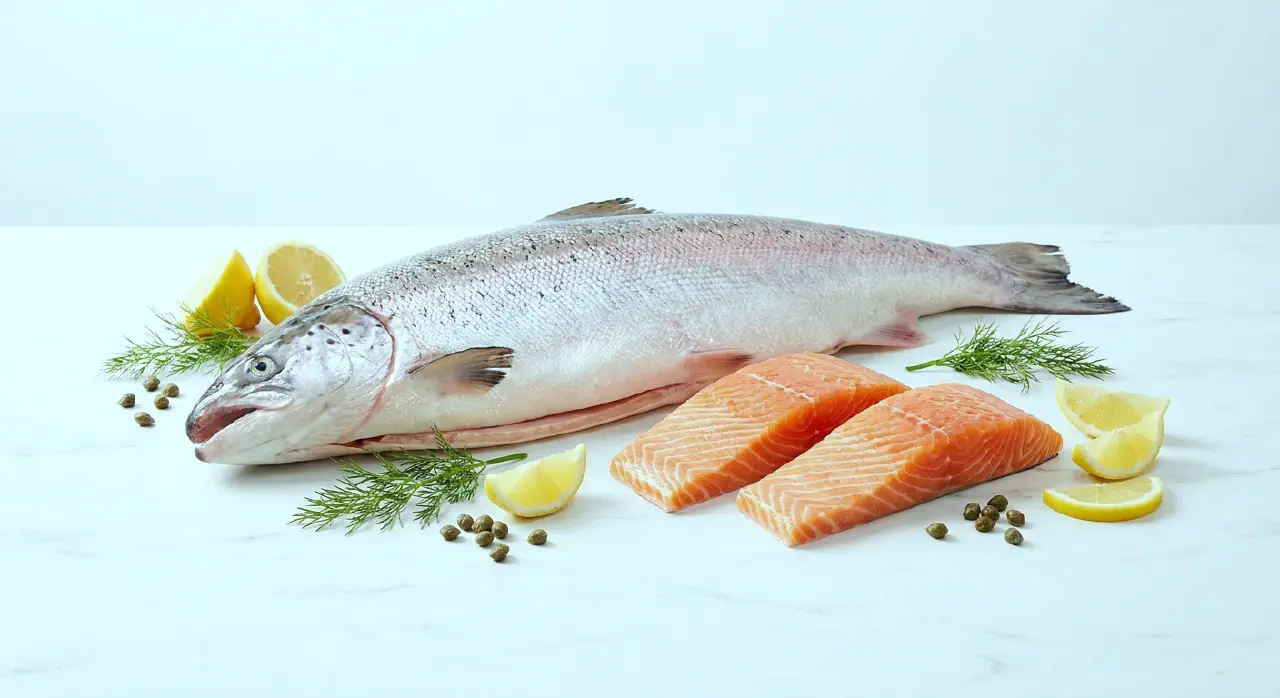
Fish is fundamentally different from land animal meat - not just milder or more delicate, but structurally and chemically distinct in ways that demand different cooking logic. Water’s buoyancy means fish never needed the heavy skeletal support and tough connective tissue that gravity imposes on land animals. The result is pale, translucent flesh with weak collagen and a layered muscle architecture unlike anything on land.
Muscle Structure: Myotomes and Flaking
Fish muscle is organized into thin sheets called myotomes - each roughly the width of a fish scale - separated by thin connective tissue layers (myosepta). A cod-sized fish has about 50 of these sheets nested in complex W-shaped folds along its length. When the collagen in myosepta dissolves during cooking (at just 120–130°F / 50–55°C), the sheets separate into the characteristic “flakes” of cooked fish. Each flake is a complete myotome. This is completely unlike land animal muscle, where fibers run continuously through unified muscles.
Collagen: The Weakness That Defines Fish
Fish collagen contains fewer structure-reinforcing amino acids than beef collagen, is less extensively cross-linked, and dissolves into gelatin at 120–130°F (50–55°C) - compared to 160°F (70°C) for beef. This means fish bones soften through brief cooking near the boil, and canned salmon becomes an excellent calcium source because its bones dissolve entirely during processing.
The collagen weakness creates a paradox: gelatin from dissolved collagen contributes moisture and succulence, but provides less protection against overcooking. Fish with more collagen (halibut, shark) appear more succulent than those with less (trout, bass). Within any individual fish, the tail has more connective tissue than the head and appears more succulent, while the belly is usually the fattiest region.
Fiber Types and Color
Most fish muscle (66–90%) is white, fast-twitch fiber for burst movement - pale, with minimal myoglobin. A thin dark layer of red, slow-twitch fiber sits just under the skin, used for continuous cruising. Tuna and other active swimmers have pink intermediate fibers - white fibers modified with extra oxygen-storing pigments for sustained work.
Red-fleshed fish have much stronger, more complex, beefy flavor from higher myoglobin content. White fish are mild. The dark muscle layer in any fish has finer texture and more gelatinous quality because its thinner fibers require more connective tissue.
Why Fish Overcooks So Easily
Fish myosin coagulates at lower temperatures than land animal muscle: shrinkage begins at 120°F (50°C), drying around 140°F (60°C) - each about 20°F lower than beef. This means fish passes from perfect to overcooked in seconds for thin fillets. But unlike overcooked meat, overcooked fish never gets tough - it just dries out, because the weak collagen can’t create toughness. See fish-cooking for temperature targets and strategies.
The Mush Problem
Four mechanisms cause mushy texture: post-spawning protein depletion, freeze-thaw enzyme damage, active protein-digesting enzymes during cooking (in sardine, herring, mackerel, tuna, shrimp, lobster), and extreme alkaline treatment (lutefisk). The enzyme problem is particularly important - these cathepsins peak at 130–140°F (55–60°C), the exact range used for gentle cooking. See fish-cooking for strategies.
Major Families
The herring family (anchovy, sardine, shad) are small, schooling, high-fat fish that deteriorate rapidly and are almost always preserved. Salmon are remarkable migratory fish whose quality peaks approaching their home river; farmed salmon is fattier and blander than wild. The cod family set the European standard for mild white fish. Tuna are essentially warm-blooded, with dark red flesh and beefy flavor. Flatfish (sole, turbot, halibut) are sedentary bottom-dwellers with mild flavor that keeps well. Chilean sea bass (Patagonian toothfish) is unusually forgiving of overcooking thanks to ~15% fat content.
Practical Implications
The 20°F gap between fish and meat means every temperature reference from meat cooking must be mentally adjusted downward. Collagen weakness means fish needs support during and after cooking - cut portions before cooking, use racks or foil stretchers for whole fish. The enzyme paradox means you can’t blindly apply “low and slow” logic to all species.
See Also
- fish-cooking - Temperature targets, methods, handling
- fish-flavor-freshness - TMAO chemistry, freshness, spoilage
- fish-safety - Mercury, parasites, histamine
- shellfish-crustaceans - Shrimp, lobster, crab
- shellfish-mollusks - Clams, oysters, scallops, squid
- preserved-fish - Salting, smoking, fermentation
- protein-denaturation - General protein science, fish vs. meat comparison
- cooking-temperatures - The Arrhenius rule applied to fish