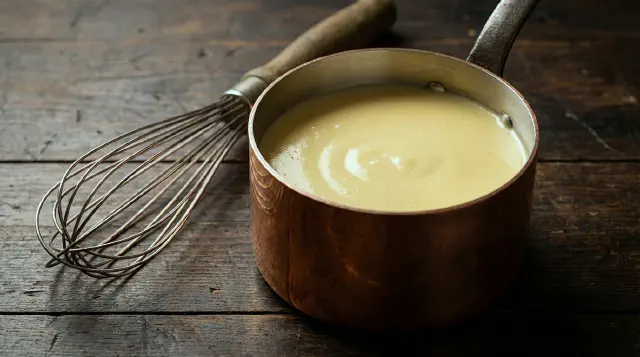
Sauce Allemande
Prep 15 min Total 45 min
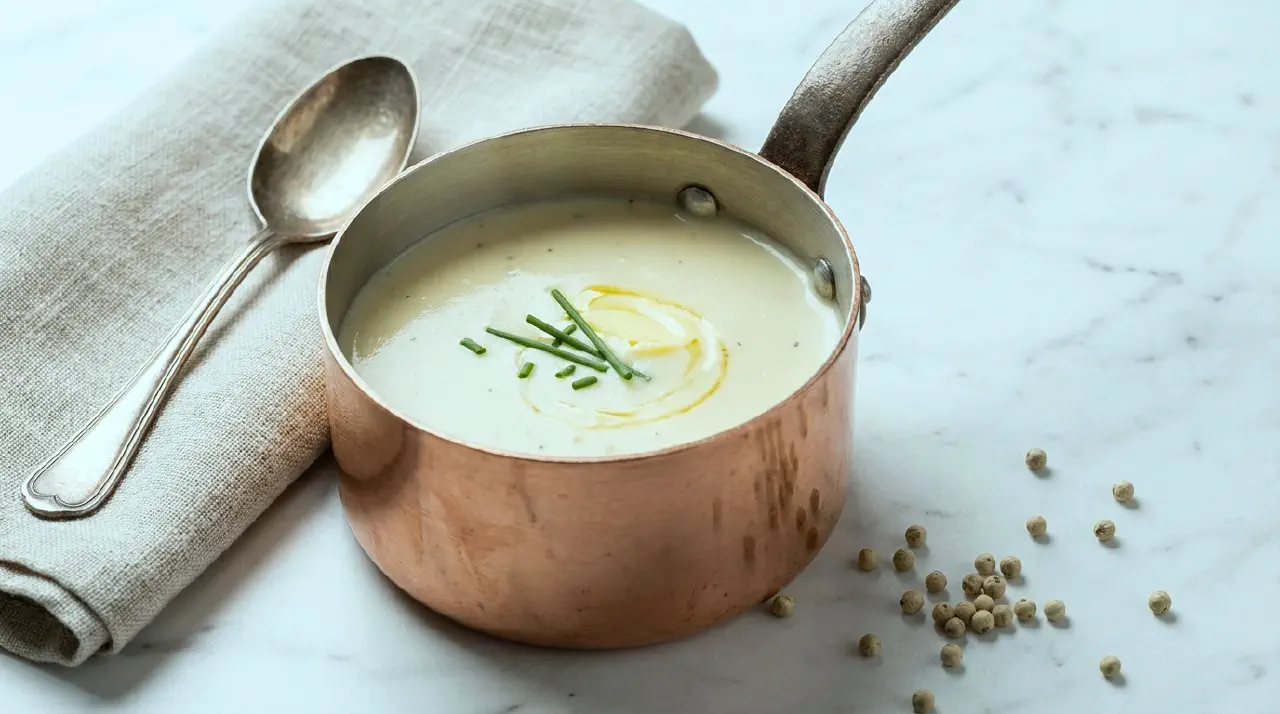
Sauce Allemande - kvalifood.com
Sauce Allemande (also called Sauce Parisienne) is a classical French compound sauce made by enriching a white veloute with a liaison of egg yolks and cream, then finishing with lemon juice and butter. It was one of Antoine Careme’s original four mother sauces (early 19th century).
Serve it with poached or roasted chicken, veal, steamed vegetables, or eggs. It also works as a filling for vol-au-vents and is the base for further derivative sauces like sauce poulette.
Makes ca. 500 ml / 2 cups
Ingredients
Veloute base
- 30 g unsalted butter
- 30 g all-purpose flour
- 650 ml white veal stock (or chicken stock)
- Salt
- White pepper
Allemande enrichment
- 500 ml veloute (from above)
- 2 egg yolks
- 75 ml heavy cream
- 2 tbsp mushroom cooking liquor (optional but recommended)
- 1 tsp lemon juice (adjust, to taste)
- 1 pinch freshly grated nutmeg (optional, classical touch)
- 25 g cold unsalted butter, cut into small pieces (for finishing)
- Salt
- White pepper, to taste
Directions
Veloute:
Melt 30 g butter in a heavy-bottomed saucepan over medium heat. Add flour and stir with a wooden spoon for 2-3 minutes to make a blonde roux (pale golden, no browning).
Gradually whisk in the stock, adding it in stages to prevent lumps. Bring to a simmer.
Reduce heat to low. Simmer gently for 25-30 minutes, skimming any skin that forms. The veloute should reduce to about 500 ml (2 cups) and coat the back of a spoon lightly.
Season lightly with salt and white pepper. Strain through a fine-mesh sieve. Set aside.
Allemande:
Pour the veloute into a clean saucepan. If using mushroom liquor, add it now. Heat over medium until gently simmering. Let it reduce by about one-quarter (5-8 minutes), stirring occasionally.
In a bowl, whisk together the egg yolks and cream until smooth. This is the liaison.
Ladle about 150 ml (one-third) of the hot veloute into the liaison, whisking constantly to temper the yolks.
Pour the tempered liaison back into the saucepan with the remaining veloute, whisking continuously.
Reduce heat to low. Stir constantly with a wooden spoon or spatula for 3-5 minutes until the sauce thickens enough to coat the back of the spoon. Do not allow it to boil - the yolks will curdle.
Remove from heat. Add lemon juice and nutmeg if using. Season with salt and white pepper.
Swirl in the cold butter pieces one at a time, stirring until each is incorporated. This adds gloss and silkiness.
Strain through a fine-mesh sieve or cheesecloth into a warm sauceboat. Serve immediately.
Notes
- Do not hold this sauce. Allemande is fragile and will break or develop a skin if left sitting. Make it just before serving.
- Mushroom cooking liquor is made by simmering mushroom trimmings (stems, peelings) in a small amount of water with a squeeze of lemon juice. It adds subtle umami depth and is what distinguishes a more classical version from a plain enriched veloute.
- Veal stock vs. chicken stock: Veal gives a more neutral, silky result traditional to the sauce. Chicken stock works well and is more accessible.
- Derivative sauces: Once you have allemande, you can make Sauce Poulette (add mushrooms and parsley), Sauce Aurore (add tomato puree), or Sauce aux Champignons (add sauteed mushrooms).
- Historical note: This sauce was one of Careme’s four original mother sauces. Escoffier demoted it to a daughter sauce of veloute, replacing it with hollandaise and tomato sauce. He also renamed it “sauce parisienne” during WWI.
See Also
Aioli (Traditional Provencal Garlic Emulsion)
Bearnaise Sauce
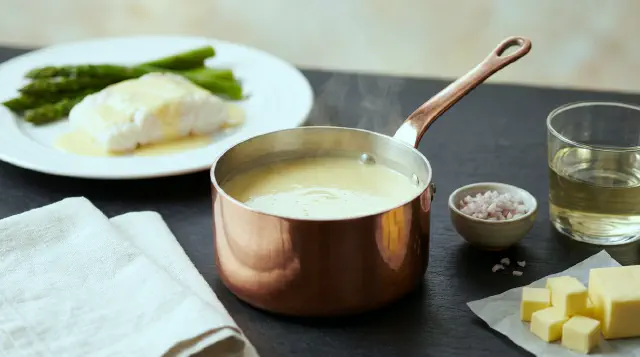
Beurre Blanc (White Butter Sauce)
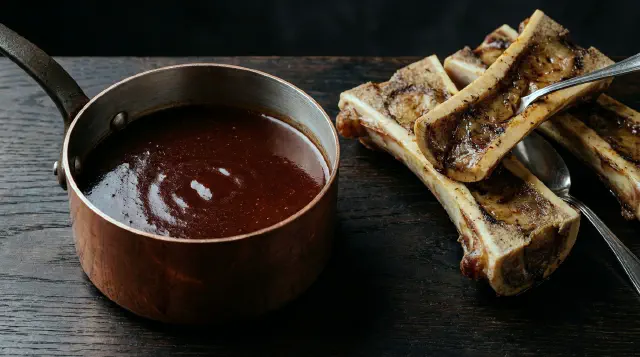
Sauce Bordelaise