Sous Vide Beef Jerky
Sous Vide Beef Jerky
Jerky is one of the oldest meat-preservation tricks around, going back to Native American drying techniques that let hunters carry protein for weeks without it spoiling. The word itself comes from the Quechua ch’arki, and the basic idea hasn’t changed in centuries: slice lean meat thin, season it, and dry it until almost all the moisture is gone. What’s new here is the middle step. Instead of relying on a long, hot dehydrator run to make the meat safe to eat at room temperature, this version uses a sous vide water bath to pasteurize the beef first, then finishes it with a much shorter drying stage that’s about texture rather than safety.
The beef is lean by design - eye of round, top round, bottom round, sirloin tip, or a trimmed brisket flat all work, as long as the fat and silverskin come off before slicing. Fat doesn’t dry the same way muscle does, so any left on turns rancid long before the meat around it. The strips go into a wet marinade of soy sauce, Worcestershire sauce, brown sugar, and a handful of aromatics, then sit in the fridge overnight so the seasoning works all the way through instead of just sitting on the surface.
Water bath at 130°F (54°C) is the number that matters most. Held for three hours, it’s hot enough to pasteurize the meat the same way a much longer, harder-to-control heat treatment would, and thin strips like these come up to that temperature almost immediately, so the hold time itself is doing the safety work. Once the bags come out of the bath and the strips are patted dry, the dehydrator or oven step that follows is comparatively quick - a couple of hours instead of most of a day - because it only has to pull out surface moisture, not cook the meat through.
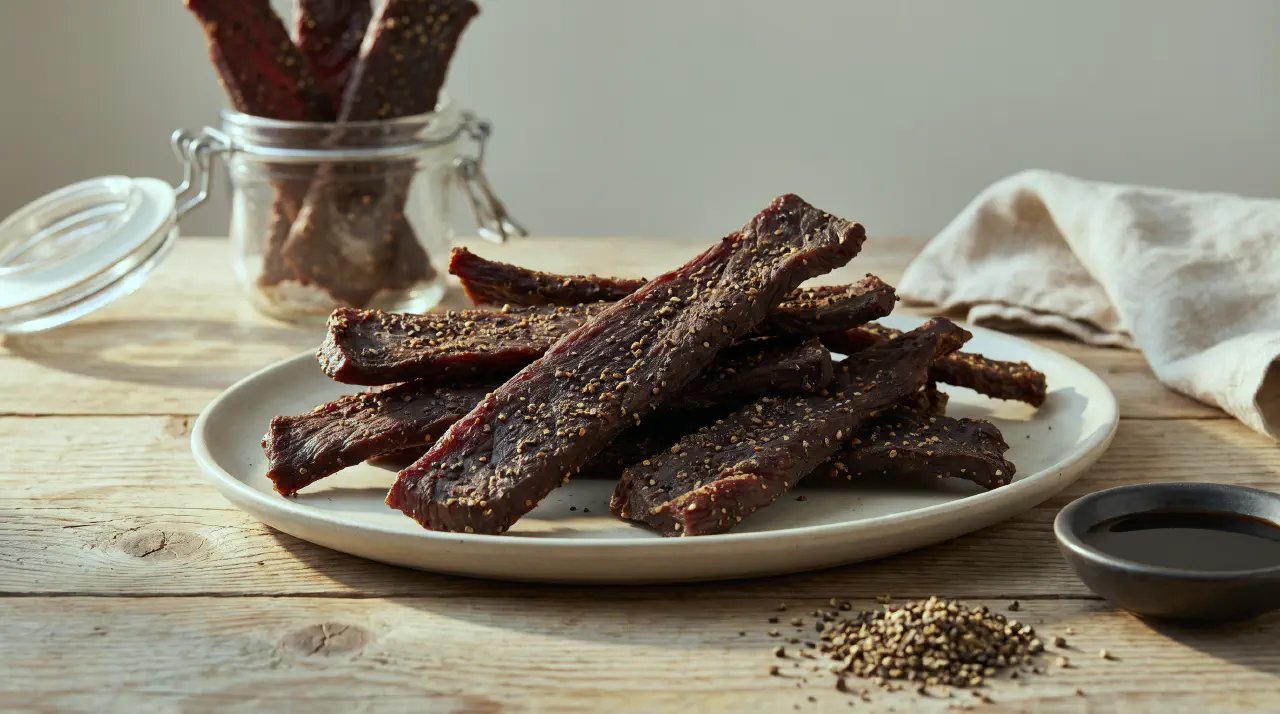
The payoff is a chewy, salty-sweet, deeply savory snack with a peppery kick from the black pepper and hot sauce, and it keeps for weeks without refrigeration - exactly what jerky has always been for: a road-trip food, a hiking food, something to toss in a bag and forget about until you’re hungry. Bend a piece before calling it done - it should crack and show white fibers rather than snap cleanly or fold like a rubber band.
Ingredients
Makes about 500 g (1 lb) jerky
The marinade
- 80 ml soy sauce
- 60 ml Worcestershire sauce
- 30 g brown sugar
- 2 tsp black pepper, coarsely cracked
- 1 tsp garlic powder
- 1 tsp onion powder
- 1-2 tsp vinegar-based hot sauce (such as Tabasco or Frank’s RedHot), or 1/2 tsp dried chili flakes
- 2.25 g curing salt (Prague Powder #1 / sodium nitrite cure), optional, for shelf-stable storage
The beef
- 900 g lean beef (eye of round, top round, bottom round, sirloin tip, or trimmed brisket flat), trimmed of fat and silverskin
Directions
The marinade
Whisk together the soy sauce, Worcestershire sauce, brown sugar, black pepper, garlic powder, onion powder, hot sauce (or chili flakes), and curing salt if using, in a bowl large enough to later hold the beef too.
The beef
Partially freeze the beef for 30 to 45 minutes, until firm enough to slice cleanly, then cut it against the grain into strips 1/8 to 1/4 inch (3-6 mm) thick. Slicing against the grain gives a more tender chew; slicing with the grain instead produces the tougher, stringier texture some people consider classic “traditional” jerky.
Add the strips to the marinade and toss until every piece is coated. Cover and refrigerate for 8 to 12 hours, turning once or twice, keeping the meat below 40°F (4°C) the whole time.
Drain the strips without rinsing off the marinade, then arrange them in a single layer inside vacuum bags and seal.
Set the water bath to 130°F (54°C). Once it’s up to temperature, submerge the bags and sous vide for 3 hours - this is the pasteurization step. Strips up to 1/4 inch thick can go as long as 4 to 5 hours in the bath without turning mushy, so a little extra time isn’t a problem if your schedule runs long.
Remove the bags from the bath. An ice bath for 10 to 15 minutes firms the strips back up if you have the time, though it isn’t required. Either way, pat the beef completely dry with paper towels before the next step - any surface moisture left on the strips will slow the dehydrator down.
Arrange the strips in a single layer with no overlap in a food dehydrator set to 160°F (71°C), and dry for 2 to 4 hours, or use an oven at 170-175°F (77-79°C) for 3 to 4 hours if you don’t have a dehydrator (see the Notes for details).
Start checking for doneness around the two-hour mark. Cool a piece for 5 to 10 minutes, then bend it: it’s ready when it cracks and shows white fibers without snapping cleanly in half. If it’s still too moist or pliable, keep drying in 20 to 30 minute increments and check again.
Let the jerky cool completely, then pack it loosely into a jar with the lid on but not sealed tight, and let it condition for 24 hours before moving it to final storage. This evens out the moisture between drier and chewier pieces so the whole batch settles at the same texture.
Notes
- No food dehydrator? Dry the strips on a wire rack in an oven at 170-175°F (77-79°C) for 3 to 4 hours, with the door propped open a crack so moisture can escape.
- Cooled jerky keeps about 1 to 2 weeks at room temperature, 3 to 4 weeks refrigerated, or several months frozen.
- Curing salt is optional for a batch you’ll eat within a couple of weeks. It matters more for extended shelf-stable storage and for the traditional pink cured color and flavor. Weigh it on a scale rather than measuring it by volume - it’s potent enough that precision matters.
- A two-phase sous vide ramp - 108°F (42°C) for 2 hours, then 130°F (54°C) for 4 hours - is an acceptable variation some cooks use to let the seasoning penetrate at a gentler temperature before the pasteurization phase, but it isn’t required. A straight 3-hour hold at 130°F (54°C) already gives ample pasteurization margin for strips this thin.
See Also
Beef Cuvette - Red Meat Sous Vide
Jerk Marinade
Steak - Cooking Methods Guide