Butter
Butter
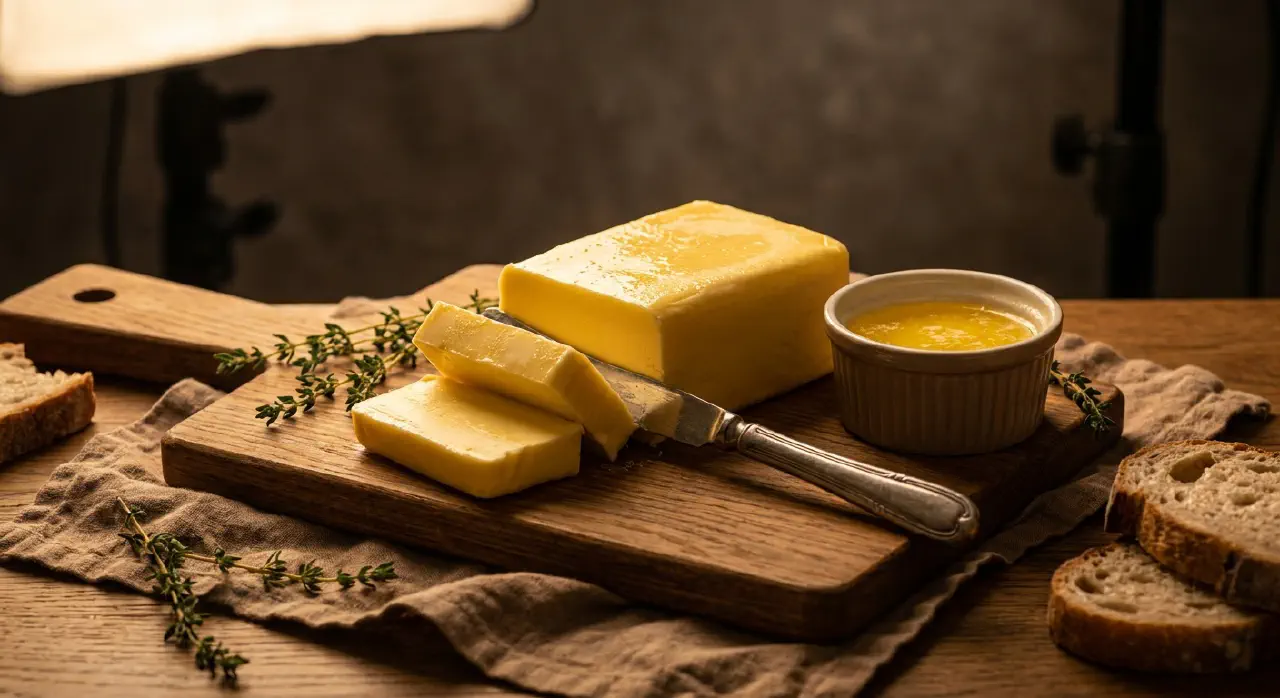
Butter is an inverted emulsion — cream turned inside out. Where cream suspends fat droplets in water, butter suspends water droplets in fat. This inversion, achieved by churning, gives butter its unique properties: solid enough to handle at room temperature, melting on the tongue at body temperature, and capable of both enriching and structuring everything from sauces to pastry.
Composition
- Fat: 80–82% (American standard) or 82–86% (European/continental)
- Water: 15–17%
- Milk solids: 1–2% (proteins, lactose, minerals)
- Salt: 0–2% (when added)
The fat is highly saturated (~60–70%), courtesy of rumen microbes that convert unsaturated fatty acids from the cow’s diet into saturated forms. This is why butter is solid at room temperature — its melting point is 90–95°F/32–35°C, right around body temperature.
Cream
Cream
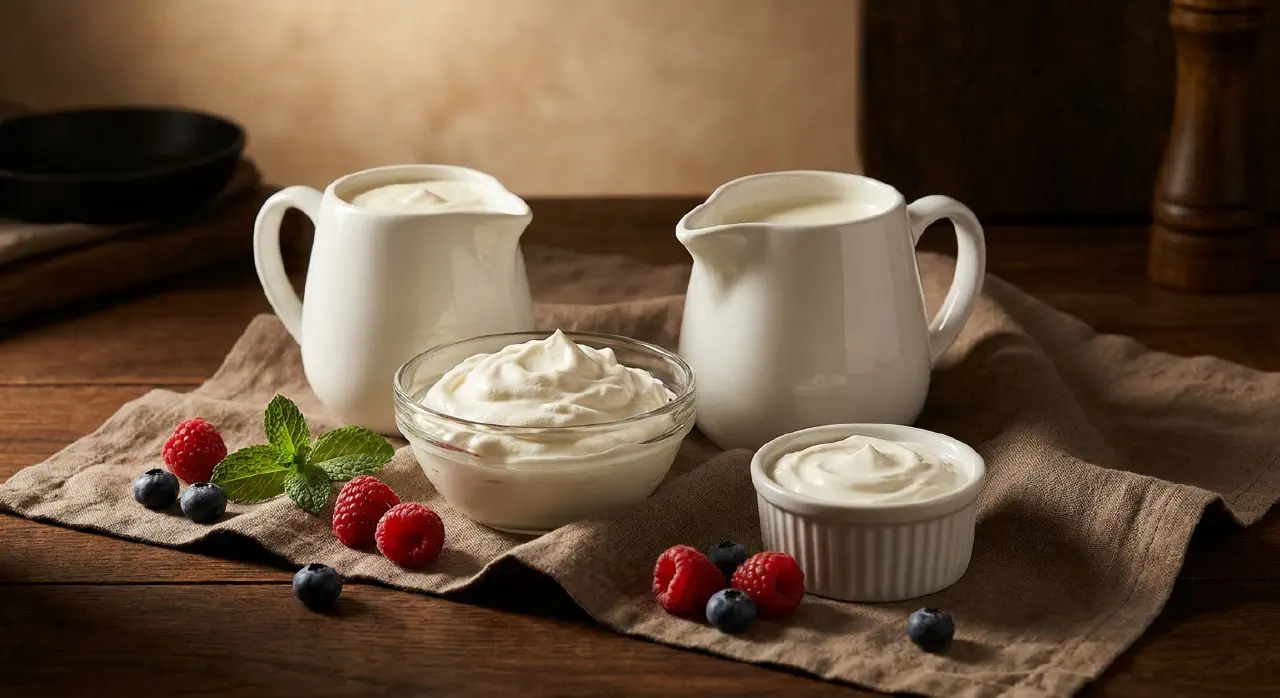
Cream is the fat-enriched portion of milk — the same emulsion, just with more fat globules per unit of water. This concentration is what gives cream its heat stability, whipping ability, and unmatched utility in sauce-making.
Types by fat content
The fat percentage defines what cream can do:
- Half-and-half (10–20% fat): Borders between milk and cream. Cannot whip. Curdles more easily than heavier creams.
- Light/whipping cream (30–36% fat): Can whip to soft peaks. Adequate for many sauces.
- Heavy/whipping cream (36–40% fat): The kitchen workhorse. Whips to stiff peaks. Survives boiling, reduction, and acidic ingredients.
- Double cream (40–48% fat): Very rich, whips to very stiff peaks. Clotted cream (55%+) is an extreme — cream heated slowly to 180°F/82°C until a thick layer of coagulated protein and concentrated fat forms on the surface.
Whipping science
Whipping cream is an exercise in controlled emulsion disruption. When a whisk incorporates air:
Milk
Milk
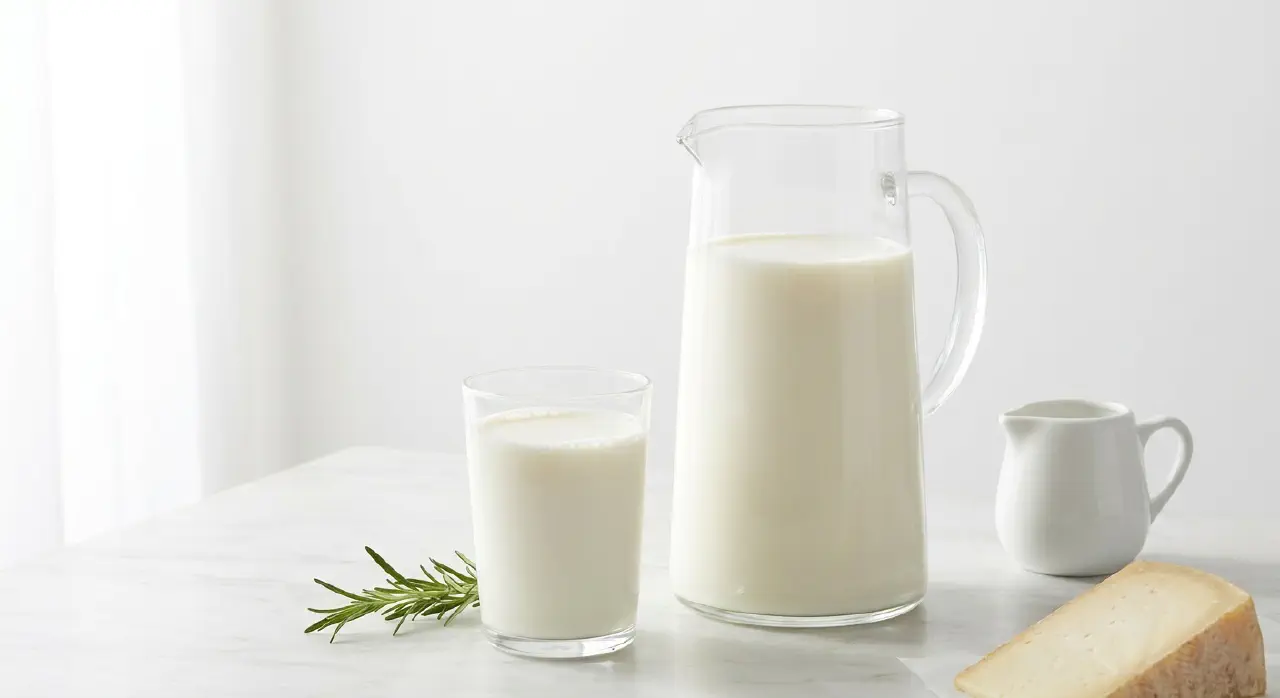
Milk is a complex suspension engineered by mammals as a complete food for rapid growth. For the cook, it’s an emulsion of fat in water stabilized by phospholipid membranes, with two fundamentally different protein families that govern most of its behavior under heat and acid.
Composition
Cow milk is roughly 87–90% water, with the remainder split between fat (3.6–5.2%), protein (3.0–3.9%), lactose (4.8–4.9%), and minerals (0.7–0.8%). These proportions vary significantly by breed — Jersey cows produce the richest milk (5.2% fat), while high-volume Holsteins are leaner (3.6%). Sheep milk is dramatically richer than cow milk (7.5% fat, 6.0% protein), and buffalo milk richer still (6.9% fat), which is why mozzarella di bufala and pecorino have such different characters from their cow-milk equivalents.