Milk
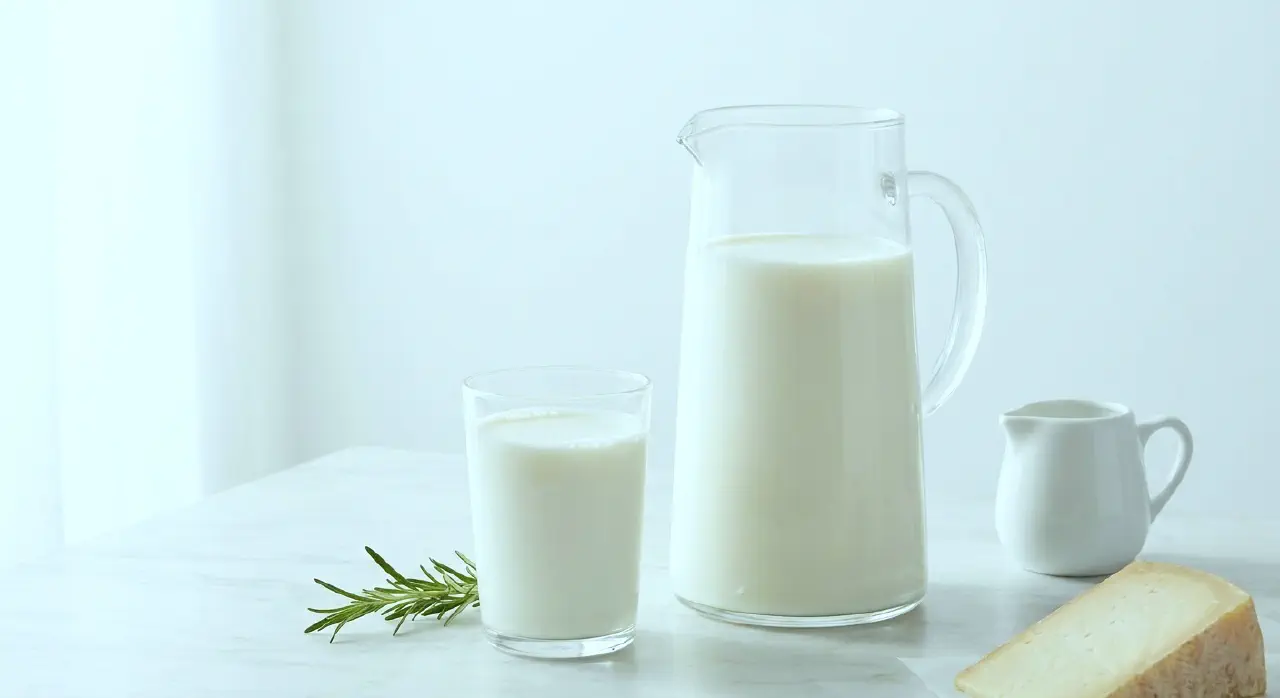
Milk is a complex suspension engineered by mammals as a complete food for rapid growth. For the cook, it’s an emulsion of fat in water stabilized by phospholipid membranes, with two fundamentally different protein families that govern most of its behavior under heat and acid.
Composition
Cow milk is roughly 87–90% water, with the remainder split between fat (3.6–5.2%), protein (3.0–3.9%), lactose (4.8–4.9%), and minerals (0.7–0.8%). These proportions vary significantly by breed - Jersey cows produce the richest milk (5.2% fat), while high-volume Holsteins are leaner (3.6%). Sheep milk is dramatically richer than cow milk (7.5% fat, 6.0% protein), and buffalo milk richer still (6.9% fat), which is why mozzarella di bufala and pecorino have such different characters from their cow-milk equivalents.
The two protein families
This is the key to understanding dairy in the kitchen:
Casein (80% of milk protein) forms colloidal clusters called micelles, stabilized by calcium phosphate. Casein is remarkably heat-stable - it survives boiling without trouble. But it’s acid-sensitive: below pH 4.7, the micelles lose their charge, clump together, and precipitate as curds. This is the foundation of both cheese making and yogurt (yogurt-and-fermented-dairy).
Whey proteins (20%) - including lactalbumin and lactoglobulin - are the opposite. They’re acid-tolerant but heat-sensitive, denaturing between 140–180°F (60–82°C). When whey proteins denature, they unfold and bond to each other and to fat globule surfaces, forming the skin on hot milk and contributing to the thickened texture of heated yogurt.
This asymmetry explains most dairy cooking puzzles. Heavy cream survives boiling with wine because it has relatively little casein. Sour cream curdles in hot soup because it has more casein and less fat to buffer it.
Fat globules: the natural emulsion
Milk fat exists as microscopic globules (0.1–15 micrometers) coated in a membrane of phospholipids and proteins - the milk fat globule membrane (MFGM). This membrane is what keeps fat suspended in the water phase, making milk a natural oil-in-water emulsion.
When milk sits undisturbed, the fat globules rise (creaming) - the origin of the cream layer. Homogenization forces milk through tiny nozzles, breaking fat globules into much smaller droplets that stay suspended indefinitely.
The MFGM itself contains emulsifiers chemically similar to egg yolk lecithin. When disrupted by churning, the globules merge and the emulsion inverts - cream (oil-in-water) becomes butter (water-in-oil).
Lactose
Lactose is a disaccharide unique to milk, composed of glucose and galactose. It’s relatively un-sweet compared to sucrose. In cooking, lactose participates in Maillard browning - this is why butter solids brown when heated and why condensed milk caramelizes at the boiling point of water (the concentrated lactose and proteins lower the effective browning threshold).
In fermentation, bacteria convert lactose to lactic acid - the fundamental reaction behind yogurt, sour cream, crème fraîche, and the initial acid development in cheese making. This also means that aged cheeses and well-fermented yogurt contain almost no lactose.
Heat treatment
Pasteurization (161°F/72°C for 15 seconds) kills pathogens while preserving protein function - pasteurized milk ferments, curdles, and cooks normally. UHT treatment (280°F/138°C for 1–2 seconds) sterilizes completely but significantly denatures proteins and triggers Maillard browning with lactose, producing the characteristic cooked flavor. UHT milk keeps for months unrefrigerated but tastes noticeably different from fresh.
Curdling prevention
Milk curdles in cooking when casein proteins encounter acid, tannins, high heat, or some combination. Prevention strategies: use fresh milk (old milk is already acidifying), add acid to milk slowly (not milk to acid), add a pinch of baking soda to buffer acidity, use a double boiler to avoid scorching, and wet the pan before adding milk to reduce protein adhesion.
Seasonal variation
Milk from grass-fed cows in summer is yellower (more carotenoids), softer (more unsaturated fat), and more complex in flavor than winter milk from hay-fed animals. This is why traditional cheesemakers prize summer milk and why seasonal butter varies in color and softness.
See also
- cream - concentrated milk fat, the cook’s most heat-stable dairy product
- butter - what happens when milk’s emulsion is inverted
- cheese - acid and enzyme coagulation of casein
- yogurt-and-fermented-dairy - lactic acid transformation of lactose
- emulsions - milk fat globule membranes as natural emulsifiers
- protein-denaturation - casein vs. whey behavior under heat