Emulsions
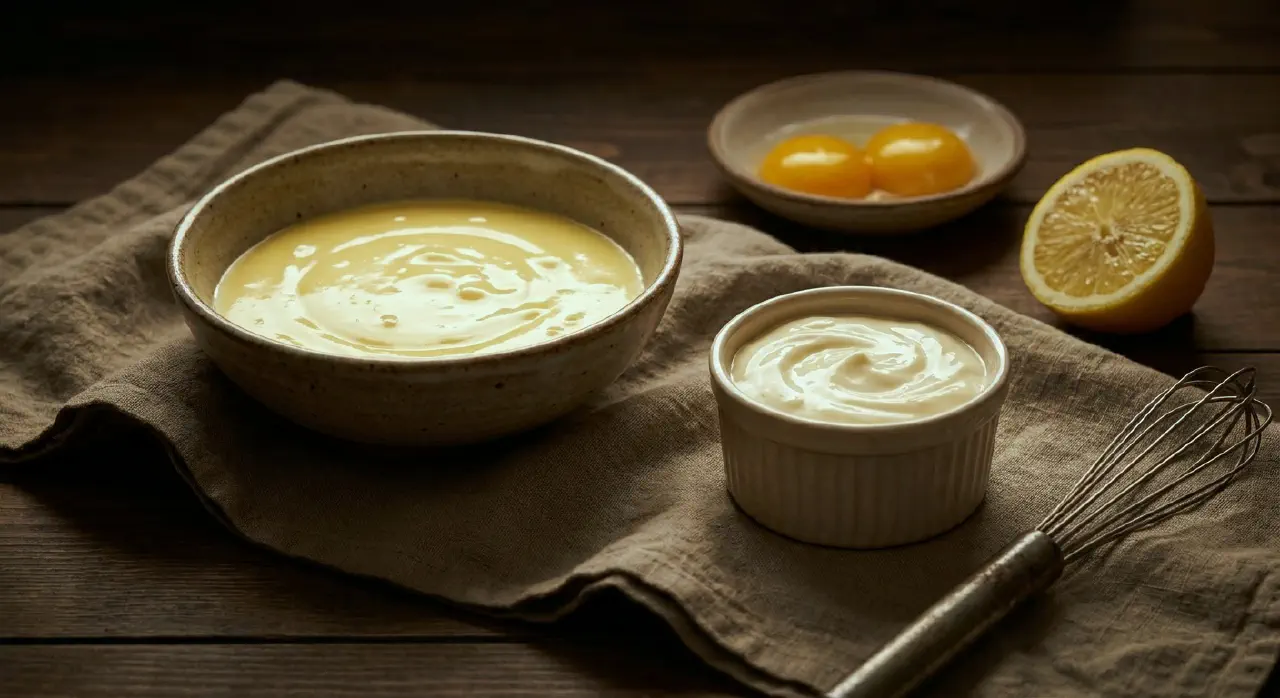
An emulsion is a stable mixture of two liquids that normally refuse to combine - almost always oil and water. Emulsions are everywhere in cooking: milk, cream, butter, mayonnaise, hollandaise, vinaigrettes, and most pan sauces.
How emulsions work
Every emulsion has two phases:
- Continuous phase - the liquid that forms the background. In cream and mayonnaise, this is water. In butter, it’s fat.
- Dispersed phase - tiny droplets (0.1–10 micrometers) suspended within the continuous phase.
Left alone, oil and water separate because oil droplets coalesce - they merge into larger and larger pools until the two liquids are fully separated. Emulsions prevent this through emulsifiers: molecules that are amphipathic (one end loves water, the other loves fat). They arrange themselves at the oil-water interface, coating each droplet in a protective shell that prevents coalescence.
Key emulsifiers in cooking:
- Phospholipids (lecithin) - abundant in egg yolk, the most powerful culinary emulsifier
- Proteins - egg white proteins, casein in milk
- Mustard seed compounds - why a dab of mustard stabilizes vinaigrette
Stabilizers work differently - they thicken the continuous phase so droplets can’t move around and collide. Gelatin, starch, and proteins all serve this role.
Oil-in-water vs. water-in-oil
The two emulsion types behave very differently:
Oil-in-water (cream, milk, mayonnaise): Water is the continuous phase. These feel watery on the tongue and mix with water-based liquids. Cream sauces, hollandaise, and most vinaigrettes are this type.
Water-in-oil (butter): Fat is the continuous phase. These feel fatty and repel water. Butter is the most important culinary example - churning inverts cream’s oil-in-water emulsion into butter’s water-in-oil emulsion.
Rules for successful emulsion sauces
- Enough emulsifier. One egg yolk can emulsify about 150 ml (5 oz) of oil. Exceed this and the emulsion breaks.
- Add oil slowly at first. Drop by drop until the emulsion thickens - this gives emulsifier molecules time to coat each new droplet.
- Acid helps. Vinegar or lemon juice activates emulsifiers and creates conditions favoring stability.
- Temperature matters. Cold for mayonnaise, carefully controlled warmth for hollandaise. Overheated egg proteins coagulate and lose their emulsifying power.
- Mechanical energy. Vigorous whisking or blending breaks oil into finer droplets.
When emulsions break
A broken emulsion suddenly thins, turns slick, and separates into pools of oil. This happens when emulsifier molecules are overwhelmed (too much oil added too fast) or when proteins coagulate from overheating.
Rescue methods:
- Mechanical: Throw the broken sauce in a blender. Works if emulsifier molecules are still intact.
- Chemical (more reliable): Start fresh with a small amount of the continuous phase plus a new egg yolk, then gradually whisk the broken sauce into it.
For butter-based sauces like beurre blanc, separation happens above ~135°F/58°C. A splash of cool water and vigorous whisking can often rescue it, since the phospholipids in butter’s water phase tolerate heat well.
Cream as a natural emulsion stabilizer
Heavy cream’s fat globules (38% fat content) and proteins make it a remarkably stable emulsion - it can withstand boiling. Reduced by one-third, cream reaches ~55% fat globule concentration and thickens to sauce consistency. Crème fraîche achieves similar thickness through fermentation rather than reduction, with a fresher flavor and less richness.
One important caveat: light cream and sour cream curdle when cooked with acid (wine, vinegar) because their casein proteins are acid-sensitive at high temperatures. Heavy cream and crème fraîche contain less casein and handle acid cooking much better.
See also
- butter - the most important water-in-oil emulsion in cooking
- eggs - the cook’s primary emulsifier source
- protein-denaturation - why overheating breaks egg-based emulsions
- seed-biology - seed oil bodies are phospholipid-stabilized emulsions, structurally parallel to milk fat globules
- nuts - nut milks (oil-in-water emulsions preserved by soaking before grinding); nut butters (inverted, oil-continuous)
- emulsion-sauces - mayonnaise, hollandaise, beurre blanc, vinaigrettes
- pan-sauces - butter enrichment as a finishing emulsion technique
- condiments - mustard as emulsifier, vinaigrettes as cold emulsion sauces
- lipid-chemistry - triglyceride structure, hydrophobia, phospholipid emulsifiers
- water-science - hydrogen bonding, the polar molecule fats cannot mix with