Cream
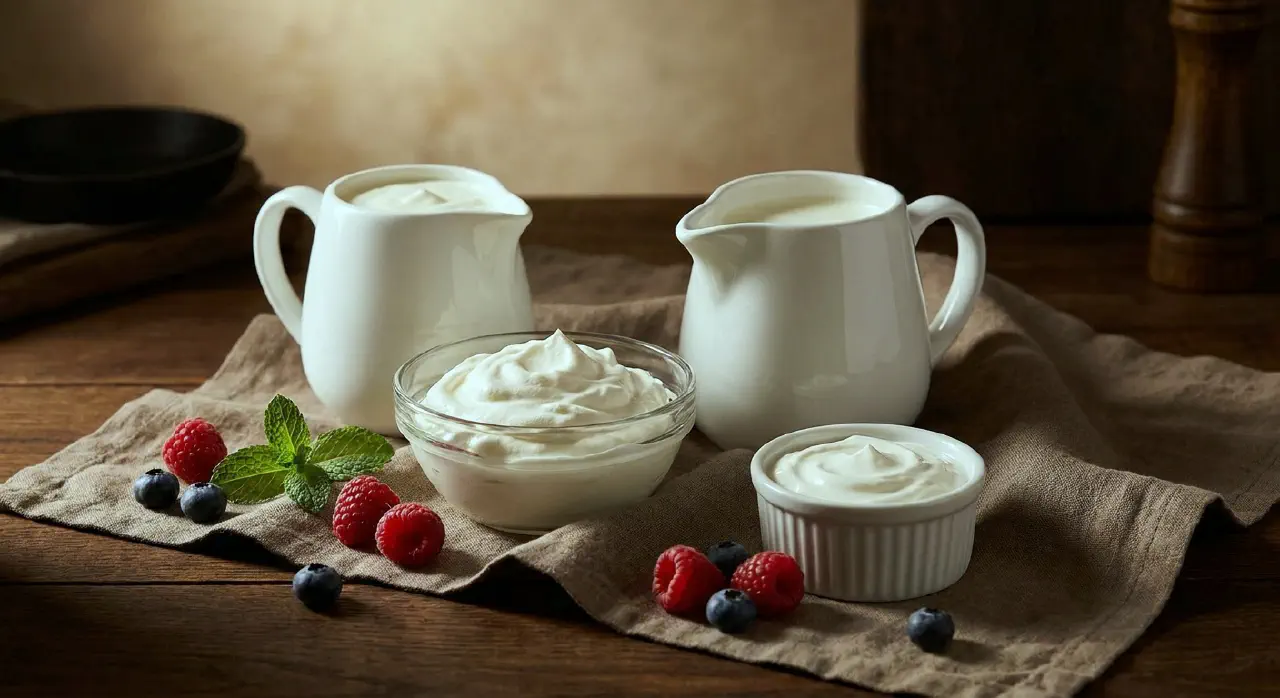
Cream is the fat-enriched portion of milk - the same emulsion, just with more fat globules per unit of water. This concentration is what gives cream its heat stability, whipping ability, and unmatched utility in sauce-making.
Types by fat content
The fat percentage defines what cream can do:
- Half-and-half (10–20% fat): Borders between milk and cream. Cannot whip. Curdles more easily than heavier creams.
- Light/whipping cream (30–36% fat): Can whip to soft peaks. Adequate for many sauces.
- Heavy/whipping cream (36–40% fat): The kitchen workhorse. Whips to stiff peaks. Survives boiling, reduction, and acidic ingredients.
- Double cream (40–48% fat): Very rich, whips to very stiff peaks. Clotted cream (55%+) is an extreme - cream heated slowly to 180°F/82°C until a thick layer of coagulated protein and concentrated fat forms on the surface.
Whipping science
Whipping cream is an exercise in controlled emulsion disruption. When a whisk incorporates air:
- Fat globules cluster around each air bubble, their MFGM membranes partially disrupting and bonding to each other.
- Denatured proteins from the milk reinforce the bubble walls.
- As more air enters, volume increases (overrun: 100–200%).
Temperature is critical: cream must be cold (35–40°F/2–4°C) so that fat is semi-solid and can form a rigid film around bubbles. Room-temperature cream whips poorly or not at all.
Stages: Soft peaks (loose, wispy), medium peaks (hold shape but droop), stiff peaks (sharp points). Beyond stiff peaks, continued whipping ruptures globule membranes completely and fat coalesces - you’ve made butter.
Whipped cream is inherently unstable. It begins weeping within 2–4 hours as bubbles break and water separates. Stabilizers (gelatin, a small amount of starch, or folded meringue) extend its life.
Heat stability: why cream doesn’t curdle
Heavy cream is the most heat-stable dairy product. It can be boiled, reduced, and combined with wine or citrus without curdling. The reasons:
- Fat globules buffer proteins - the sheer density of fat globules shields casein from acid and heat.
- Less casein relative to fat - cream has proportionally less of the acid-sensitive casein per volume than milk.
- MFGM proteins reinforce stability - the fat globule membrane proteins help maintain the emulsion under stress.
This is why cream sauces work with wine and sour cream doesn’t. Sour cream is only 18–20% fat - not enough fat to protect its casein from acid-induced curdling at high temperature. Crème fraîche (35–48% fat) handles heat much better for the same reason.
Cream in sauce-making
Reduction: Boiling heavy cream concentrates fat globules by evaporating water. Reduced by one-third (~55% fat concentration), cream reaches the consistency of a light starch-thickened sauce. Reduced by half (~75% concentration), it’s nearly semi-solid. Quick and rich, but produces a cooked flavor.
Crème fraîche achieves similar thickness through fermentation rather than reduction - lactic acid bacteria thicken the cream by causing casein proteins to cluster into a network. The result is less rich, fresher-tasting, and tolerant of high heat (unlike sour cream).
Mounting: Whisking cold cream into a hot pan sauce creates a quick emulsion - the fat globules disperse, thicken, and add glossy richness.
See also
- milk - cream’s parent liquid, and the science of casein vs. whey
- butter - what happens when cream is churned past the whipping stage
- emulsions - cream as a naturally stabilized oil-in-water system
- yogurt-and-fermented-dairy - crème fraîche and sour cream as fermented creams
- pan-sauces - cream and crème fraîche as finishing enrichments
- sauce-making - cream reduction as a thickening strategy
- emulsion-sauces - cream’s stabilizing role in beurre blanc