Butter
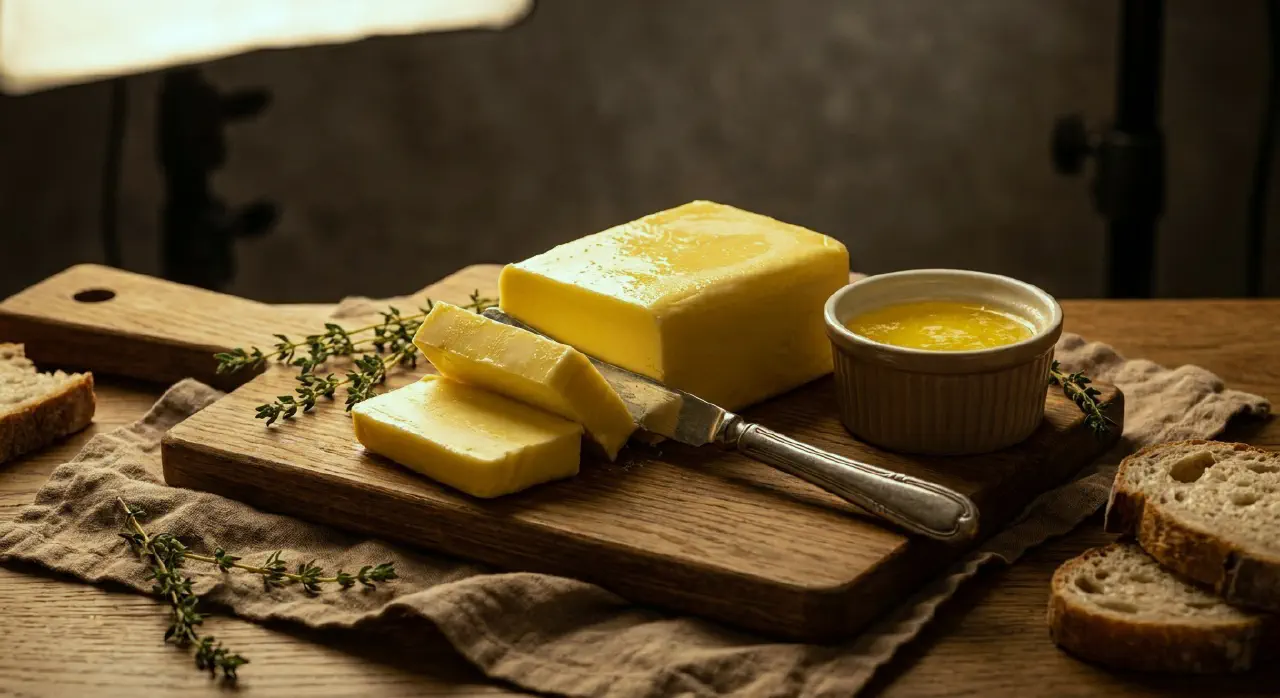
Butter is an inverted emulsion - cream turned inside out. Where cream suspends fat droplets in water, butter suspends water droplets in fat. This inversion, achieved by churning, gives butter its unique properties: solid enough to handle at room temperature, melting on the tongue at body temperature, and capable of both enriching and structuring everything from sauces to pastry.
Composition
- Fat: 80–82% (American standard) or 82–86% (European/continental)
- Water: 15–17%
- Milk solids: 1–2% (proteins, lactose, minerals)
- Salt: 0–2% (when added)
The fat is highly saturated (~60–70%), courtesy of rumen microbes that convert unsaturated fatty acids from the cow’s diet into saturated forms. This is why butter is solid at room temperature - its melting point is 90–95°F/32–35°C, right around body temperature.
Churning: how butter forms
Churning is violent agitation of cream at 50–60°F/10–16°C. The mechanical force ruptures fat globule membranes, allowing the fat to coalesce into a continuous mass while water droplets become trapped inside. The liquid drained off is buttermilk - historically a thinner, richer product than the cultured buttermilk sold today.
Temperature is critical: too warm (above 65°F/18°C) and the fat is too fluid for membranes to rupture; too cold (below 45°F/7°C) and the fat is too hard.
Butter flavor
Fresh butter’s flavor comes from residual lactose, minerals, and volatile compounds from the cow’s diet (grass-fed butter has more varied aromatics than grain-fed). Cultured butter - made from cream fermented by lactic acid bacteria - gets its distinctive tang from diacetyl and other fermentation byproducts.
Butter absorbs odors readily and should be stored wrapped, away from strong-smelling foods.
Clarified butter and ghee
Removing butter’s water and milk solids produces clarified butter (~99.5% pure fat). The process: melt slowly at ~190°F/88°C, let solids sink, skim or pour off the clear fat.
Ghee takes clarification further - the milk solids are browned at 200–220°F/93–104°C before filtering, producing nutty, caramel-like flavors through the maillard-reaction. Ghee has a higher smoke point (375–400°F/190–204°C), keeps for months without refrigeration, and is foundational in Indian and Middle Eastern cooking.
The tradeoff: clarified butter and ghee have less “buttery” flavor than whole butter because the milk solids - which contribute to browning and aroma - have been removed (or transformed, in ghee’s case).
Butter in cooking
Sauces: Butter emulsifies sauces when whisked in cold, piece by piece (mounting). Beurre blanc - butter whisked into a wine/vinegar reduction - relies on the phospholipids in butter’s water phase, which can emulsify 2–3x the surrounding butterfat. Temperature must stay below ~135°F/58°C or the emulsion breaks.
Brown butter (beurre noisette): Whole butter heated until the water boils off and milk solids undergo Maillard browning, producing a nutty aroma. A simple technique that transforms butter from a background fat into a sauce.
Baking: Butter’s plasticity - solid at room temperature, easily worked - makes it essential for laminated doughs (croissants, puff pastry). The water content creates steam pockets during baking. Creaming butter with sugar incorporates air, leavening cakes and cookies.
Sautéing: Butter’s smoke point (~350°F/177°C) limits its use at very high heat, but the water content and milk solids promote excellent Maillard browning at moderate temperatures. Browning milk solids at the pan bottom is desirable, not a mistake - unless they blacken.
See also
- milk - butter’s parent liquid, and the fat globule membranes that churning disrupts
- cream - what butter was before churning inverted the emulsion
- emulsions - butter as a water-in-oil emulsion
- maillard-reaction - the science behind brown butter and ghee
- bread-baking - butter’s role in laminated and enriched doughs
- emulsion-sauces - beurre blanc as reconstituted cream, compound butters
- pan-sauces - butter enrichment as finishing technique
- sauce-making - butter’s role across the thickening taxonomy