Cabbage Family
Cabbage Family
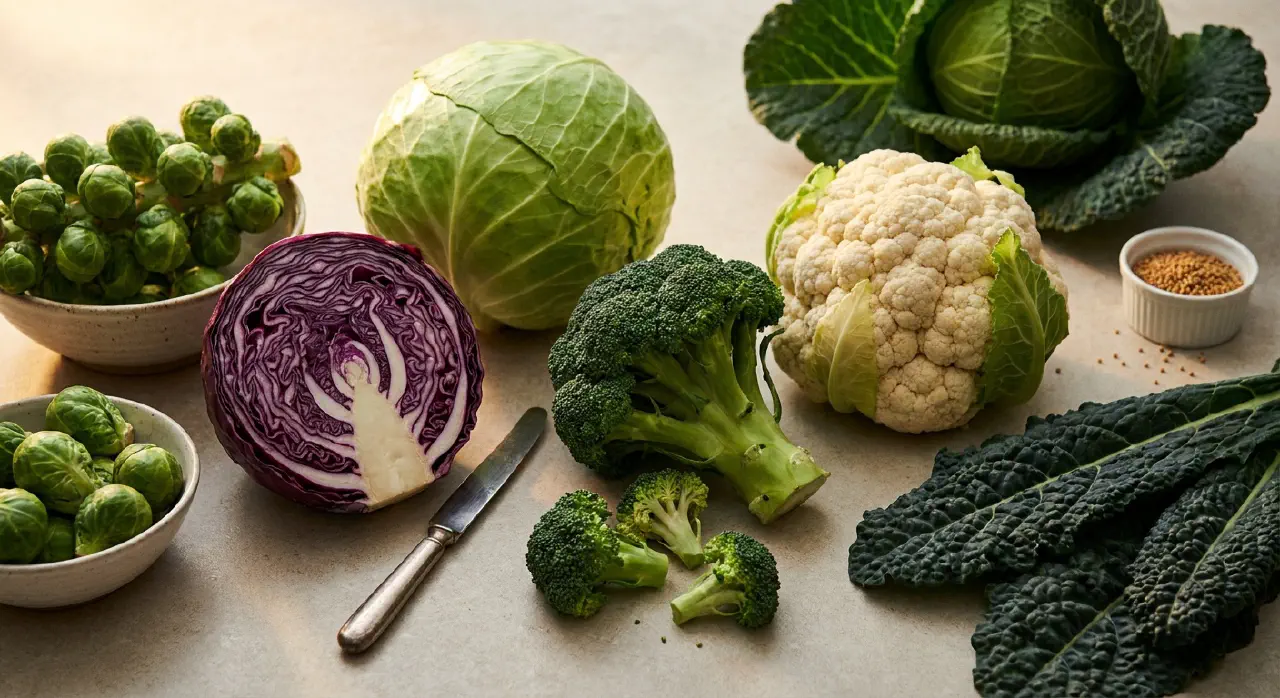
Two weedy Mediterranean and Central Asian natives (Brassica oleracea and B. rapa) have been bred into a dozen or more major crops: leaves (cabbage, kale, collards), flowers (broccoli, cauliflower), stems (kohlrabi), roots (turnip, rutabaga), and seeds (mustard). All share a formidable sulfur-and-nitrogen defense system — glucosinolates — that determines their flavor, their cooking behavior, and their health effects. Understanding glucosinolates is the key to cooking every brassica well.
Flavor Chemistry of Herbs and Spices
Flavor Chemistry of Herbs and Spices
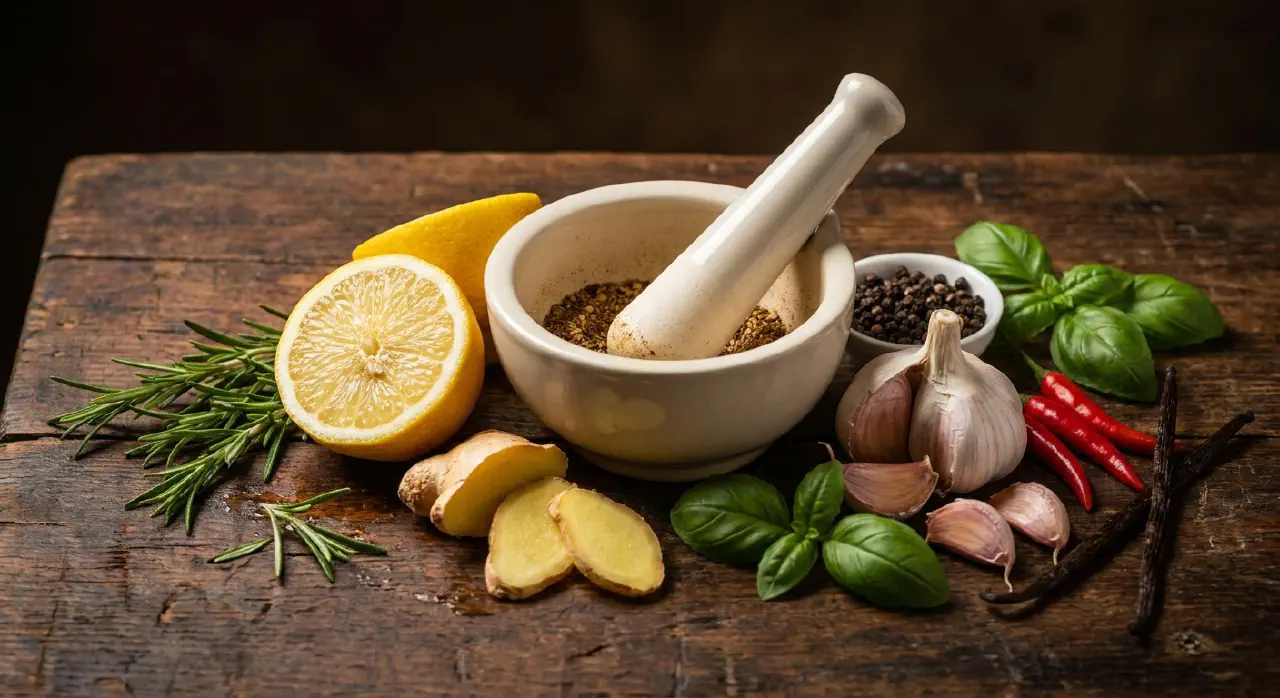
All herb and spice flavors are plant defense chemicals — evolved to repel insects, fungi, and grazing animals. Humans learned to dilute them (a few milligrams in a pound of food) to convert weapons into pleasures. The science of these chemicals explains why some flavors vanish with cooking while others persist, why fat extracts more flavor than water, and why a spice blend can be greater than the sum of its parts.
Plant Flavor
Plant Flavor
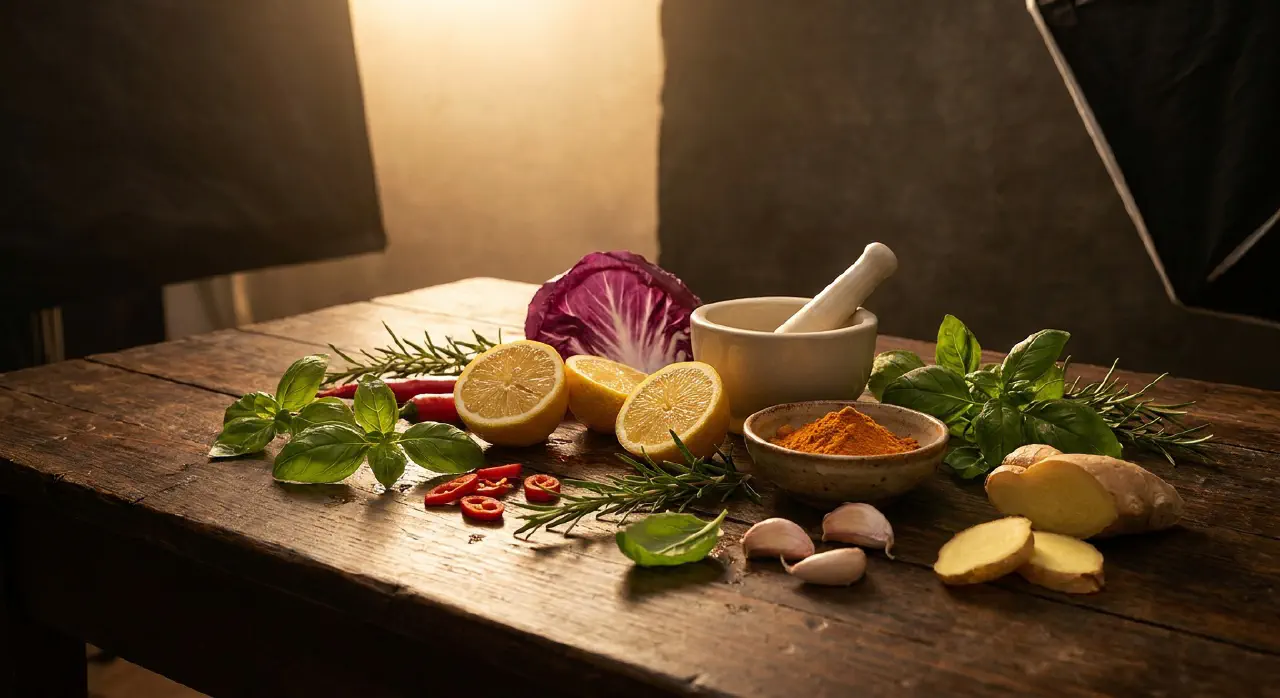
Plant flavor is a composite of four distinct sensory channels: taste (tongue), touch (mouth feel), irritation (pain receptors), and aroma (olfactory receptors). Taste tells you the basic composition — sweet, sour, bitter, savory. Touch reveals astringency. Pain receptors register pungency. And aroma, with its hundreds of volatile molecules, is where the fine discriminations happen — the difference between an apple and a pear, between basil and oregano.
Taste: the basic composition
Sweetness
Sugar is the main product of photosynthesis, so plants are inherently sweet. Ripe fruits average 10–15% sugar by weight. In unripe fruit, sugar is locked away as tasteless starch, then converted to sugar during ripening while acid content simultaneously drops — making the fruit seem even sweeter than the sugar alone would suggest.
Pungent Spices
Pungent Spices
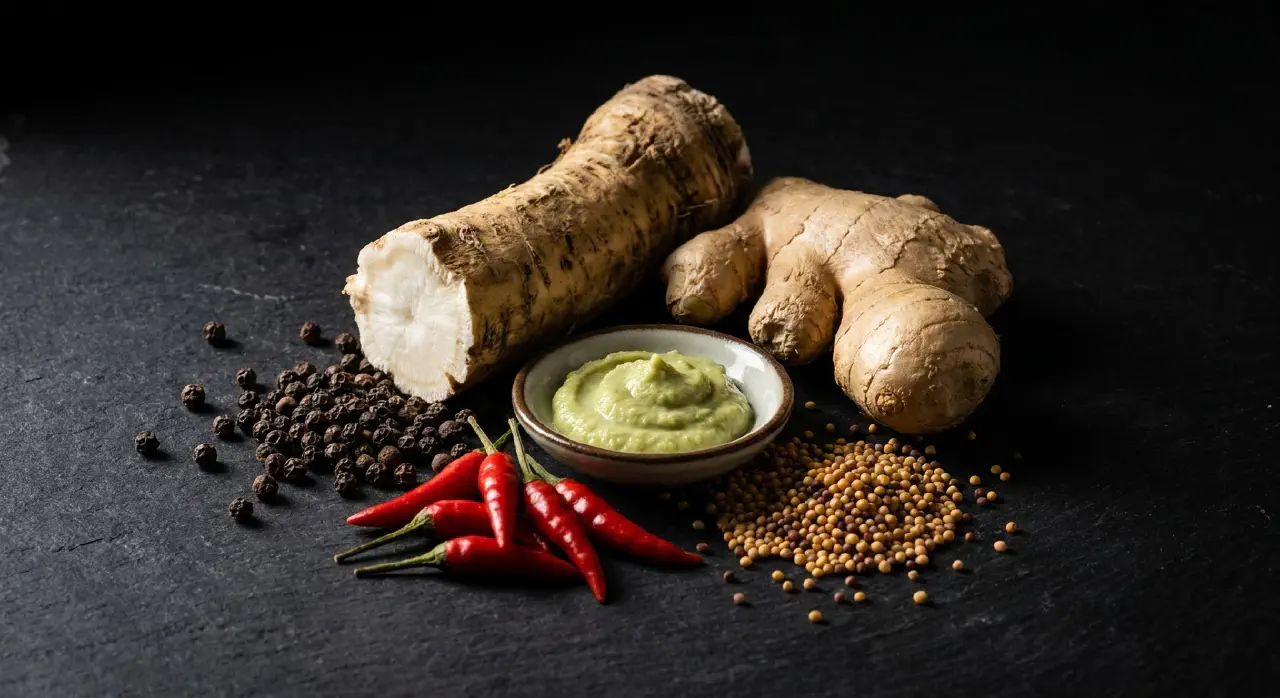
The heat-producing spices — black pepper, chillis, ginger, mustard, horseradish, and wasabi — are defined by compounds that activate pain receptors rather than taste or smell receptors. They divide into two fundamentally different pungency mechanisms: preformed alkyl-amides (pepper, chilli, ginger) that mainly affect the mouth and survive cooking, and enzyme-generated thiocyanates (mustard, horseradish, wasabi) that are volatile enough to irritate the nose and are destroyed by cooking.
Black pepper
The most traded spice from Asia historically, still preeminent in European/North American cooking. Native to tropical southwest India; 3,500+ years of sea and overland trade. Piperine (~100× less pungent than capsaicin) provides moderate heat while a rich terpene profile (pinene, sabinene, limonene, caryophyllene, linalool) gives fresh, citrusy, woody, warm, floral character — making pepper a universal background seasoning like salt.