Pungent Spices
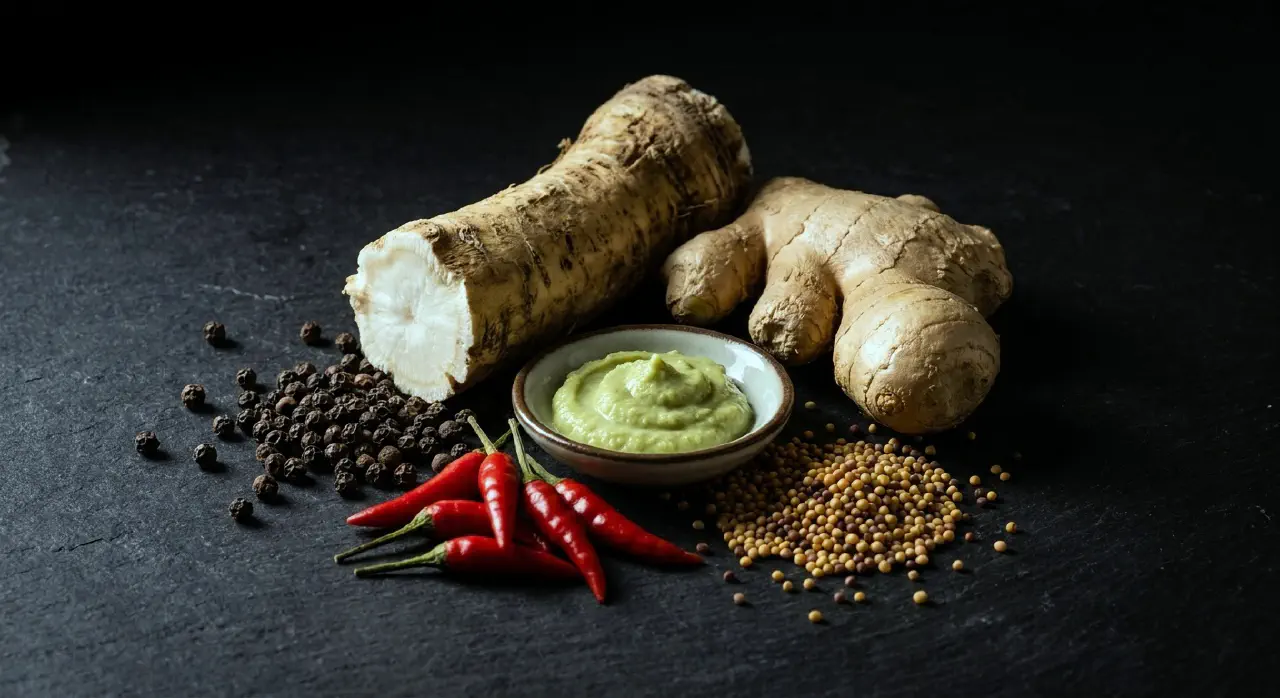
The heat-producing spices - black pepper, chillis, ginger, mustard, horseradish, and wasabi - are defined by compounds that activate pain receptors rather than taste or smell receptors. They divide into two fundamentally different pungency mechanisms: preformed alkyl-amides (pepper, chilli, ginger) that mainly affect the mouth and survive cooking, and enzyme-generated thiocyanates (mustard, horseradish, wasabi) that are volatile enough to irritate the nose and are destroyed by cooking.
Black pepper
The most traded spice from Asia historically, still preeminent in European/North American cooking. Native to tropical southwest India; 3,500+ years of sea and overland trade. Piperine (~100× less pungent than capsaicin) provides moderate heat while a rich terpene profile (pinene, sabinene, limonene, caryophyllene, linalool) gives fresh, citrusy, woody, warm, floral character - making pepper a universal background seasoning like salt.
Processing variants from the same berry: Black pepper - mature but unripe (still green, peak aromatics), blanched, sun-dried (outer layer darkens). White pepper - fully ripe berries soaked a week (fruit layer fermented off by bacteria), dried; provides pungency invisibly in light sauces but lacks much aroma and often carries musty/horse-stable notes from prolonged fermentation. Green pepper - harvested before ripening, preserved by sulfur/dehydration/brining/freeze-drying; includes green-leaf freshness. Pink/poivre rose - just-ripened red berries in brine, rare.
Storage note: Light exposure rearranges piperine to nearly tasteless isochavicine - always store dark. Whole corns in a grinder lose much aroma after a month.
Chillis
The most widely grown spice globally - world production/consumption ~20× black pepper. South American native fruits of the Capsicum genus (~25 species, 5 domesticated). Capsaicin is synthesized only by placenta surface cells inside the fruit (the pale spongy tissue bearing seeds), where it accumulates in droplets just under the cuticle. Maximum pungency occurs around the green-to-color-change transition; capsaicin actually declines as fruit ripens further.
Scoville scale (invented ~1912): Bell pepper 0–600, jalapeño 2,500–10,000, serrano 10,000–25,000, cayenne 30,000–50,000, habanero 80,000–150,000.
Pungency control: Remove placental tissue and seeds to reduce heat. Heat relief is temporary - ice-cold substances cool receptors below activation temperature; solid rough food (rice, crackers, sugar) distracts nerves. Capsaicin is more soluble in alcohol/oil than water, but studies show cold sweetened water is as effective as fatty foods for relief. Pain fades within 15 minutes. Regular exposure produces desensitization lasting 2–4 days.
Dried chillis are far more than stable pungency - drying concentrates cell contents and encourages reactions generating dried-fruit, earthy, woody, nutty aromas (rare complexity among herbs and spices). Smoke-dried Mexican chipotles and Spanish pimentóns add an additional dimension. Rehydrated dried chillis easily puree into smooth sauces (abundant cell-wall pectins cook into smoothness).
Ginger
Pungent, aromatic rhizome of tropical Zingiber officinale (distantly banana-related). Domesticated prehistoric southern Asia; dried form reached the Mediterranean by classical Greek times. One of the most important medieval European spices - gingerbread dates from that era.
The gingerol transformation series: Fresh ginger’s pungency comes from gingerols (least potent of the alkyl-amides). Drying transforms gingerol → shogaol (2× pungent), which is why dried ginger is markedly hotter than fresh. Cooking transforms both → zingerone (only slightly pungent, sweet-spicy aroma), which is why cooked ginger tastes different from fresh or dried. This makes ginger uniquely versatile - the same spice produces three distinct flavor effects depending on processing.
Flavor profile: lemon-juice brightness with fresh, floral, citrus, woody, eucalyptus notes plus mild peppery heat. Regional variation: Chinese (mainly pungent), South Indian/Australian (distinctly lemony from citral), Jamaican (delicate, sweet - considered finest), African (penetrating). Contains a protein-digesting enzyme that can cause problems in gelatin preparations.
Mustard, horseradish, and wasabi
The volatile pungency group - all use the cabbage-family isothiocyanate defense system. Storage forms (irritants bonded to sugar molecules) are bitter but not irritating. Cell damage triggers special enzymes that liberate the irritant molecules and eliminate the bitterness. Unlike chilli/pepper heat, this pungency is volatile enough to irritate the nose - the “head-filling hotness.”
Mustard seeds: Three kinds. Black (Brassica nigra): highest pungency potential from sinigrin; important historically. Brown (B. juncea): hybrid black × turnip, somewhat less sinigrin; makes most European prepared mustards. White/yellow (Sinapis alba): different defensive compound sinalbin with less volatile irritant - mostly mouth-affecting, generally milder; dominates US prepared mustards.
Making mustard: Dry seeds/powder are NOT pungent. Pungency develops when moistened (reviving enzymes that liberate irritant compounds). Acidic liquids (vinegar, wine) slow the enzymes and slow the later disappearance of pungent compounds (gradual oxidation) - stabilizing the heat. Heating drives off the irritant molecules, reducing pungency; usually added at the end of cooking. Ground mustard seeds (~1/3 protein, 1/3 carbohydrate, 1/3 oil) also function as emulsion stabilizers - their particles coat oil droplets in mayonnaise and vinaigrette.
Horseradish (Armoracia rusticana): Large fleshy white roots rich in sinigrin. Volatile irritants reach the airstream aggressively - can cause coughing/choking. Overdose handling: breathe out through the mouth, in through the nose.
Wasabi (Wasabia japonica): East Asian enlarged-stem plant accumulating sinigrin. Fresh grating releases 20+ enzyme-generated volatiles - some pungent, some oniony, some green, some sweet. Most “wasabi” served in restaurants is ordinary dried horseradish powder colored green - similar pungency but little else in common with the real thing.
The psychology of pungency
Psychologist Paul Rozin proposed two explanations for why humans enjoy pain from food. First, “constrained risk” - the edible equivalent of a rollercoaster, where the brain can ignore warning signals it knows aren’t truly dangerous, then releases natural pain-relieving chemicals leaving a pleasant glow. Second, pungent compounds induce temporary mouth inflammation that heightens all sensations - touch, temperature, salt, acid, carbonation, alcohol are all magnified. Chinese hot-sour soup exploits this: hot + acidic + salty, experienced at heightened intensity. The trade-off: strong pungency diminishes sensitivity to true tastes and aroma by usurping brain attention.
See also
- flavor-chemistry - two pungency mechanisms (thiocyanates vs alkyl-amides), phenolic chemistry
- cabbage-family - the isothiocyanate defense system shared by mustard, horseradish, wasabi
- warm-spices - cinnamon, cloves, nutmeg - the non-pungent warming spices
- aromatic-seeds - grains of paradise (ginger-family pungent alternative to pepper)
- spice-handling - storage (pepper light sensitivity), extraction, marinades
- tropical-fruits - papaya contains isothiocyanates like cabbage/mustard