Flavor Chemistry of Herbs and Spices
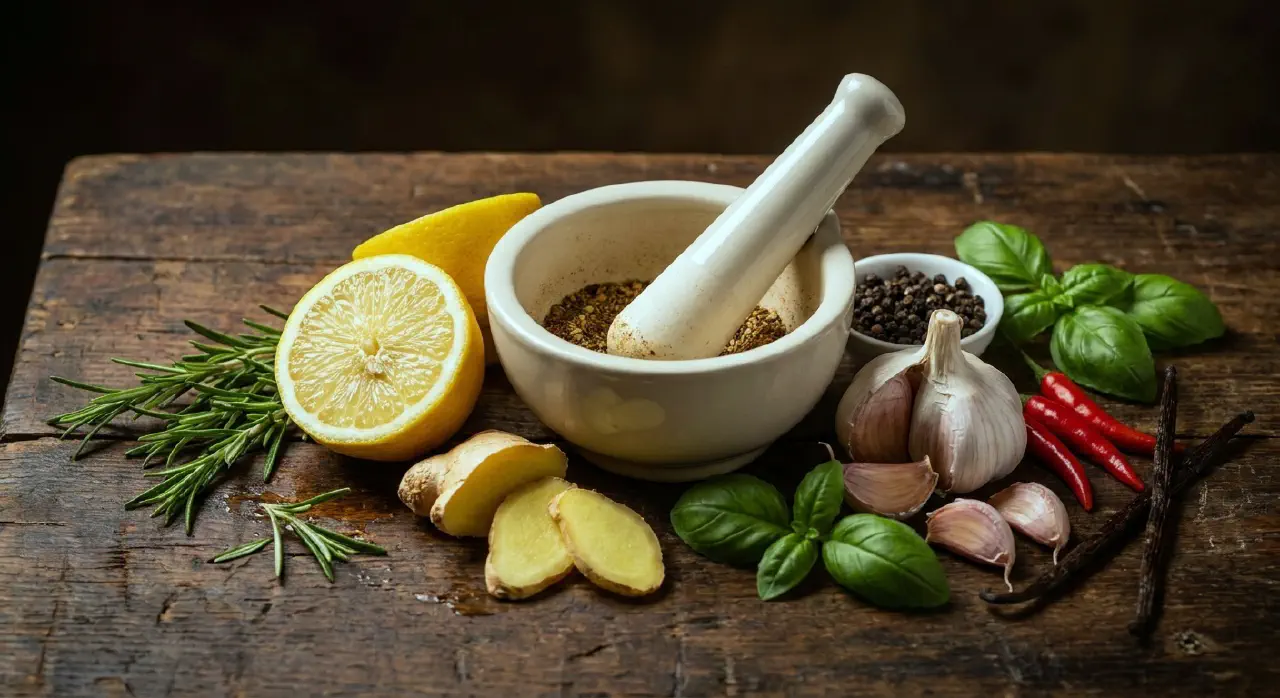
All herb and spice flavors are plant defense chemicals - evolved to repel insects, fungi, and grazing animals. Humans learned to dilute them (a few milligrams in a pound of food) to convert weapons into pleasures. The science of these chemicals explains why some flavors vanish with cooking while others persist, why fat extracts more flavor than water, and why a spice blend can be greater than the sum of its parts.
Essential oils
The traditional term for the flavorful material in herbs and spices. Chemically more similar to oils and fats than to water - more soluble in oil, alcohol, and acetic acid than in water. Plants store them in specialized cells (oil glands, ducts) isolated from their own tissues because the compounds are disruptive or toxic even to the plant itself. Fresh herbs contain ~1% essential oil by weight; dried spices typically 5–10%, with some reaching 15%. Cloves hold the record at ~17% volatile chemicals.
The two chemical families
Terpenes (top notes)
Built from a versatile 5-carbon zigzag building block that can assemble into tens of thousands of different molecules. Terpenes are the most volatile and reactive flavor compounds - the first to reach the nose, providing the “top notes” of fresh, citrusy, floral, pine-like, and leafy character. This same volatility makes them the first to disappear during cooking or storage. Characteristic of coniferous trees, citrus fruits, and flowers.
Key examples: pinenes (pine), limonene and citral (citrus), geraniol (rose), linalool (lily of the valley), cineole (eucalyptus), menthol (peppermint), carvone (spearmint/caraway - the L- and D- mirror forms smell completely different).
In the kitchen: Fresh, light terpene notes vanish with heating but can be restored by adding fresh herb or spice near the end of cooking. This is why a dish benefits from both a long-cooked herb addition and a finishing sprinkle of fresh.
Phenolics (bottom notes)
Built from a closed ring of 6 carbon atoms with at least one oxygen-hydrogen group attached. More water-soluble than terpenes, more persistent in foods and in the mouth. These are the “mid- and bottom notes” - slower to reach the nose, but they define the character of many spices with their warm, penetrating, distinctive aromas.
Key examples: eugenol (clove), cinnamaldehyde (cinnamon), anethole (anise/fennel, 13× sweeter than sugar), vanillin (vanilla), thymol (thyme), carvacrol (oregano), estragole (tarragon).
Pungent phenolics: Capsaicin (chillis), piperine (black pepper), gingerols (ginger) are all phenolic-related compounds that bind to pain receptors.
Two pungency mechanisms
Pungency is pain, not flavor - it uses different receptors from taste and smell. Two completely different chemical systems produce it:
Thiocyanates (mustard, horseradish, wasabi): Small, volatile molecules (a dozen or two atoms) that irritate both nose and mouth. Created only when cell damage mixes enzymes with storage precursors - the same cabbage-family defense system. Cooking inactivates the enzymes, eliminating pungency entirely.
Alkyl-amides (chilli, black pepper, ginger, Sichuan pepper): Larger, heavier molecules (40–50 atoms) that mainly affect the mouth. Preformed in the plant, not released by damage. Bind to nerve receptors causing hypersensitivity. Cooking does not eliminate them - a cooked habanero is as hot as a raw one.
Relative pungency (piperine = 1): gingerol 0.8, shogaol (dried ginger) 1.5, capsaicin 150–300.
Flavor extraction and transformation
Solubility matters: Fats and oils dissolve more aroma molecules than water during cooking and release them slowly during eating (persistent flavor). Alcohol extracts efficiently but releases quickly. Water extractions are slower and less complete. This is why sautéing spices in oil before adding liquid produces deeper flavor than simply simmering them in water.
Heat effects: Increases volatility (aromas escape faster), drives reactive changes, and at higher temperatures triggers Maillard browning reactions that break simple aroma molecules into complex new ones - generating savory pyrazines (the roasted/toasted notes of toasted cumin, roasted coffee, dry-toasted mustard seeds).
Flavor complexity: Herbs and spices contain 5+ major aroma compounds; some have 100+. The perfumery framework helps: top notes (immediate, ethereal, quick-fade - mostly terpenes), mid-notes (main character, persistent), bottom notes (slow-developing, long-lasting - mostly phenolics).
Antioxidant and health properties
Phenolic compounds often have antioxidant activity - oregano, bay leaf, dill, rosemary, and turmeric are the most effective. They prevent both DNA/cholesterol damage in the body and oxidative deterioration of food flavor. Terpenes don’t prevent oxidation but reduce the body’s production of DNA-damaging molecules and help control tumor growth. Moderate, occasional culinary use is safe; daily consumption of concentrated extracts is problematic for some compounds (notably sage’s thujone and licorice’s glycyrrhizic acid).
See also
- plant-flavor - foundational taste, aroma, and pungency science from plant biology
- culinary-herbs - the mint, carrot, and laurel family herbs
- warm-spices - cinnamon, cloves, nutmeg, allspice
- aromatic-seeds - cumin, coriander, saffron, vanilla, and other seeds/tropical spices
- pungent-spices - pepper, chilli, ginger, mustard
- spice-handling - storage, extraction, toasting, the Indian maturation system
- wood-smoke - lignin breakdown producing the same phenolics found in spices
- maillard-reaction - browning reactions that transform spice flavors during toasting