Cabbage Family
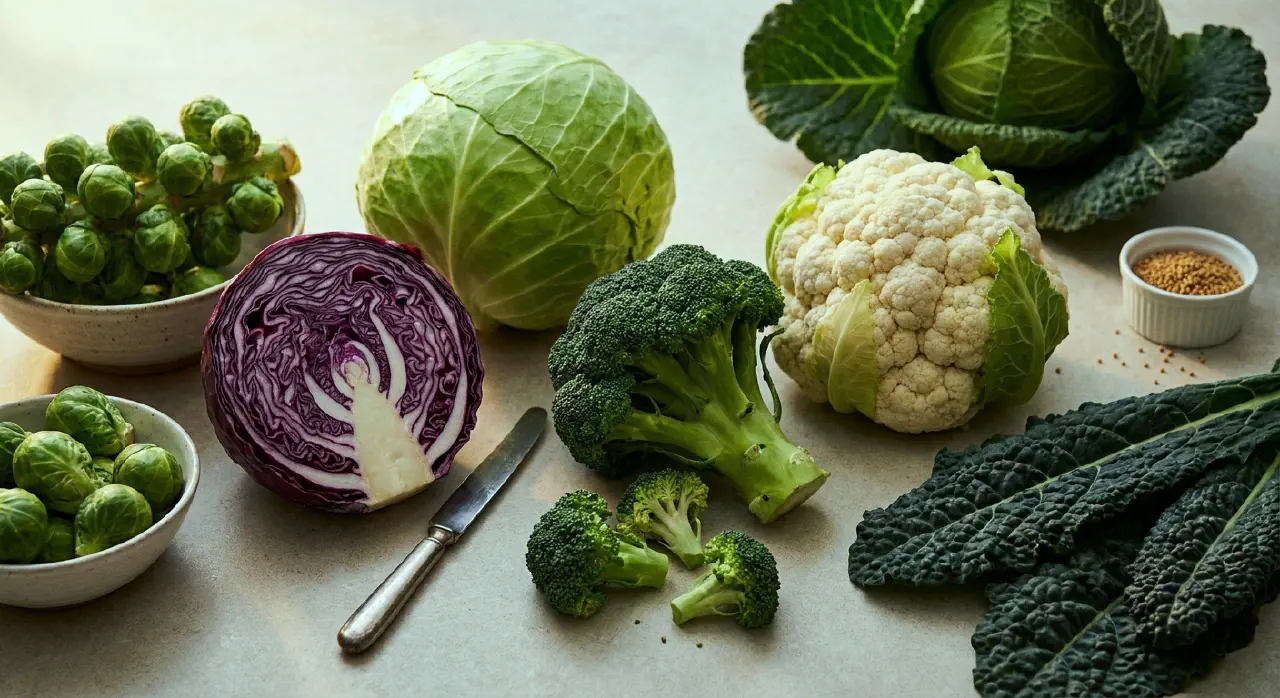
Two weedy Mediterranean and Central Asian natives (Brassica oleracea and B. rapa) have been bred into a dozen or more major crops: leaves (cabbage, kale, collards), flowers (broccoli, cauliflower), stems (kohlrabi), roots (turnip, rutabaga), and seeds (mustard). All share a formidable sulfur-and-nitrogen defense system - glucosinolates - that determines their flavor, their cooking behavior, and their health effects. Understanding glucosinolates is the key to cooking every brassica well.
Glucosinolates: the defense system
Like alliums, brassicas stockpile chemical ammunition and enzymes in separate cellular compartments. Cell damage (cutting, chewing, cooking) mixes them, triggering chain reactions that produce bitter, pungent, strong-smelling compounds - mainly isothiocyanates.
The critical difference from alliums: prolonged cooking makes brassicas worse, not better. Onions sweeten with long cooking; cabbage generates trisulfides that accumulate into the classic overcooked-cabbage stink. This is the single most important cooking distinction between the two great sulfur families.
What affects pungency
Season and growing conditions: Summer heat and drought stress increase glucosinolate stockpiling. Autumn and winter vegetables, grown in cold, wet, dim conditions, are usually milder - one reason brassicas are traditional cold-weather foods.
Tissue age: Young, actively growing tissue is strongest. The center of a Brussels sprout is twice as pungent as its outer leaves. The core of a cabbage concentrates precursors.
Species: Relative glucosinolate levels vary enormously. Brussels sprouts (35) and green cabbage (26) lead; broccoli (17) is moderate; cauliflower (2) is the mildest common brassica.
Health compounds
Some isothiocyanates interfere with thyroid function (a concern only when diet is iodine-poor). Others help dispose of foreign chemicals and appear to protect against cancer development - the same defensive compounds that make brassicas pungent are the ones that make them medicinal.
Cooking strategies
Quick blanching (abundant boiling water, short time): Rapidly inactivates enzymes, leaving many glucosinolate precursors intact. For mustard greens, this minimizes hot pungency but preserves intense bitterness from the precursors themselves.
Boiling in excess water (prolonged): Leaches flavor molecules into the water, producing milder results than stir-frying or steaming. The tradeoff is nutrient loss.
Stir-frying and steaming: Retain more nutrients but also more pungency, since fewer compounds leach away.
Fermentation (sauerkraut, kimchi): Transforms nearly all glucosinolate precursors and products into less bitter, less pungent substances. This is the most thorough flavor moderation technique - see plant-preservation.
Avoid prolonged dry heat: Unlike alliums, extended cooking of brassicas generates increasing amounts of trisulfides - the harsh, lingering, overcooked-cabbage smell. Keep cooking times moderate.
Chopping amplifies everything
Chopping cabbage increases both the liberation of flavor compounds and the production of new precursors. Adding an acidic dressing then increases pungent products sixfold. Mitigation: soak chopped cabbage in cold water to leach away flavor compounds formed by cutting. This also hydrates the leaves, making coleslaw crispier.
The Brussels sprout paradox
Brussels sprouts contain two types of glucosinolates: sinigrin (bitter itself, produces non-bitter breakdown products) and progoitrin (non-bitter, produces bitter breakdown products). Whether you cook quickly (minimizing breakdown product formation) or slowly (transforming all glucosinolates), the result is still bitter. The best mitigation: halve the sprouts and cook in a large pot of boiling water to leach both precursors and products simultaneously.
Cross-family interaction
Brassicas and alliums share related enzyme systems. Adding raw scallion bits to cooked (non-pungent) mustard greens produces a surprising result: the scallion enzymes transform heat-stable mustard precursors into pungent products, making the scallion bits taste more mustardy than the greens themselves.
Individual vegetables
Cabbage, kale, and collards
Heading cabbage stores well for months and often contains more sugar than open-leaved varieties. But open-leaved plants (kale, collards) accumulate more vitamins C and A and more antioxidant carotenoids, since their leaves are exposed to sunlight rather than shielded inside a head. Red cabbage gets its color from anthocyanins.
Broccoli and cauliflower
Both are varieties of cabbage where normal flower development has been arrested. Broccoli arose in Italy and gave rise to cauliflower. Cauliflower’s dense curd is developmentally immature and rich in cell-wall pectins - it purees to an exceptionally fine, creamy consistency but readily turns to mush if overcooked whole. Growers tie leaves over the curd to maintain whiteness. Broccoli rabe is a separate turnip variety, notably more bitter than true broccoli.
Asian cabbages
From B. rapa: bok choy (prominent white midribs, mild), napa (large elongated heads), tatsoi (rosette of rounded leaves), mizuna and mibuna (finely divided feathery leaves that tolerate dressings better than delicate lettuces). Chinese kale/gai lan is a distinct variety of B. oleracea.
Kohlrabi and rutabaga
Kohlrabi is cabbage with a swollen main stem - moist, mild, similar to broccoli stalk. Rutabaga is a turnip-cabbage cross, sweeter and starchier than either parent but still only half the carbohydrate of a potato.
Rocket, cress, and mustard greens
Arugula is especially pungent with a full, almost meaty flavor from aldehydes including benzaldehyde (almond essence). Even brief cooking inactivates its protection-generating enzymes and tames it completely. Mustard greens range from mild to intensely bitter depending on variety.
See also
- alliums - the other great sulfur-defense vegetable family, with opposite cooking behavior
- plant-flavor - glucosinolates as one of several pungency mechanisms
- plant-preservation - fermentation as the most effective brassica flavor moderator
- vegetable-cooking - general cooking principles for plant tissues
- plant-color - anthocyanins in red cabbage, carotenoids masked by chlorophyll in green brassicas
- pungent-spices - mustard, horseradish, wasabi share the isothiocyanate defense system
- tropical-fruits - papaya contains isothiocyanates paralleling brassica chemistry