Coffee
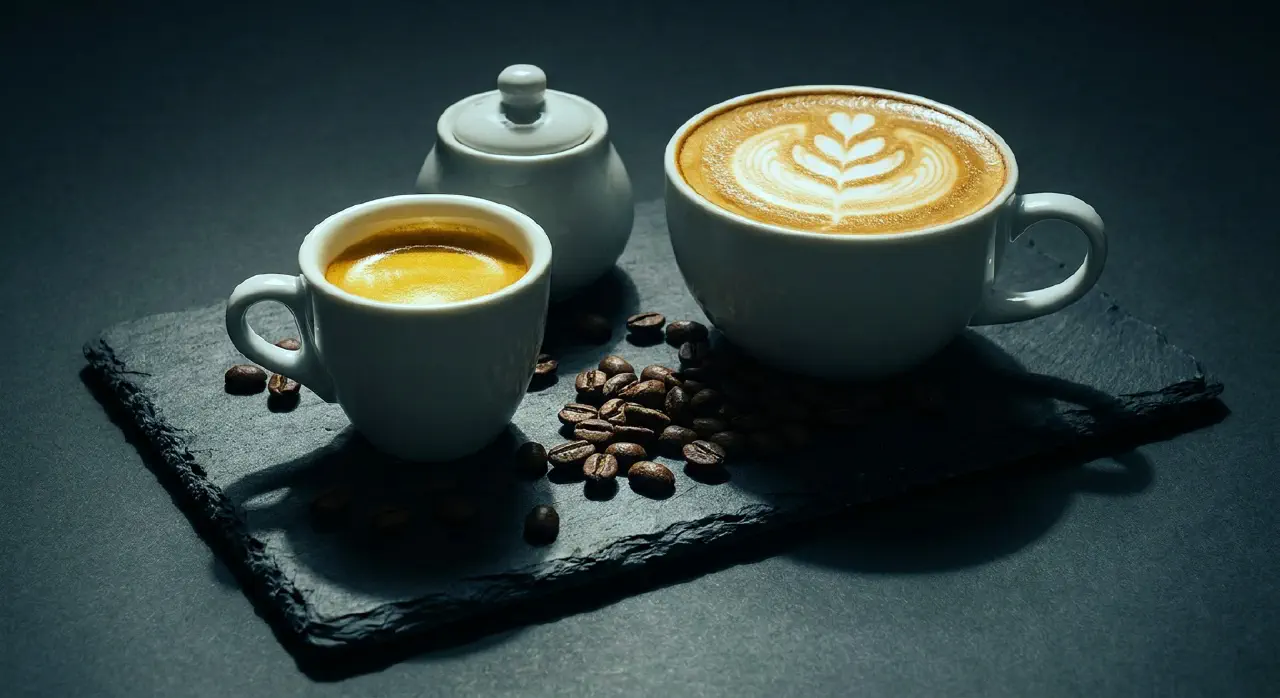
Among foods’ most complex flavors - 800+ aroma compounds identified - coffee owes its richness to an extraordinary chain of transformations: the bean is processed, roasted through intense Maillard browning, ground, and extracted into water, each step shaping the final cup. The central variables are species (arabica vs robusta), roast degree, grind size, and extraction percentage.
Species
Two cultivated species of Coffea, native to east Africa:
Arabica (C. arabica): Highland Ethiopian/Sudanese tree producing roughly two-thirds of world trade. More oil (16%), more sugar (7%), less caffeine (1.5%), less phenolic material (6.5%) - yielding more complex, balanced flavor with pronounced acidity. The specialty coffee standard.
Robusta (C. canephora): Lowland West African tree, disease-resistant, cheaper. More caffeine (2.5%), more phenolics (10%), less oil (10%), less sugar (3.5%). Distinctly less acidic; characteristic smoky, tarry aroma valued in dark roasts and espresso blends. Higher phenolic content means more antioxidant activity but harsher flavor.
Bean processing
Ripe coffee berries are cleaned of fruit pulp by one of two methods:
Dry method: Berries sun-dried whole (sometimes briefly heap-fermented first), then mechanically stripped. Retains more sugars and minerals - fuller body, less acidity.
Wet method: Pulp machine-removed, residue liquefied by brief microbial fermentation, seeds washed and dried to ~10% moisture, inner parchment shell removed. Loses some sugars/minerals (less body, more acidity) but often produces more aroma and more uniform quality - the preferred method for specialty arabicas.
Roasting
Raw beans are hard and nearly tasteless. Roasting at 375–425°F (190–220°C) for 90 seconds to 15 minutes transforms them through a cascade of reactions:
Internal steam puffs beans to half their original volume. Sugars, proteins, and phenolics fragment and recombine through browning reactions, generating brown pigments and roasted aromas. Around 320°F the reactions become self-sustaining. At higher temperatures, CO₂ production rises sharply and oil migrates to the bean surface (visible gloss).
Flavor by roast level: Light brown beans have pronounced tartness from organic acids (citric, malic, formic, acetic). Medium roasts offer the fullest body - acids partially destroyed, bitter browning products moderate, origin character still audible. Dark roasts overwhelm distinctive aromas with generic roast flavor; acids, tannins, and soluble carbohydrates all decline, reducing body and tongue stimulation. This is why dark roasting can mask inferior beans.
Composition shift: Raw → roasted (approximate): water 12→4%, protein 10→7%, carbohydrate 47→34%, phenolics 6→3%, large brown aggregates (color and body) 0→25%. Weight loss ranges from 12% (lightest) to 20% (darkest).
Grinding
The goal is consistent particle size appropriate to the brewing method. Smaller particles expose more surface area for faster extraction, but too wide a particle range means fine powder overextracts (bitter) while coarse pieces underextract (weak). Burr grinders produce more uniform particles than propeller grinders, which smash indiscriminately.
Brewing
Brewing extracts aroma compounds, taste compounds, brown pigments (~⅓ of extract, providing color), and cell-wall carbohydrates (~⅓ of extract, providing body).
The 20% sweet spot: Balanced flavor comes from extracting about 20% of the coffee’s soluble solids. Underextraction (coarse grind, too brief, too cool) produces watery, overly acidic cups. Overextraction (too fine, too long, too hot) produces harsh bitterness from slowly dissolving phenolics and browning pigments. Ideal brewing temperature: 190–200°F (85–93°C).
Espresso is the extreme case: a piston or pump drives 200°F water through finely ground coffee at 9 atmospheres pressure in ~30 seconds. The high pressure forces bean oil into a creamy emulsion of tiny droplets, creating substantial velvety body and intense, lingering flavor. The crema - a remarkably stable foam on the surface - forms from CO₂ trapped in the grounds, stabilized by dissolved carbohydrates, proteins, and phenolic aggregates that hold bubble walls together.
Practical principle: Always use more coffee rather than less. A strong, balanced cup diluted with hot water stays balanced; a weak cup cannot improve.
Storage
Whole beans keep reasonably well at room temperature for a couple of weeks - CO₂ trapped inside helps exclude oxygen. Ground coffee’s vastly increased surface area means a shelf life of only days at room temperature. Freezer storage extends both significantly.
Caffeine and health
Brewed coffee delivers 65–175 mg caffeine per cup (espresso 80–115 mg). Bitterness comes less than one-third from caffeine; the rest is from phenolic compounds and browning pigments that extract more slowly - explaining why overextracted coffee is disproportionately bitter. Medium roasts show the highest antioxidant activity, making brewed coffee a significant dietary antioxidant source. Milk and cream reduce astringency (proteins bind phenolics) but also bind aroma molecules, weakening overall flavor.
Decaffeination
Green beans are soaked in water to dissolve caffeine, which is then removed by solvent extraction (methylene chloride or ethyl acetate), charcoal filtration (“Swiss/water process”), or supercritical CO₂. Result: 2–5 mg caffeine per cup versus 60–180 mg in regular coffee. Flavor is inevitably diminished - the processes also remove some aroma precursors.
Instant coffee
Brewed in two stages - first near boiling (for aroma), then at 340°F under high pressure (for maximum pigment and body extraction). Water removed by spray-drying or freeze-drying (freeze-drying retains more volatile aroma). Valuable as a concentrated dry flavoring in baked goods, confections, and ice creams.
See also
- maillard-reaction - browning reactions that generate roasted aromas and brown pigments
- flavor-chemistry - phenolic compounds, extraction principles, fat vs water solubility
- tea - the other major caffeine beverage, contrasting processing and chemistry
- spice-handling - extraction principles shared with coffee brewing (solubility, timing, temperature)