Tea
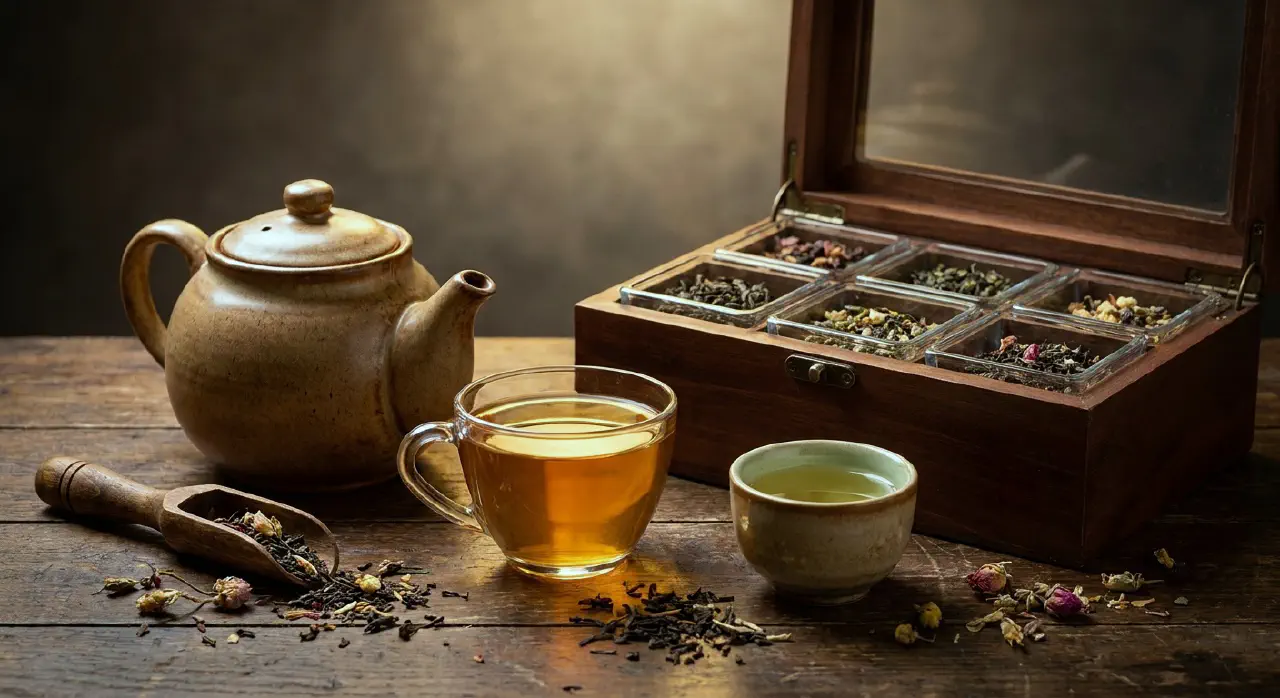
An infusion of the leaves of Camellia sinensis, native to southeast Asia, tea is defined by a single remarkable process: the leaf’s own enzymes transform bitter, astringent defensive chemicals into an enormous range of flavors and colors. The degree of this enzymatic transformation - none (green), partial (oolong), or extensive (black) - determines the tea’s character. Young leaves packed with defensive phenolics and caffeine are the best raw material, which is why the choice pluck is the terminal bud plus two adjacent leaves.
Enzymatic transformation (not fermentation)
Despite universal trade terminology, tea “fermentation” involves no significant microbial activity. It is enzymatic transformation driven by the leaf’s own polyphenoloxidase, triggered when rolling or pressing breaks cell structure and exposes phenolics to oxygen. Two transformations occur simultaneously:
Aroma liberation: Fresh leaves hold aroma compounds locked to sugar molecules in non-volatile forms. Cell damage releases enzymes that cleave these bonds, freeing hundreds of volatile aromatics - this is why oolong and black teas have richer, fuller aroma than green tea. 600+ volatile compounds have been identified in black tea.
Phenolic polymerization: The browning enzyme joins small, colorless, bitter, astringent three-ring phenolic compounds into progressively larger complexes. Two phenolics yield theaflavins (yellow to light copper, less bitter but still astringent). Three to ten phenolics yield thearubigens (orange-red, less astringent). Even larger complexes become brown and lose astringency entirely. Oolong transforms ~50% of small phenolics; black tea ~85%. These large complexes, especially caffeine–theaflavin aggregates, also create body by physically obstructing one another and slowing water movement across the tongue.
Major tea styles
Green tea: Leaves heated early to inactivate enzymes, then pressed and dried. Chinese pan-firing produces roasted pyrazine aromas and yellow-green infusion. Japanese steaming preserves grassy, seaweed-like character and green color (dimethyl sulfide contributes sea notes).
Oolong: Withered leaves lightly bruised at edges, rested for hours (edges turn red from localized enzyme action), then pan-fired and gently dried. Light amber brew with distinctive fruity aroma.
Black tea: Withered, rolled repeatedly (~1 hour), rested 1–4 hours for deep enzyme transformation (leaves turn copper-brown, apple aroma develops), then air-dried at ~100°C. About 75% of world tea production.
White tea: Almost exclusively buds, withered 2–3 days, dried without rolling - minimal transformation.
Pu-erh: Green tea that is then moistened and truly microbially fermented in heaps, converting all remaining phenolics to non-astringent complexes and developing complex spicy-clove aroma. The exception to the “no real fermentation” rule.
Prized varieties
Gyokuro and kabusecha (Japan): Shoots shaded under bamboo boxes for two weeks before harvest, developing higher carotenoid content (violet notes) and a unique “covered aroma.” Lapsang souchong: Chinese black tea dried over smoky pine fires - see wood-smoke. Scented teas: Held 8–12 hours alongside jasmine, rose, or other flowers, absorbing their volatiles. Hoji-cha: Japanese green tea roasted at 360°F (180°C), tripling volatile content.
Brewing science
Extraction timing: Caffeine extracts rapidly - more than 75% in the first 30 seconds. Larger phenolic complexes extract much more slowly. A typical 3–5 minute black tea infusion extracts ~40% of leaf solids.
Temperature matters: Oolong and black teas take near-boiling water for relatively brief infusions. Green teas use cooler water (110–160°F / 45–70°C) with longer steeping - this limits bitter phenolic extraction and minimizes chlorophyll damage.
Asian vs Western approach: Western brewing uses a small quantity of tea (a teaspoon per cup), brewed once for several minutes. Asian brewing uses far more leaf (up to a third of the pot volume), rinsed first, then infused briefly multiple times - second and third infusions often offer the most delicate, subtle balance.
Critical rule: Separate liquid from leaves immediately after proper brewing. Continued contact means continued extraction, driving the cup toward harshness.
Tea with additions
Milk: Phenolic compounds immediately bind milk proteins, becoming unavailable to bind mouth surfaces - dramatically reducing astringency. Best method: add hot tea to warm milk (gradual heating reduces curdling risk).
Lemon: Bolsters tartness and adds citrus aroma. Lightens black tea color by altering phenolic complex structure. Alkaline brewing water conversely produces blood-red black tea.
Iced tea: Popularized at the 1904 St. Louis World’s Fair. Normal hot-brewed tea turns cloudy when chilled - caffeine–theaflavin complexes aggregate into visible particles at low temperature. Solution: brew at room temperature or in the refrigerator over several hours, which extracts less caffeine and theaflavin, preventing visible cloudiness.
Caffeine
Tea leaves contain 2–3% caffeine (more than coffee beans at 1–2%), but brewed tea has less caffeine per cup because less leaf weight is used. A cup of tea delivers ~50 mg caffeine versus 65–175 mg for brewed coffee. Theanine, a unique amino acid in tea, provides sweet and savory character and partly breaks down during processing into savory glutamic acid - Chinese green teas additionally contain the savoriness synergizers GMP and IMP.
Culinary uses
Beyond the cup: marinades and cooking liquids, ices and ice creams, steamed foods, and aromatic smoke (Chinese tea-smoked duck exploits tea leaves as a smoke source).
See also
- flavor-chemistry - phenolic polymerization, enzymatic vs thermal flavor development
- coffee - the other major caffeine beverage, contrasting roast-driven vs enzyme-driven chemistry
- maillard-reaction - browning reactions in pan-fired green teas and roasted hoji-cha
- wood-smoke - Lapsang souchong’s pine-smoke drying, tea-smoking technique
- spice-handling - parallels in extraction science (solubility, temperature, timing)