Hops
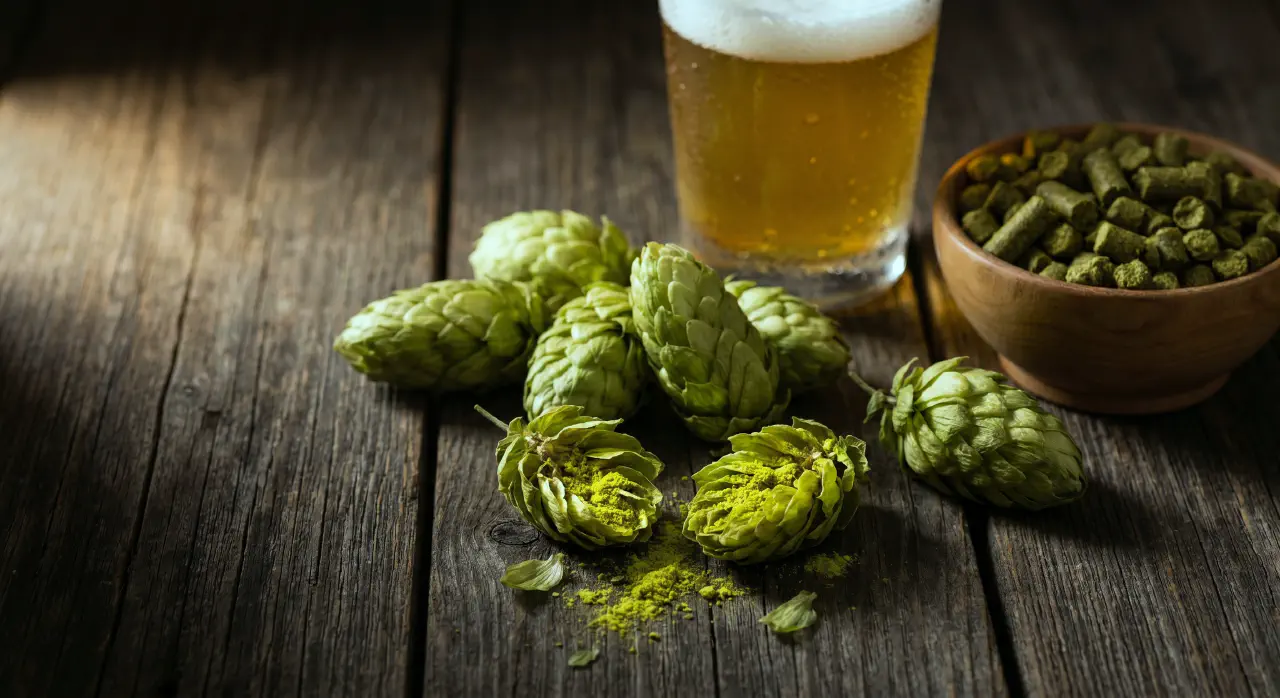
Hops are the dried female flower cones of Humulus lupulus, a climbing plant in the same family as cannabis. They serve two distinct functions in beer: bitterness (from resins that require boiling to become soluble) and aroma (from volatile oils that boiling destroys). These two roles are chemically incompatible - hops added early provide bitterness; hops added late preserve aroma - and this tension shapes how brewers use them.
Alpha acids: the source of bitterness
The yellow glandular powder (lupulin) at the base of each cone contains two classes of soft resins:
Alpha acids (humulone, cohumulone, adhumulone) are insoluble in water in their raw form. During boiling, heat isomerizes them into iso-alpha acids - soluble, stable, and bitter. The conversion is slow: 60–90 minutes of vigorous boiling achieves maximum isomerization (~35% of total alpha acid content). Undisturbed (no rolling boil) or short boils extract far less bitterness. This is why beer brewing calls for extended vigorous boiling rather than a gentle simmer.
Beta acids (lupulone) contribute very little direct bitterness but oxidize over time into bitter compounds - partly explaining why aged hops produce a harsher, less pleasant bitterness.
IBU (International Bitterness Units) measures iso-alpha acid concentration in finished beer (1 IBU = 1 mg/L). A mass-market lager sits around 10–15 IBU; a pale ale 30–50 IBU; an Imperial IPA 70–100+ IBU. Above ~70 IBU, the human threshold for perceiving added bitterness is saturated - more hops do not produce proportionally more perceived bitterness.
Aroma compounds
Hop aroma comes from terpenes and esters in the essential oil - a complex mixture that varies significantly by variety:
| Compound | Character | Associated varieties |
|---|---|---|
| Myrcene | Resinous, piney, herbal | Most hops; highest in fresh whole-cone |
| Humulene | Woody, noble, subtle | European “noble” hops (Hallertau, Saaz) |
| Linalool | Floral, citrus, lavender | American Cascade, Citra |
| Geraniol | Rose, citrus | Some US and NZ varieties |
| β-Pinene | Pine, fresh | Simcoe, Centennial |
| Limonene | Lemon, citrus | American hop varieties |
These compounds are highly volatile - boiling drives them off within minutes. Brewers exploit this in two ways:
Late hopping: Adding hops in the final 5–15 minutes of the boil retains aroma but extracts minimal bitterness.
Dry hopping: Adding hops to cold finished beer (or during conditioning), with no heat, extracts aroma compounds into the beer through direct contact. Dry hopping produces the most intense and fresh hop character - essential in modern New England IPAs and many pale ales. Contact time is typically 2–5 days; longer contact can introduce grassy, onion-like notes from autolysis of hop material.
Hop varieties
Hundreds of named varieties exist, broadly grouped by origin and use:
Noble hops (Hallertau, Saaz, Spalt, Tettnang): Central European varieties with low alpha acid content (3–5%) and delicate, spicy, floral aroma. The defining character of German and Czech lager traditions.
English varieties (Fuggles, East Kent Goldings): Earthy, herbal, woody character. Lower alpha acid. Traditional for British ales.
American varieties (Cascade, Centennial, Chinook, Citra, Simcoe): Higher alpha acid (6–15%+), intense citrus, pine, tropical fruit, or resinous character. Drove the craft beer revolution.
New Zealand / Australian varieties (Nelson Sauvin, Galaxy, Motueka): Distinctive tropical and white wine notes from high geraniol and linalool content. Increasingly used in modern pale ales.
Hop form
Whole cone (pellet-free): Traditional, produces the smoothest aroma. Requires more storage space; pellets have largely replaced them commercially.
Pellets (T-90, T-45): Dried hops ground and compressed. More stable, better utilization (the cell walls are broken, releasing resins more easily), easier to handle. The dominant commercial form.
Extracts: CO₂-extracted alpha acids or oils added directly to beer. Used in commercial brewing for precise bitterness control without the variability of whole hops.
See also
- beer-brewing - the four-stage brewing process; how hops fit into mashing, boiling, and fermentation
- fermentation-overview - yeast and the production of flavors that interact with hop bitterness and aroma
- flavor-chemistry - terpene chemistry; how aroma molecules are perceived
- aromatic-seeds - other plant-derived flavoring agents with similar terpene chemistry