Aromatic Seeds and Tropical Spices
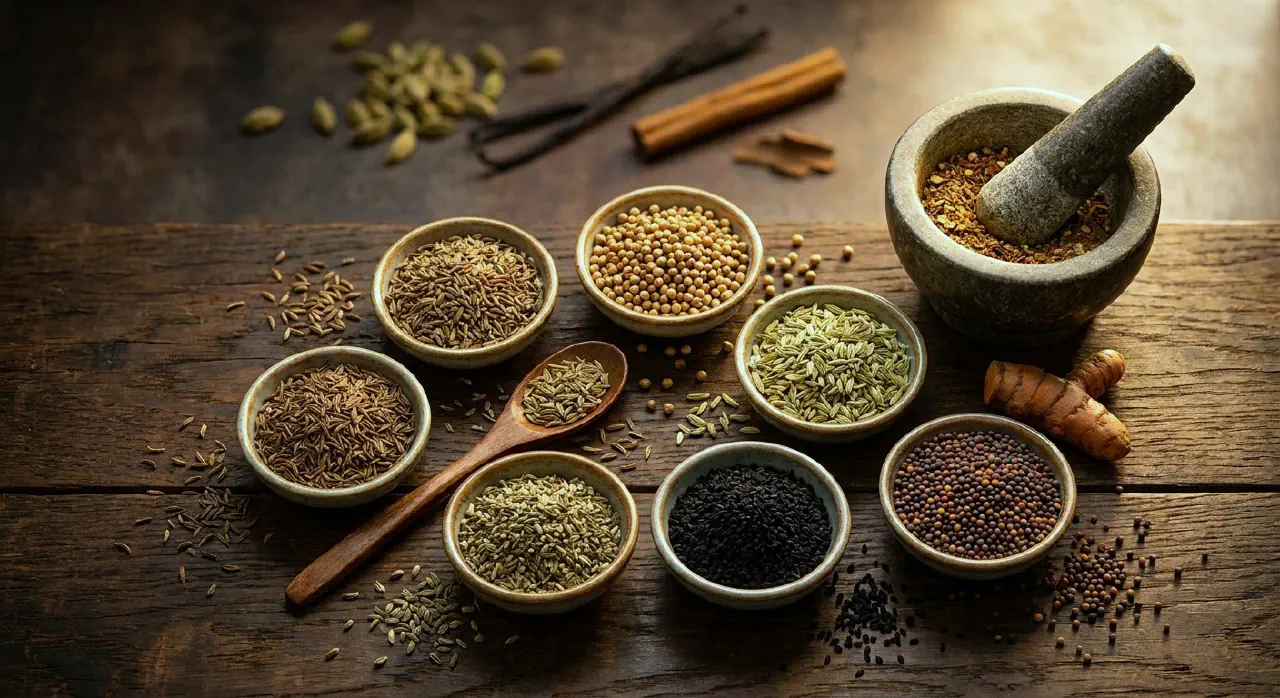
A diverse group united by the fact that the flavoring comes from seeds, roots, rhizomes, stigmas, or pods rather than leaves or bark. Includes the workhorses of Indian, Middle Eastern, and Latin American spice blends (cumin, coriander, cardamom), the world’s two most expensive spices (saffron, vanilla), and several of the most chemically unusual flavorings in the kitchen (asafoetida, fenugreek).
Carrot family seeds (Apiaceae)
Seeds with distinctive ridged surfaces containing aromatic oil in canals beneath the ridges. Many of these plants also provide culinary herbs from their leaves.
Cumin (Cuminum cyminum): Southwest Asian native. Distinctive cuminaldehyde (related to bitter almond essence) plus fresh, pine notes. Greeks kept it at the table in its own box (like pepper today). Largely disappeared from European cooking in the Middle Ages, but Spanish colonists established it in Mexico. Now marks the foods of North Africa, western Asia, India, and Mexico. Black cumin (C. nigrum) is a different species - darker, more complex aroma, less pungent.
Coriander seed (Coriandrum sativum): Entirely different from the fresh leaf (cilantro). Valued since ancient times for its irreplaceable floral, lemony oil - unique in the cook’s arsenal. Often paired with cumin as the backbone of Indian dishes. European type (small, high linalool/flowery) differs from Indian type (larger, lower oil, different aromatics). Ground with the husk, the brittle fiber absorbs water and thickens curry liquids. Coarsely cracked, it provides crunchy insulation coating meats.
Anise (Pimpinella anisum): Central Asian native prized for its remarkably high anethole content - a phenolic that is both aromatic and 13× sweeter than sugar. Unusual among phenolics for being pleasant even at high concentrations. Mainly flavors sweets and alcohols (Pernod, pastis, ouzo). The “clouding phenomenon” when diluting anise liqueurs: anethole dissolves in alcohol but not water, so adding water causes molecules to cluster into light-scattering bunches.
Caraway (Carum carvi): Possibly among the first cultivated spice plants in Europe. Defined by D-carvone (the mirror image of spearmint’s L-carvone - same molecule, completely different smell). Important in Eastern European cabbage, potato, pork dishes; Scandinavian aquavit; breads and cheeses.
Fennel seed (Foeniculum vulgare): Same anethole dominance as anise with citrus/pine support. Italian sausage ingredient, Indian spice mix standard, and the traditional after-meal breath freshener in India. Fennel pollen: collected flower pollen with intensified anise + floral character, sprinkled on Italian dishes at the last minute.
Other carrot family seeds: Dill seed (mildly caraway-like, cucumber pickle standard), celery seed (concentrated phthalide celery note, pickling/sausages), ajwain (thyme essence in a caraway-like seed, Indian use).
Ginger family spices (Zingiberaceae)
Cardamom (Elettaria and Amomum species): World’s third most expensive spice after saffron and vanilla. Herbaceous plant from southwest Indian mountains, hand-harvested pod by pod. Two distinct aroma sets stored below the seed surface: floral/fruity/sweet terpenes (linalool, esters) and penetrating eucalyptus-like cineole. Malabar variety is delicate and flowery; Mysore is pine/woody/eucalyptus. Nordic countries consume 10% of world trade (baked goods); Arab countries 80% (cardamom coffee - gahwa: fresh-roasted coffee with fresh-broken green pods). Large cardamom (Amomum subulatum) from the eastern Himalayas is often smoke-dried with a harsher, camphor-rich character.
Turmeric (Curcuma longa): Dried ginger-family rhizome, domesticated prehistoric India likely for its intense yellow color (Sanskrit root meaning “yellow”). Major pigment curcumin is a phenolic and excellent antioxidant - explaining traditional fish-dusting practice. pH-sensitive: acid = yellow, alkaline = orange-red. Makes up 25–50% of most prepared curry powders. Limited flavor contribution despite prominence: mild woody/earthy terpenes, slight bitterness.
Grains of paradise (Aframomum melegueta): West African ginger relative with mild pungency (gingerol relatives - paradols, shogaols) plus faint woody/evergreen aromatics. Used in Europe from the Middle Ages to the 19th century; now a Moroccan ras el hanout component and interesting black pepper alternative.
Saffron
Dried stigmas of the crocus flower - the world’s most expensive spice, a testament to extraordinary labor (70,000 flowers yield ~1 lb/450 g dried saffron, requiring ~200 hours hand-harvesting). Bronze Age or near-Greece domestication. Today: Iran and Spain are the major producers.
Color: Intense from carotenoid pigments (10%+ of dried weight). The most abundant, crocin, has sugar molecules attached that make it water-soluble - explaining why saffron easily colors rice, stock, and non-fatty foods at 1 part per million.
Flavor: Notable bitterness plus penetrating hay-like aroma from picrocrocin (sugar-hydrocarbon compound, probably insect defense). Drying transforms picrocrocin via enzyme action into volatile safranal, moderating bitterness and developing the characteristic aroma. Use tiny quantities; rehydrate in warm liquid before adding to extract both color and flavor.
Vanilla
Second most expensive spice; the pod fruit of a climbing orchid (Vanilla planifolia) native to Central America, first cultivated by the Totonac Indians of eastern Mexico possibly 1,000 years ago. Aztecs used it in chocolate drinks. 19th-century hand-pollination breakthrough enabled cultivation outside Mexico’s native pollinator range - Madagascar (“Bourbon vanilla”) and Indonesia became the largest producers.
The curing process is what creates vanilla’s extraordinary flavor. Green pods are killed (brief high heat), then alternately sun-exposed and cloth-wrapped (“sweated”) for days - liberating aromatic phenolics from sugar-bonded storage forms while Maillard browning reactions generate additional complexity. Final aging over weeks/months develops fruity esters and new notes. Cured beans: ~20% water, 25% sugars, 15% fat, with 200+ identified volatile compounds - vanillin is the principal one, but alone it suggests only a fraction of whole vanilla’s richness.
Bourbon (Madagascar): finest, richest, most balanced. Indonesian: lighter, less vanillin, sometimes smoky. Mexican: distinctive fruity/winy. Tahitian (V. tahitensis): unique flowery/perfumed, much less vanillin. ~90% of US vanilla flavoring is synthetic vanillin (from wood lignin) - far cheaper but lacking the full complexity.
Other notable spices
Fenugreek (Trigonella foenumgraecum): Small hard legume seed with distinctive sotolon aroma - the molecule responsible for hay, maple syrup, and caramel notes (also in molasses, soy sauce, sherry). Outer cell layer exudes thick mucilaginous gel when soaked (Yemen’s hilbeh sauce). Ethiopian berbere and some Indian curry powders.
Asafoetida (Ferula species): The strangest, strongest spice. Giant carrot plant resin from Central Asian mountains - harvested by repeatedly wounding the root and collecting protective sap. Contains a dozen sulfur compounds identical to onion family volatiles (di-, tri-, tetrasulfides), producing impressions of onions, garlic, eggs, meat, and white truffles. So strong it’s sold ground and diluted with flour. Major use in Indian cooking, especially Jain cuisine (which avoids onion and garlic).
Licorice (Glycyrrhiza glabra): Root containing glycyrrhizic acid, 50–150× sweeter than sugar. Flavors confections, dark beers (porter, stout), and tobacco. Hormone-like structure means daily consumption risks blood pressure disruption.
Sumac: Dried purplish-red berry of a cashew/mango-family shrub. Unusual combination: very tart (malic acid), astringent (4% tannins by weight), and aromatic (pine, woody, citrus). Ground into Middle Eastern and North African dishes.
Nigella (Nigella sativa): Small black angular seeds with a milder, more complex thyme/oregano character plus caraway hint. Across India through southwest Asia, mainly on breads.
See also
- flavor-chemistry - terpene vs phenolic chemistry, anethole sweetness, extraction principles
- culinary-herbs - leaf forms of many plants whose seeds appear here
- warm-spices - cinnamon, cloves, nutmeg, allspice
- pungent-spices - pepper, chilli, ginger, mustard
- spice-handling - toasting, grinding, storage, the Indian system
- alliums - sulfur compounds paralleled in asafoetida
- plant-color - saffron carotenoids, turmeric curcumin
- maillard-reaction - browning reactions in vanilla curing and spice toasting