Sauce Mousseline
Prep 5 min Total 5 min
Sauce Mousseline - kvalifood.com
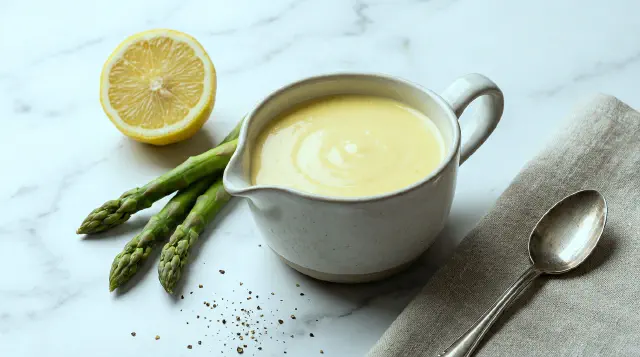
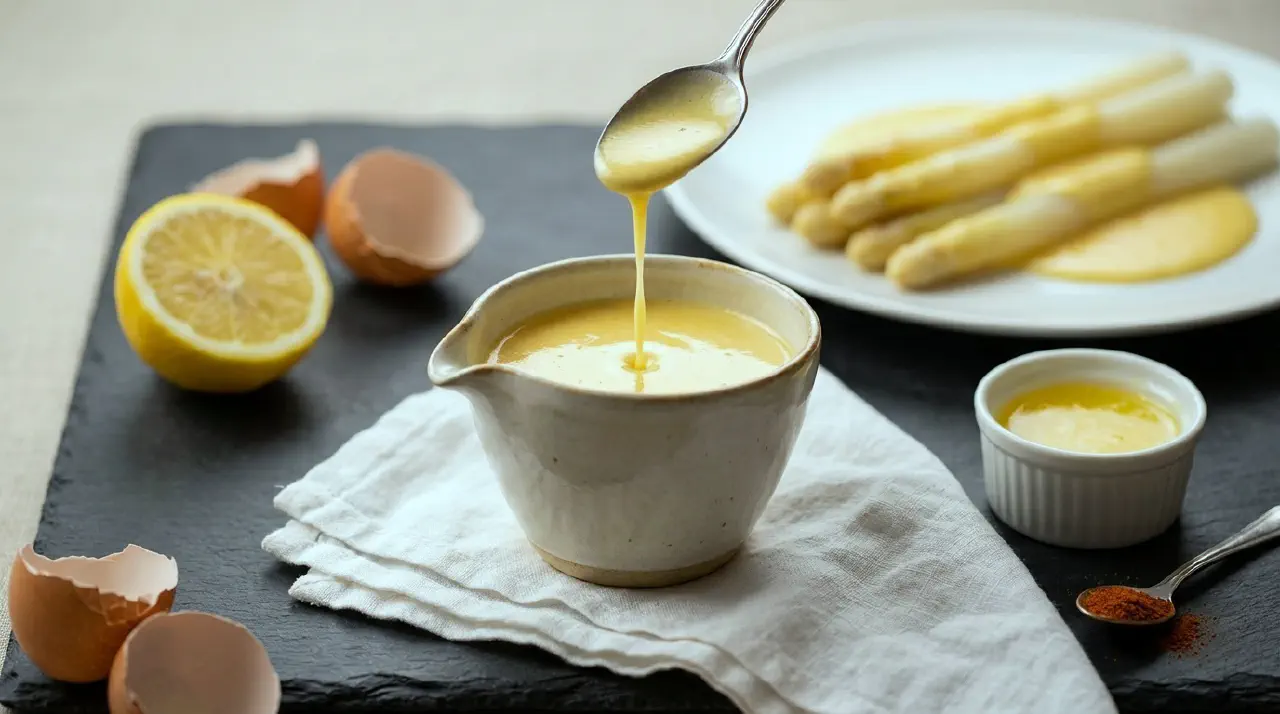
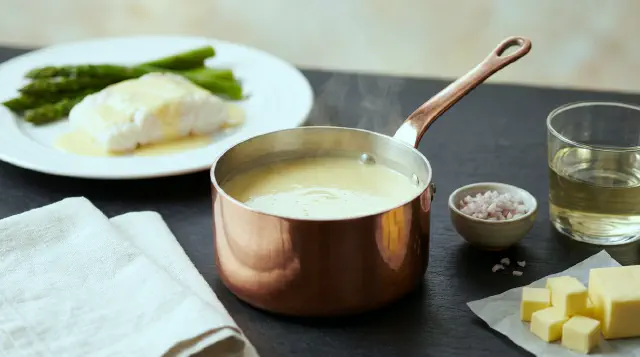
Sauce Mousseline (also called Sauce Chantilly) is a derivative of hollandaise sauce in which whipped heavy cream is gently folded into a finished hollandaise just before serving. The name “mousseline” means muslin in French, referencing the lightness of the sauce.
Serve it with steamed asparagus, poached fish, or delicate vegetables where a lighter touch than straight hollandaise is preferred.
Serves 4, approximately 250 ml sauce
Ingredients
Hollandaise base
- 3 large egg yolks
- 1 tbsp cold water (or dry white wine)
- 175 g clarified butter, warmed to ~55 C (130 F)
- 1 tbsp fresh lemon juice
- 1 pinch fine salt
- 1 pinch cayenne pepper
Mousseline addition
- 80 ml cold heavy cream (min. 36% fat), whipped to soft peaks
Directions
Whip the cold cream to soft peaks in a chilled bowl. Refrigerate until needed.
Set up a bain-marie: place 3-4 cm of water in a saucepan, bring to a bare simmer. Have ready a heatproof bowl that sits on the pan without touching the water.
In the bowl (off the heat), whisk the egg yolks and water (or wine) until combined and slightly frothy, about 30 seconds.
Place the bowl over the simmering water. Whisk continuously for 2-3 minutes until the mixture doubles in volume, turns pale yellow, and reaches the ribbon stage – when the whisk is lifted, the mixture falls back in a thick ribbon that holds its shape briefly.
Remove the bowl from the heat. While whisking constantly, add the warm clarified butter in a thin, steady stream. Start very slowly (a few drops at a time) until the emulsion takes, then increase to a thin stream. Continue until all butter is incorporated. The sauce should be thick and glossy.
Whisk in the lemon juice, salt, and cayenne pepper. Taste and adjust.
Immediately fold in the whipped cream using a rubber spatula. Work gently to preserve the air – a few streaks of cream remaining is better than deflating the sauce.
Serve at once over asparagus, poached fish, eggs Benedict, or steamed vegetables.
Notes
- Clarified butter is preferred because it contains no milk solids or water, which makes the emulsion more stable and the flavor cleaner. To clarify: melt butter gently, skim foam, pour off clear yellow fat, discard milky solids.
- Temperature control is the main challenge. If the sabayon gets too hot, the yolks scramble. If the butter is too cool, the emulsion breaks. Aim for warm-to-the-touch throughout.
- If the sauce breaks: whisk a fresh yolk with 1 tsp water in a clean bowl, then slowly whisk in the broken sauce. It should re-emulsify.
- Cream ratio: 80 ml cream to 175 g butter (ratio ~0.46) gives a noticeable but not overwhelming lightness. For a more traditional Escoffier-style sauce, reduce to 60 ml (~4 tbsp). For a lighter, more modern version, increase to 120 ml.
- Do not hold this sauce. Unlike plain hollandaise, which can be kept warm for a short time, the whipped cream deflates and the sauce loses its point within minutes.
See Also
Aioli (Traditional Provencal Garlic Emulsion)
Bearnaise Sauce
Beurre Blanc (White Butter Sauce)
Sauce Bordelaise