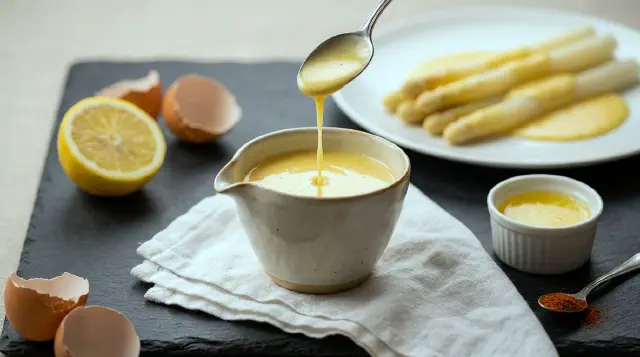
Hollandaise Sauce
Prep 15 min Total 15 min
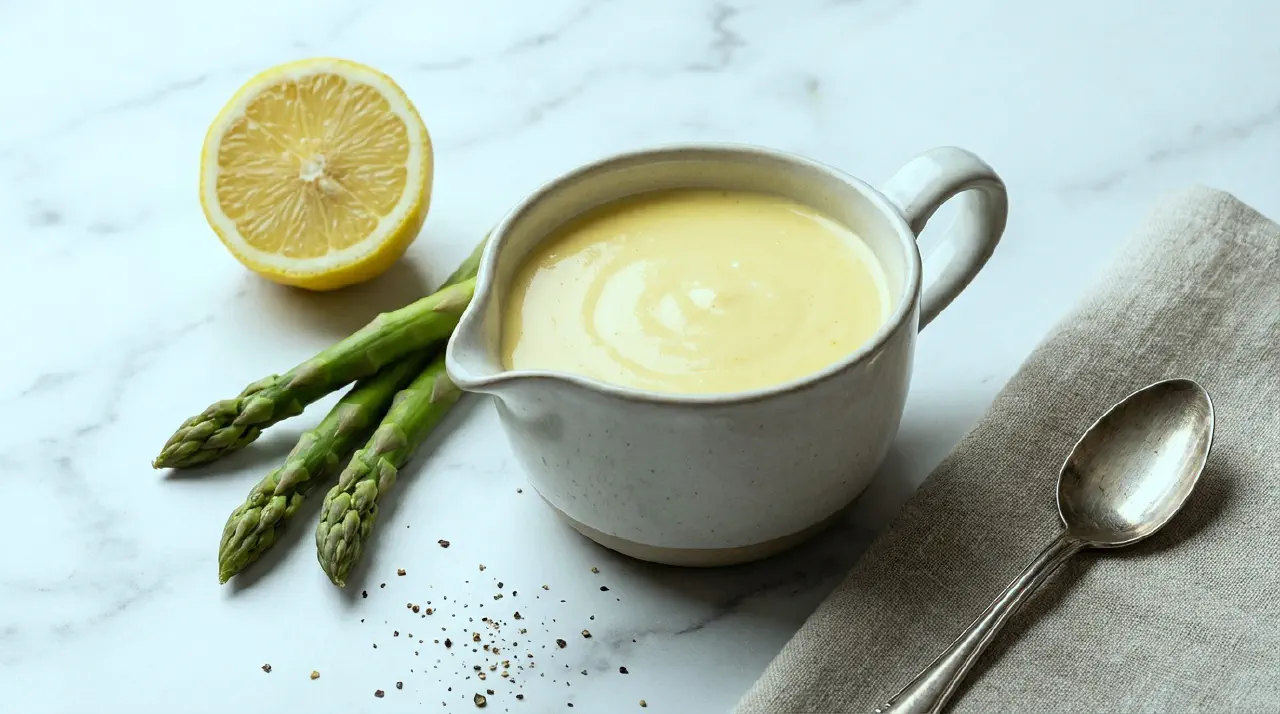
Hollandaise Sauce - kvalifood.com
Hollandaise is one of the five French mother sauces (sauces mères) of haute cuisine. It is a warm emulsion of egg yolk, clarified butter, and acid (lemon juice or a vinegar reduction), seasoned with salt and white or cayenne pepper.
Serve it over eggs Benedict, steamed asparagus, poached fish, or artichokes. It is also the base for derivative sauces like bearnaise and mousseline.
Makes about 1¼ cups, serves 4-6
Ingredients
- 3 large egg yolks
- 1 tbsp cold water
- 1 tbsp fresh lemon juice, plus more, to taste
- 170 g unsalted butter
- 1 pinch fine salt (~2 g)
- 1 pinch white pepper (or cayenne pepper)
Optional (closer to Escoffier)
- 2 tbsp white wine vinegar
- 3-4 cracked white peppercorns
- 1 small shallot, finely minced
Directions
Clarify the butter (optional but recommended): Melt the butter in a small saucepan over medium heat. Let it foam, then settle. Skim the white foam from the top. Carefully pour the clear golden butterfat into a warm vessel, leaving the milky whey behind. Keep warm. (Alternatively, use whole melted butter and simply leave the milky residue behind when pouring.)
Make the reduction (optional): In a small saucepan, combine the vinegar, peppercorns, and shallot. Reduce over medium heat until only about 1 Tb of syrupy liquid remains. Strain through a fine sieve into the bowl you will use for the sabayon. Allow to cool slightly.
Prepare the sabayon: In a medium heat-proof bowl (or a saucepan with a rounded bottom), whisk together the egg yolks, cold water, lemon juice, and salt. Whisk vigorously for about 1 minute until the yolks are thick, pale, and slightly foamy. If using the reduction, add it here.
Cook the sabayon: Set the bowl over a saucepan of barely simmering water (the bowl should not touch the water). Whisk constantly and vigorously for 2-3 minutes. The mixture will gradually thicken and increase in volume. You should be able to see the bottom of the bowl between whisk strokes. If it heats too fast, lift the bowl off the water and whisk in the air for a few seconds.
Incorporate the butter: Remove the bowl from the heat. Begin adding the warm clarified butter (or clear melted butter) very slowly - a few drops at a time at first, whisking constantly. As the emulsion takes hold and the sauce thickens, you can increase to a thin, steady stream. Continue until all the butter is incorporated. The sauce should be thick, creamy, and pourable - similar to a loose mayonnaise.
Season and serve: Taste and adjust with more lemon juice, salt, and white pepper or cayenne. Serve immediately, or keep warm by setting the bowl over (not in) warm water, covered, for up to 30 minutes. Do not reheat over direct heat.
Notes
- Rescue a broken sauce: If the sauce separates, add 1 Tb warm water and whisk vigorously. If that fails, start with a fresh yolk in a clean bowl, whisk it over heat for a moment, then slowly whisk the broken sauce into the fresh yolk.
- Temperature: The sabayon should reach roughly 65-70°C (150-160°F). Above 80°C (176°F), the yolks will curdle.
- Butter temperature: The butter should be warm but not hot (around 50-60°C / 120-140°F) when added. Too hot and it will cook the yolks; too cool and the emulsion will not form properly.
- Storage: Hollandaise does not keep well. Best made fresh and used within 30 minutes. It can be held warm in a thermos or over a warm water bath, but it will gradually lose its silky texture.
- Scaling: The ratio is 1 yolk : 55-60 g butter : 5 mL lemon juice. Scale up or down as needed.
See Also
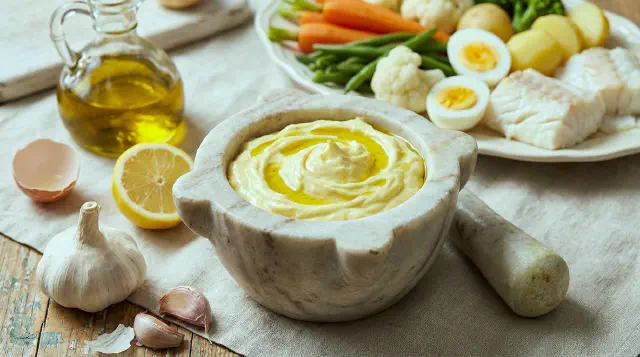
Aioli (Traditional Provencal Garlic Emulsion)
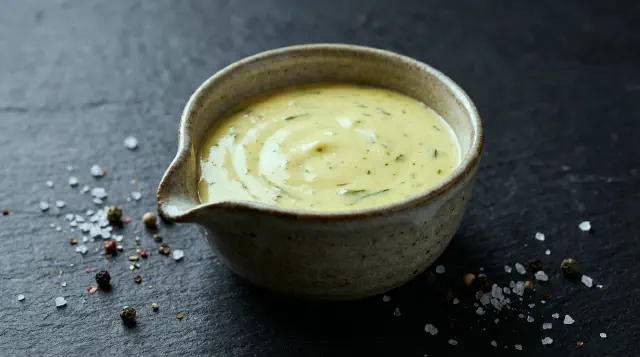
Bearnaise Sauce
Béchamel Sauce
Sauce Choron