Butter
Butter
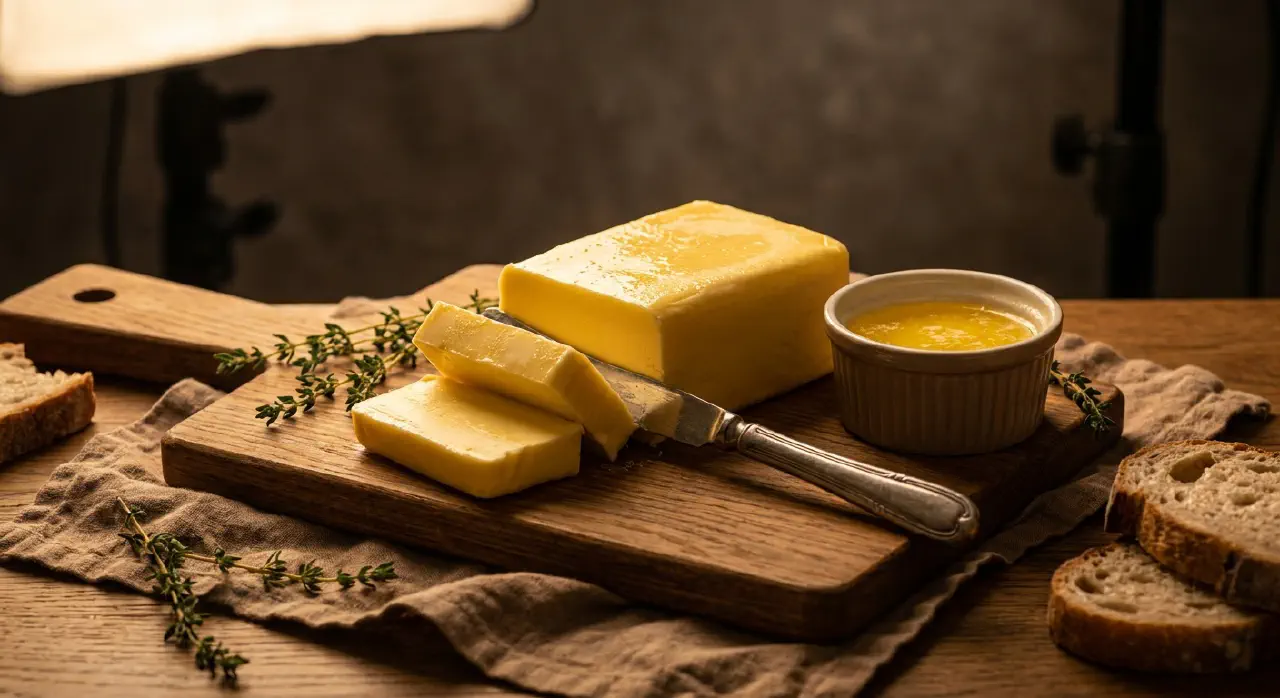
Butter is an inverted emulsion — cream turned inside out. Where cream suspends fat droplets in water, butter suspends water droplets in fat. This inversion, achieved by churning, gives butter its unique properties: solid enough to handle at room temperature, melting on the tongue at body temperature, and capable of both enriching and structuring everything from sauces to pastry.
Composition
- Fat: 80–82% (American standard) or 82–86% (European/continental)
- Water: 15–17%
- Milk solids: 1–2% (proteins, lactose, minerals)
- Salt: 0–2% (when added)
The fat is highly saturated (~60–70%), courtesy of rumen microbes that convert unsaturated fatty acids from the cow’s diet into saturated forms. This is why butter is solid at room temperature — its melting point is 90–95°F/32–35°C, right around body temperature.
Cream
Cream
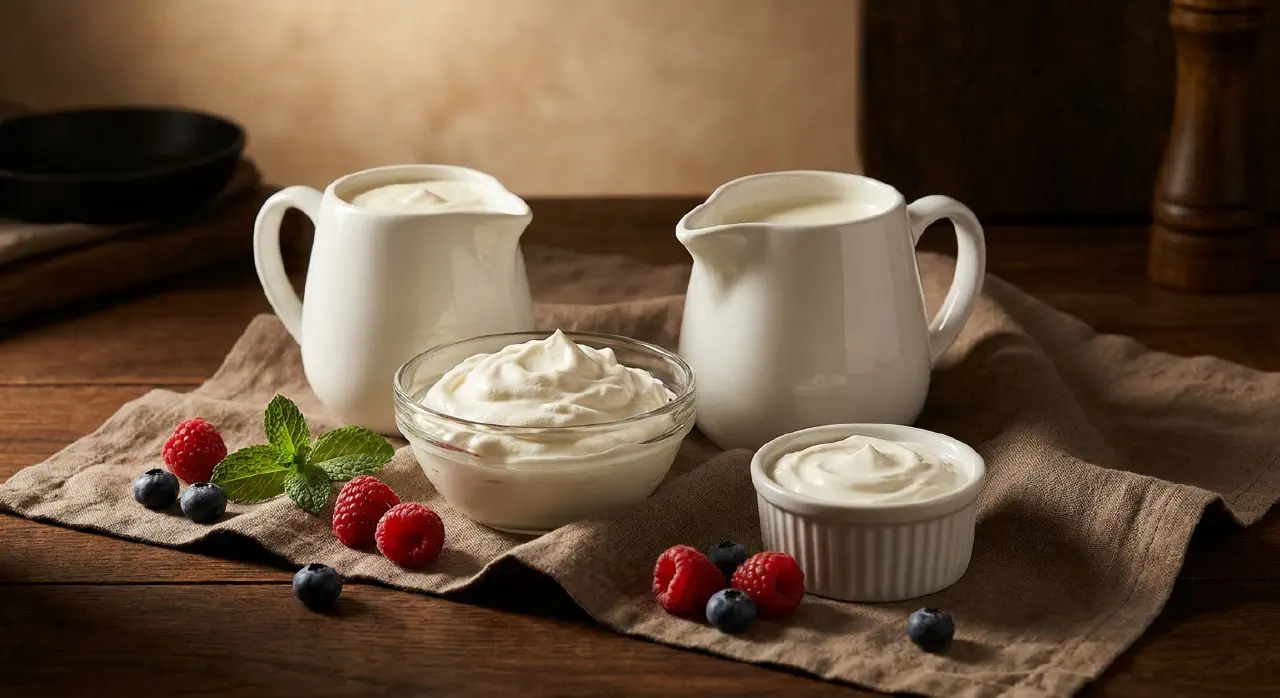
Cream is the fat-enriched portion of milk — the same emulsion, just with more fat globules per unit of water. This concentration is what gives cream its heat stability, whipping ability, and unmatched utility in sauce-making.
Types by fat content
The fat percentage defines what cream can do:
- Half-and-half (10–20% fat): Borders between milk and cream. Cannot whip. Curdles more easily than heavier creams.
- Light/whipping cream (30–36% fat): Can whip to soft peaks. Adequate for many sauces.
- Heavy/whipping cream (36–40% fat): The kitchen workhorse. Whips to stiff peaks. Survives boiling, reduction, and acidic ingredients.
- Double cream (40–48% fat): Very rich, whips to very stiff peaks. Clotted cream (55%+) is an extreme — cream heated slowly to 180°F/82°C until a thick layer of coagulated protein and concentrated fat forms on the surface.
Whipping science
Whipping cream is an exercise in controlled emulsion disruption. When a whisk incorporates air:
Emulsions
Emulsions
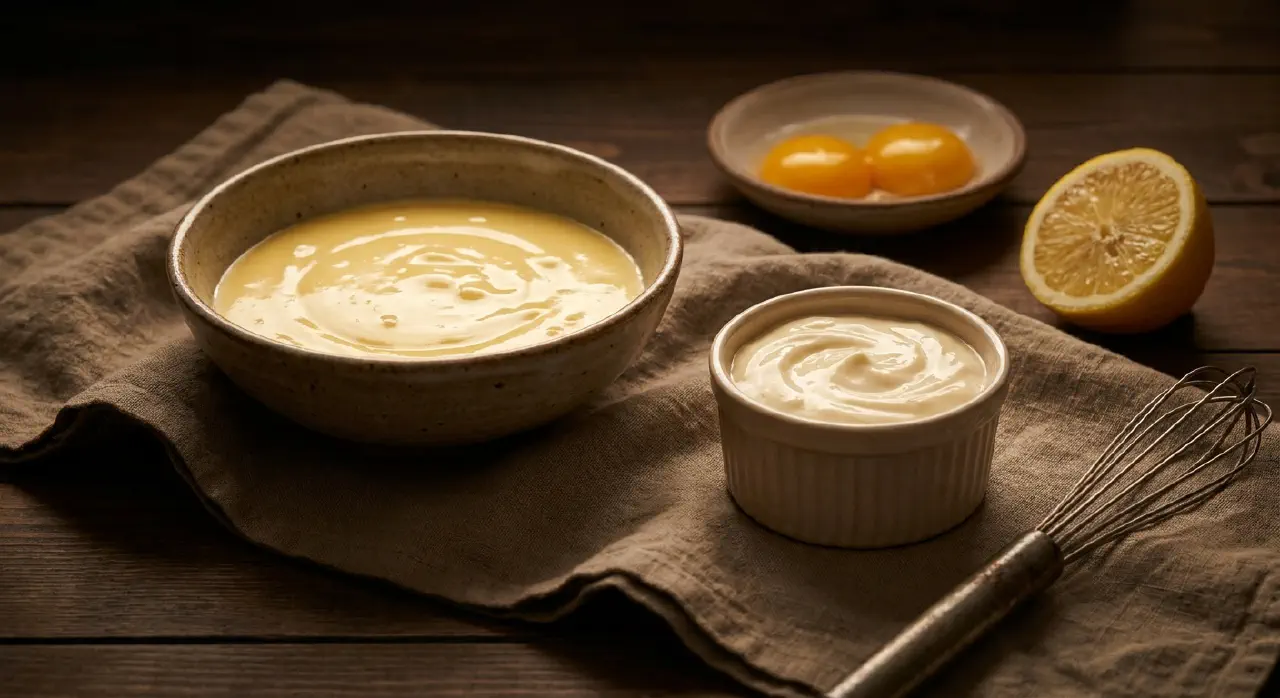
An emulsion is a stable mixture of two liquids that normally refuse to combine — almost always oil and water. Emulsions are everywhere in cooking: milk, cream, butter, mayonnaise, hollandaise, vinaigrettes, and most pan sauces.
How emulsions work
Every emulsion has two phases:
- Continuous phase — the liquid that forms the background. In cream and mayonnaise, this is water. In butter, it’s fat.
- Dispersed phase — tiny droplets (0.1–10 micrometers) suspended within the continuous phase.
Left alone, oil and water separate because oil droplets coalesce — they merge into larger and larger pools until the two liquids are fully separated. Emulsions prevent this through emulsifiers: molecules that are amphipathic (one end loves water, the other loves fat). They arrange themselves at the oil-water interface, coating each droplet in a protective shell that prevents coalescence.
Starch Gelatinization
Starch Gelatinization
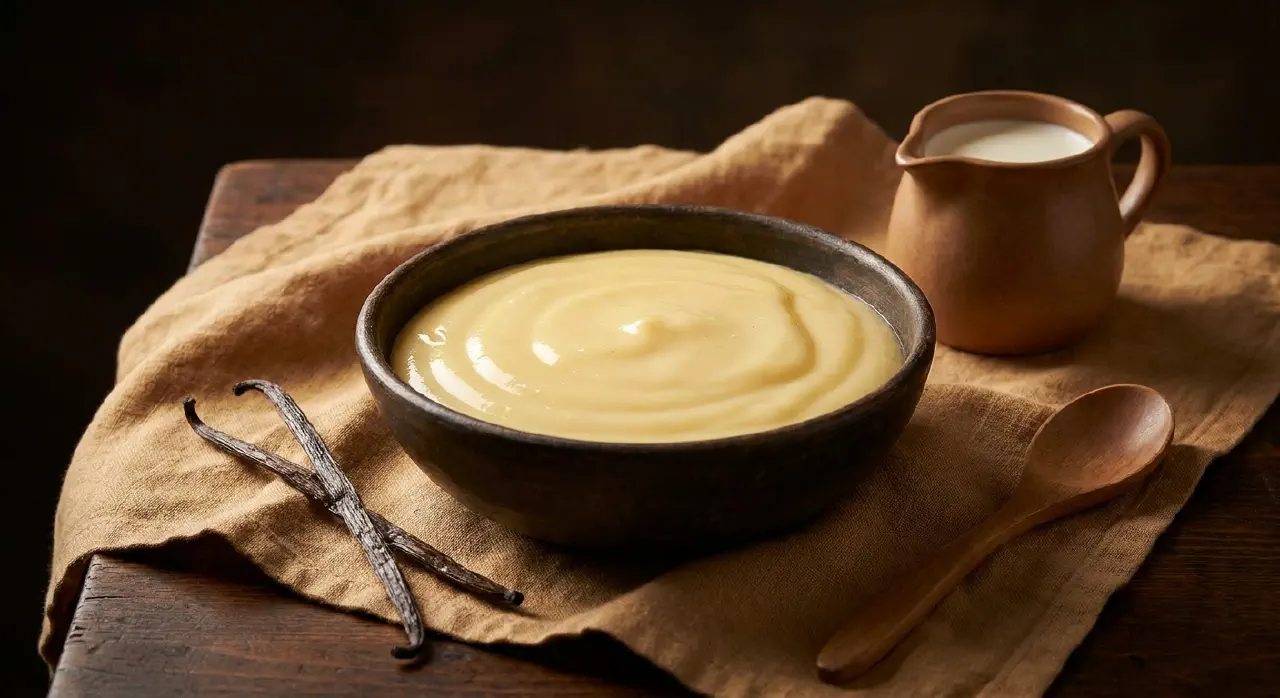
Starch gelatinization is the process by which starch granules absorb water, swell, and release their molecules to thicken a liquid into a gel. It’s the mechanism behind every roux-thickened sauce, every pot of cooked rice, and the structure of bread’s crumb.
What starch is
Starch is a plant’s way of storing energy — compact, unreactive chains of glucose sugars deposited in concentric layers within microscopic granules. Plants build two forms: