Baker's Percentage
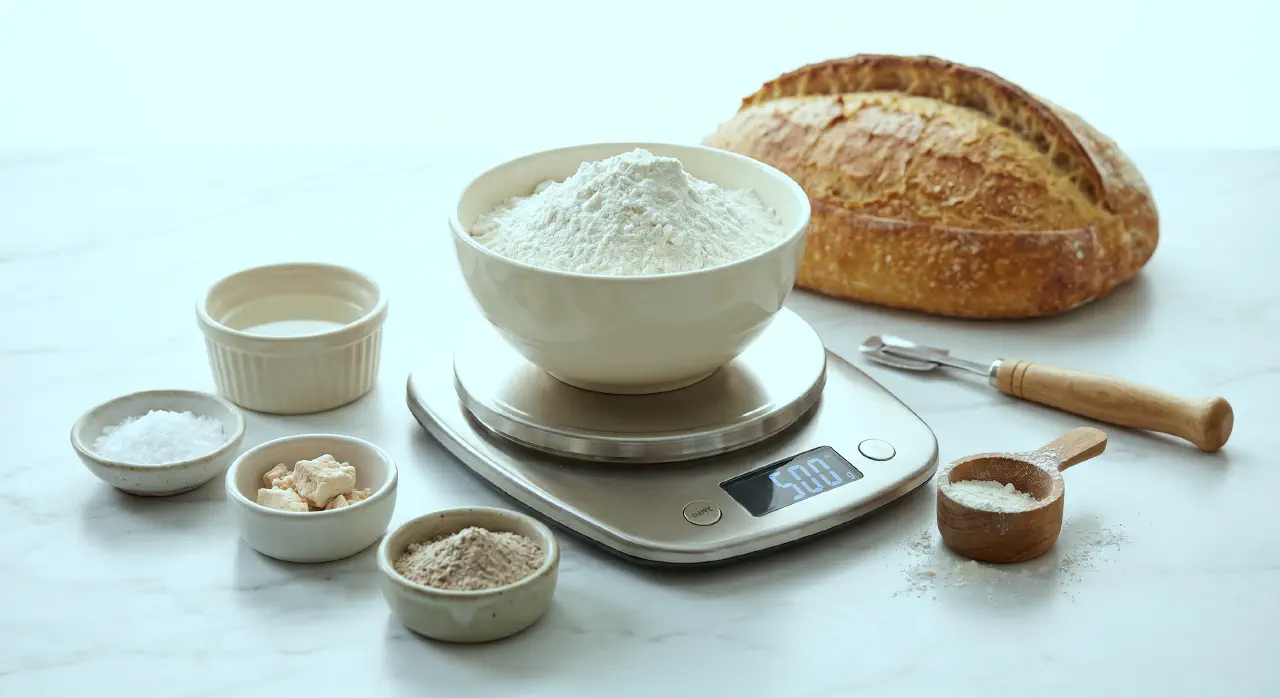
Baker’s percentage is a notation system for bread recipes where every ingredient is expressed as a percentage of the total flour weight, not as a percentage of the total recipe weight. It is the universal language of professional bakers and the fastest way to read, compare, and scale any bread recipe.
How it works
All flour in the recipe - wheat flour, rye flour, spelt, whole wheat, flour kernels - is summed and set as 100%. Every other ingredient is then expressed as a weight percentage of that total flour weight.
This means the percentages in a baker’s percentage recipe do not add up to 100. They add up to the total percentage (tp), which for a typical lean bread is around 165–185%.
Example: spelt bread
| Ingredient | Weight | Baker’s % |
|---|---|---|
| Wheat flour | 375 g | 75% |
| Spelt flour | 125 g | 25% |
| Total flour | 500 g | 100% |
| Salt | 14 g | 2.8% |
| Water | 400 g | 80% |
| Yeast | 2 g | 0.4% |
| Total | 916 g | 183.2% |
What the numbers tell you
Experienced bakers can read a recipe’s character from its baker’s percentages alone:
| Parameter | Range | Character |
|---|---|---|
| Hydration | 50–57% | Dry dough - bagels, stiff rolls |
| 57–65% | Standard dough - white bread, rye | |
| 65–80%+ | Wet dough - ciabatta, no-knead, pizza | |
| Fat | 0–5% | Lean dough - hearth breads |
| 5–20% | Enriched dough - focaccia, cinnamon buns | |
| 20%+ | Rich dough - brioche | |
| Salt | 1.5–2.5% | Normal range; above 2.5% noticeably salty |
| Yeast | 0.1–0.5% | Long fermentation (hours to overnight) |
| 1–2% | Fast fermentation (1–2 hours) |
Low yeast % is intentional, not a typo - long, slow fermentation with minimal yeast develops more flavor than a fast rise. A recipe with 0.2% yeast is designed to ferment overnight in the fridge.
For laminated doughs (croissants, Danish pastry), rolling butter is typically expressed as 30–50% of the finished dough weight, not as baker’s percentage, because both dough and butter are pre-weighed complete assemblies.
Scaling a recipe
Baker’s percentages make scaling straightforward.
To convert from % to weight for a target batch:
- Decide target total batch weight (e.g., 7,000 g for 10 × 700 g loaves)
- Divide by total percentage to get the weight per percentage point: 7,000 ÷ 183.2 = 38.2 g/%
- Multiply each ingredient’s % by that factor
To convert from weight to %:
- Sum all flours → total flour weight (tfw)
- For each ingredient: (ingredient weight ÷ tfw) × 100
Handling pre-ferments
A pre-ferment (poolish, biga, pâte fermentée) contains flour and water. Two conventions exist:
Treat pre-ferment as a single ingredient - calculate its total weight as a % of total flour. Simple, and useful when you make the pre-ferment in varying amounts or hydrations. The recipe’s true overall hydration is obscured.
Distribute the pre-ferment’s ingredients - add its flour to the total flour and its water to the total water. The overall hydration and salt percentages are then accurate. The pre-ferment must be a fixed, precise recipe for this to work.
Both conventions are valid. Consistency within a recipe is what matters.
Why weigh, never measure by volume
Baker’s percentage only works with weights. The same 1 kg of flour can range from under 1.5 liters (tightly packed, transported, compressed) to 2.5 liters (freshly sifted and airy) - a nearly 2:1 range in volume for identical weight. Volume measurements introduce this error directly into the hydration calculation, making recipe comparisons meaningless. Always weigh flour.
See also
- bread-baking - the full bread process; how hydration % translates to dough behavior
- gluten-science - how hydration and flour choice affect gluten development
- leavening - yeast amounts, pre-ferments, fermentation timing
- baking-stones - oven setup for different dough types
- pastry - fat content in enriched and laminated doughs