Bread Baking
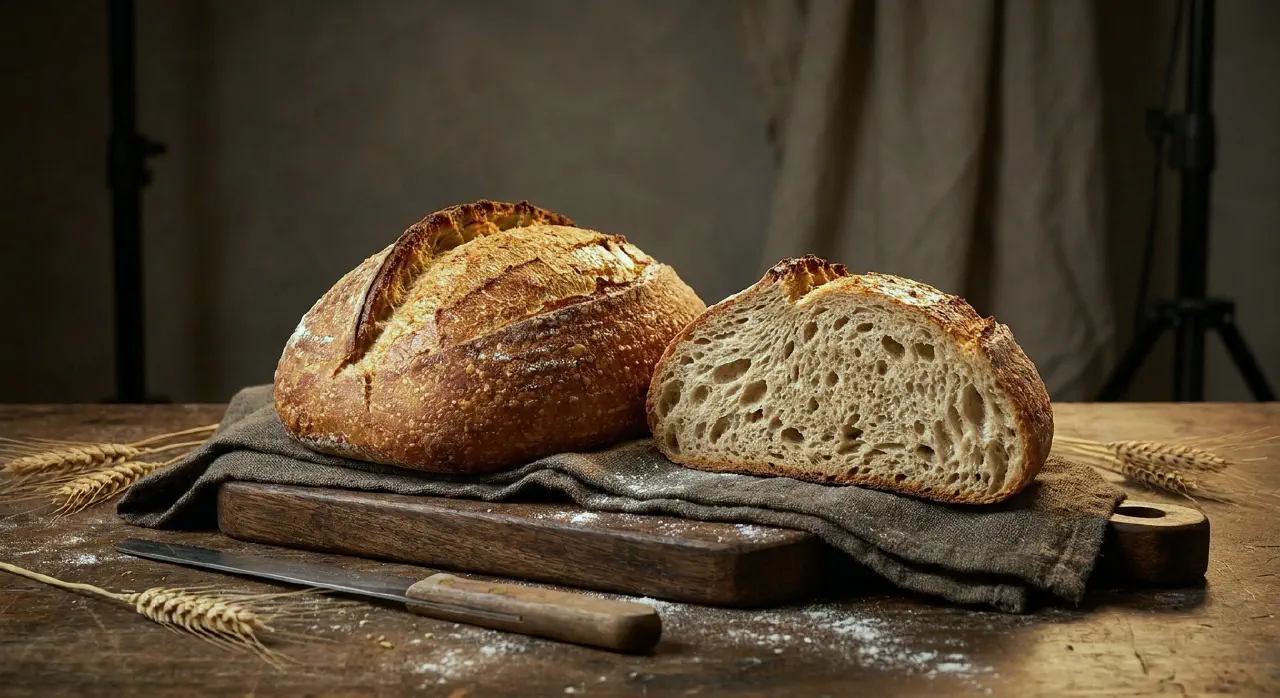
Bread baking is the transformation of flour, water, yeast, and salt into a structured, leavened, browned food - and it involves nearly every major concept in food science. Gluten provides structure, fermentation provides lift and flavor, starch-gelatinization sets the crumb, and the maillard-reaction creates the crust.
Dough classification
Before mixing a single gram, the recipe’s character is already visible in its baker’s percentage.
By hydration (water % of flour):
| Category | Water % | Examples |
|---|---|---|
| Dry | 50–57% | Bagels, stiff rolls |
| Standard | 57–65% | White bread, rye bread |
| Wet | 65–80%+ | Ciabatta, pizza dough, no-knead bread |
Wetter doughs develop more open, irregular crumbs. They ferment faster, require less kneading (gluten develops passively in the extra water), but are harder to shape.
By fat % (enrichment):
| Category | Fat % | Examples |
|---|---|---|
| Lean | 0–5% | Hearth breads, baguettes, sourdough |
| Enriched | 5–20% | Focaccia, English muffins, cinnamon buns |
| Rich | 20%+ | Brioche |
Fat tenderizes by interrupting gluten bonds (see gluten-science), slows yeast, and produces a softer, moister crumb. Rich doughs can use retarded fermentation (overnight in the fridge) to firm the fat and develop flavor simultaneously.
Stage 1: Mixing and gluten development
When flour meets water, two proteins - glutenin and gliadin - hydrate and begin bonding into gluten. Mixing and kneading unfold these proteins, orient them side by side, and encourage them to cross-link into a cohesive, elastic network. See gluten-science for the full mechanics of glutenin elasticity, gliadin extensibility, and how every ingredient modifies the network.
Autolyse - resting flour and water for 15–30 minutes before adding salt and yeast - allows gluten to develop passively. Developed by French baker Raymond Calvel, it produces a more extensible dough that’s easier to work, requires less kneading, and preserves wheat flavor and color because less oxygen is incorporated.
Salt is added after initial mixing because it tightens gluten by neutralizing electrical charges on the protein chains - adding it too early slows hydration. Salt also controls yeast activity (slows fermentation for a more gradual rise).
Kneading physically aligns gluten strands and traps air pockets. More kneading = stiffer, stronger dough with finer crumb. Over-kneading (mainly a risk with machines) breaks the gluten bonds and makes dough sticky and slack.
Stage 2: Fermentation
Yeast (Saccharomyces cerevisiae) feeds on sugars released by starch enzymes, producing CO₂ and ethanol. The CO₂ inflates the trapped air pockets in the gluten network, and the dough rises. See leavening for yeast biology, the three commercial yeast forms, and how biological leavening compares to chemical and steam alternatives.
But fermentation’s contribution to flavor is as important as its contribution to lift. Yeast produces dozens of flavor compounds (esters, alcohols, organic acids), and in longer fermentations, enzymes break proteins into flavorful amino acids. This is why slow, cold fermentation (overnight in the fridge) produces more complex bread than a fast, warm rise.
Fermentation timing rule of thumb: halving the yeast amount doubles the fermentation time. At ½ packet (25 g) fresh yeast, a standard loaf doubles in about 30 minutes; at ¼ packet, about 60 minutes; at ⅛ packet, about 2 hours. Secondary proofing follows a similar but faster pattern: roughly 20 minutes at ½ packet, plus 20 minutes for each halving. These are approximations - room temperature, water temperature, salt content, and flour batch variation can shift times significantly. See leavening for the quantitative data behind these rules.
Pre-ferments - poolish (equal flour and water), biga (stiff), pâte fermentée (old dough) - develop flavor and some gluten structure before the main mix. They provide organic acids and alcohols that improve bread flavor, dough handling, and keeping quality.
Sourdough adds lactic acid bacteria alongside wild yeast - no commercial yeast. The bacteria produce lactic acid (mild, yogurt-like) and acetic acid (sharp, vinegar-like); their ratio depends on culture hydration and temperature. Sourdough’s complexity comes from this microbial ecology. See leavening for sourdough culture maintenance and acid balance control.
Retarded fermentation: Chilling shaped dough to near-freezing for 12–72 hours slows yeast dramatically while bacterial acid production continues at a relatively higher rate - producing more complex flavor with minimal additional rise. Essential for brioche and enriched breads.
Stage 3: Baking
Oven setup matters as much as dough preparation. Professional ovens deliver 10× more power than home ovens and inject steam - both addressable with cast iron or steel baking surfaces and a steam pan. See baking-stones for the material science and practical setup. In the oven, the dough undergoes a cascade of transformations:
- Oven spring - heat accelerates yeast activity and expands gas, causing a final burst of rise in the first 10 minutes. Steam in the oven (from the dough’s moisture, a pan of water, or injected steam) keeps the crust flexible long enough for this expansion and creates the shiny crust characteristic of hearth-baked bread.
- Foam-to-sponge transformation - the critical structural transition. Gas bubbles expand until pressure ruptures the thin gluten-starch walls between them. The closed foam (separate bubbles) becomes an open sponge (interconnected pores). This happens as starch gelatinizes at 155–180°F (68–80°C) and gluten coagulates, permanently fixing the expanded structure.
- Crust formation - the surface dehydrates and rises above 280°F/140°C, initiating Maillard browning. The crust is where almost all of bread’s aromatic complexity lives - it contains hundreds of Maillard compounds.
Staling
Bread stales not primarily through moisture loss but through retrogradation - amylose molecules in the crumb slowly rebond into a more crystalline, rigid structure. Refrigerator temperature accelerates this process (bread stales fastest at fridge temp). Freezing halts it. Reheating temporarily reverses it - toast a stale slice and the crumb softens again as starch re-gelatinizes.
See also
- bakers-percentage - the recipe notation system; hydration and enrichment classification
- baking-stones - heat delivery, steam, Dutch oven, and internal temperature targets
- gluten-science - glutenin/gliadin mechanics, autolyse, salt effects, gluten control strategies
- leavening - yeast biology, fermentation timing, chemical leavening, pre-ferments, sourdough science
- wheat-flour - the ingredient that makes bread possible; protein levels and flour types
- fermentation-overview - the microbial process behind dough rise and flavor
- starch-gelatinization - crumb structure, foam-to-sponge transition, and staling
- maillard-reaction - crust chemistry
- wheat - wheat variety comparison, gluten elasticity and milling
- seed-biology - gelatinization setting crumb structure; retrogradation causing staling
- grains - rye’s pentosans in sourdough; barley malt and diastatic enzymes
- flatbreads-specialty - pizza, bagels, pretzels, enriched breads, sourdough breads
- pasta-noodles - the dense, unaerated counterpart to bread’s foam structure
- pastry - the low-gluten counterpart to bread’s high-gluten strategy
- cakes-batters - the batter-based counterpart; starch replaces gluten as primary structure
- protein-denaturation - gluten’s permanent set during baking
- precision-fermentation - temperature control in fermentation
- precision-cooking - temperature precision techniques and tools