Pastry
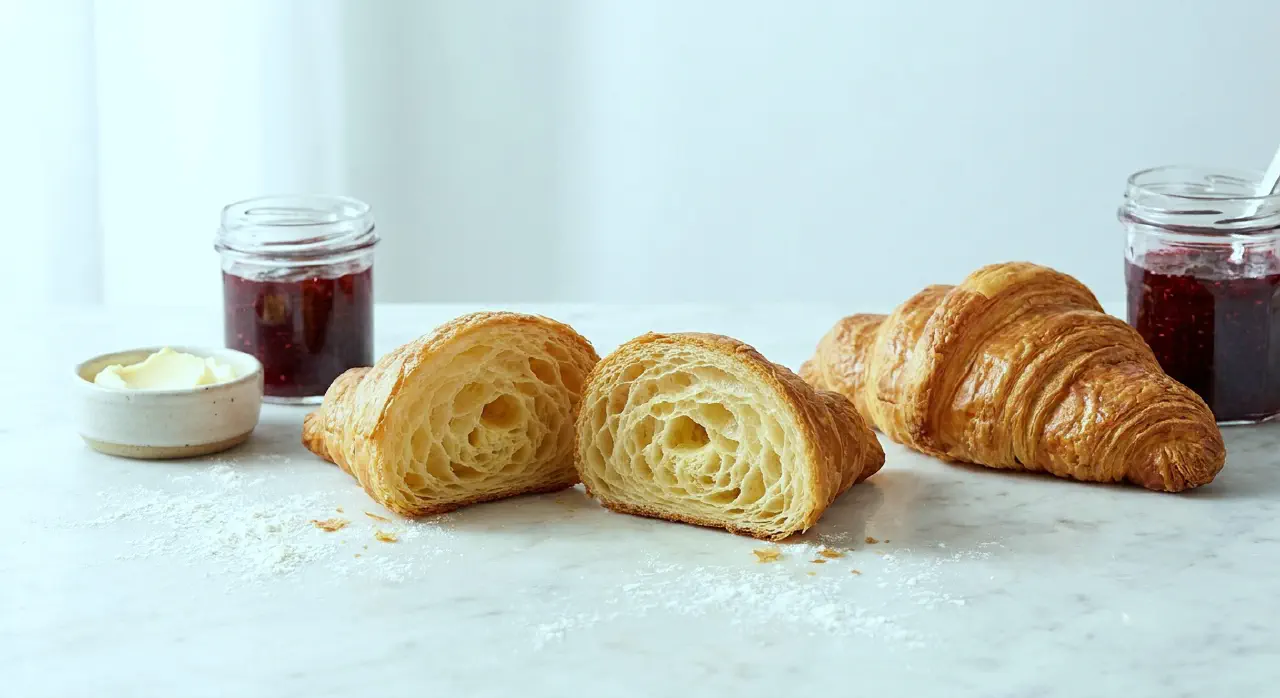
Pastry is the art of controlling fat to control gluten. Where bread maximizes gluten development for airy structure, pastry uses fat to weaken, interrupt, or separate gluten - producing textures from crumbly to flaky to layered. The word “shortening” literally means making dough “short” (tender, crumbly) by preventing long gluten networks from forming. Every pastry type is a variation on how fat is distributed through flour.
The shortening mechanism
Fat and oil molecules bond to hydrophobic portions of gluten protein coils, preventing those proteins from linking into long, elastic chains. The result: weaker gluten, tenderer product. How the fat is distributed determines the pastry type:
- Fine particles coating flour → crumbly (shortcrust)
- Larger chunks layered through dough → flaky (American pie crust)
- Systematic butter sheets between dough layers → hundreds of distinct layers (puff pastry)
- Hot fat fully absorbed into flour → dense, strong (hot-water pastry)
Small quantities of fat also stabilize gas bubble walls during expansion in breads and cakes - preventing premature rupture and increasing volume and textural lightness.
Shortcrust pastry (pâte brisée)
The simplest pastry: cold fat (butter, lard, or shortening) cut into flour until the mixture resembles coarse breadcrumbs. Each fat particle coats surrounding flour, preventing hydration and gluten development. Minimal cold water binds the dough just enough to hold together.
Critical rules: Fat must stay cold and solid (melted fat mixes into flour rather than coating it). Mixing must be minimal (overworking develops gluten, producing tough pastry). The dough should look rough and barely cohesive - smoothness means overdevelopment.
During baking, fat melts and leaves voids; starch gelatinizes and sets; the result is tender, crumbly, buttery. This is the pastry of tarts and quiches.
Flaky pastry (American pie crust)
Same ingredients as shortcrust, but fat is left in larger, visible pieces (pea-sized rather than breadcrumb-sized). When the dough is rolled, these pieces flatten into discrete layers. During baking, the fat melts, water in the dough vaporizes to steam, and steam pressure pushes the dough layers apart - each baking into a separate flaky sheet.
The difference between shortcrust and flaky is entirely about fat particle size: small = crumbly, large = flaky.
Laminated pastry: puff pastry (pâte feuilletée)
The most architecturally precise pastry. A basic dough (détrempe: flour, water, salt) encloses a block of butter (beurrage), then undergoes repeated folding and rolling sequences that multiply the layers exponentially:
- A single fold (thirds) creates 3 layers
- After 3 single folds: 27 layers
- After 4 single folds: 81 layers
- Double folds (quarters) multiply faster: 3–4 sequences produce 64–256+ alternating dough-butter layers
The physics: During baking, butter melts and water vaporizes. Steam (expanding to ~1,600× its liquid volume) pushes the layers apart. Each thin dough layer, now separated from its neighbors, sets as starch gelatinizes and gluten coagulates - creating hundreds of distinct, crisp, flaky sheets.
Critical conditions: Temperature is everything. Butter must remain solid throughout folding - if it melts, it mixes into the dough and the layered structure collapses. Rest periods between folds allow gluten to relax (preventing tearing and layer-merging) and butter to re-chill.
Choux pastry (pâte à choux)
The outlier. Choux is cooked dough: water and butter are boiled together, flour is stirred in over heat until it forms a ball and a starch film appears on the pan bottom, then eggs are beaten in one at a time after slight cooling.
The result is a smooth, shiny, thick paste that behaves unlike any other pastry:
- Piped or spooned into mounds and baked at high heat
- Starch granules gelatinize and egg proteins coagulate, forming walls
- Vigorous steam generation inflates the paste into hollow balloons
- The exterior sets first; the interior hollows as steam escapes
- Result: light, crisp shells with thin walls - natural containers for cream fillings
Choux relies on steam as its sole leavener - no yeast, no baking powder, no lamination. The pre-cooked starch and egg protein provide the wall strength that gluten provides in other pastries.
Sheet pastries: phyllo and strudel
Phyllo (filo): Paper-thin sheets of dough stretched until nearly translucent. The dough itself contains minimal fat; butter or oil is brushed between assembled layers. During baking, the fat layers separate the thin dough sheets (same principle as puff pastry, but hand-assembled rather than systematically laminated). The result: shatteringly crisp, delicate layers.
Strudel: Similar ultra-thin dough wrapped around filling - typically stretched over the backs of hands until translucent. The filled roll produces a distinctive spiral cross-section when sliced.
Pastry-bread hybrids: croissants and Danish
Croissants combine lamination with yeast fermentation. A yeasted dough undergoes the same fold-and-roll sequences as puff pastry, but the yeast provides additional lift beyond steam. The dual leavening - steam separating layers, yeast expanding them - produces pastry that is both flaky and tender, with fermentation-derived flavor complexity that pure puff pastry lacks.
Danish pastries are similar: laminated yeasted dough, often enriched with eggs, shaped into rectangles or spirals and filled. The enrichment makes them more tender than croissants.
Both require careful temperature management - the yeasted dough is alive and rising, but the butter must stay cold for lamination to work. Retarding (chilling) between folds serves double duty: relaxing gluten and controlling fermentation.
Hot-water pastry (pâte à pâté)
The structural opposite of shortcrust. Hot water and hot melted fat (traditionally lard) are mixed with flour - the heat fully absorbs the fat into the flour and partially gelatinizes the starch, creating a dense, elastic dough that can support heavy savory fillings. This is the pastry of British pork pies and French pâtés en croûte - sturdy enough to stand unsupported.
Cookies
Cookies live on the pastry-cake spectrum. High-fat cookies (shortbread) are essentially shortcrust pastry with sugar - crumbly, tender, rich. High-sugar cookies spread and become dense or crisp. Egg-free cookies are brittle when cooled. Chemical leavening in small amounts controls spread and produces a slightly open texture, but excess leavening creates coarse, crumbly results.
The interaction of sugar, fat, flour, and eggs determines cookie texture more than any single variable.
General principles
| Factor | Effect on pastry |
|---|---|
| Cold fat | Stays discrete; creates layers or coats flour |
| Melted/hot fat | Absorbs into flour; creates dense, sturdy pastry |
| Minimal mixing | Limits gluten; produces tenderness |
| Weak flour (pastry/cake) | Less gluten potential; tenderer result |
| High fat ratio | Very tender, crumbly |
| Moderate fat + technique | Flaky or layered |
| High baking temperature | Rapid steam generation; better layer separation |
| Rest periods | Gluten relaxation; fat re-chilling |
See also
- gluten-science - how fat interrupts gluten formation (the shortening mechanism)
- leavening - steam physics, the 1,600× expansion that powers puff pastry and choux
- bread-baking - the high-gluten counterpart to pastry’s low-gluten strategy
- cakes-batters - cakes as the batter-based extension of pastry’s anti-gluten approach
- butter - the fat that defines Western pastry tradition
- wheat-flour - flour protein levels and their pastry implications