Gluten Science
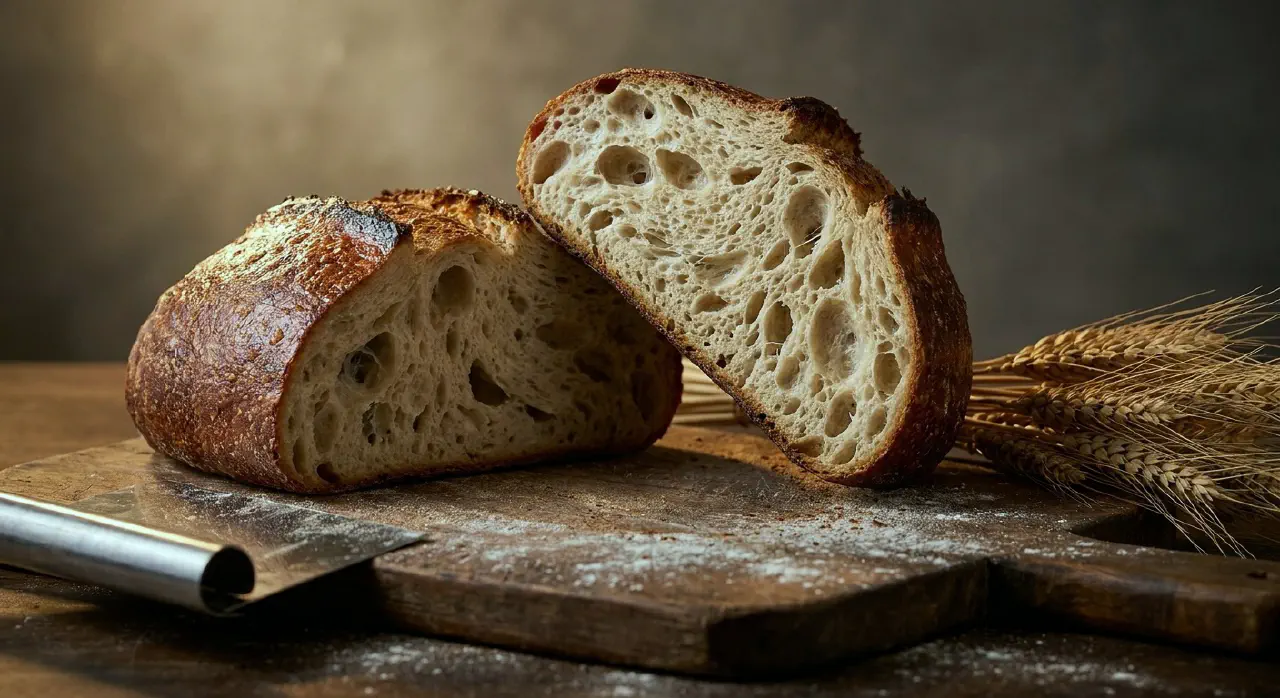
Gluten is the protein network that makes wheat doughs uniquely capable of trapping gas, holding shape, and producing textures from airy bread to chewy pasta to crumbly pastry. It doesn’t pre-exist in flour - it forms when two storage proteins, glutenin and gliadin, hydrate and bond during mixing. Understanding gluten is understanding why wheat dominates world baking, and why every dough-based preparation is fundamentally a strategy for controlling this one variable.
The two proteins
Glutenin provides elasticity - the ability to stretch and spring back. Its molecules are very large, coiled chains that bond end-to-end into an extensive network. When stretched, these coils unfold; when released, they recoil. Bread wheat’s hexaploid genome produces a glutenin with uniquely springy bonds - no other grain replicates this.
Gliadin provides extensibility - the ability to stretch without snapping back. Gliadin molecules are compact, single chains that act as a plasticizer, lubricating the glutenin network so it can deform without tearing. Too much gliadin relative to glutenin (as in einkorn, where the ratio inverts to 2:1) makes dough sticky and collapsible rather than elastic.
The balance between these two proteins determines dough character. Bread dough needs high elasticity (strong glutenin) to trap fermentation gas. Pasta needs strong but inelastic gluten (durum’s glutenin is cohesive but doesn’t spring back) for dense, chewable sheets. Pastry wants gluten minimized entirely.
Gluten development
Mixing hydrates the proteins and brings glutenin chains into contact, allowing them to bond into longer networks. Kneading aligns these networks into organized sheets. The process is visible: dough transforms from shaggy and rough to smooth, elastic, and windowpane-translucent.
Autolyse - resting flour and water before adding salt or yeast - allows passive hydration and enzyme activity to begin gluten alignment without mechanical work. Developed by French baker Raymond Calvel, it reduces total kneading time and produces a more extensible dough.
Salt tightens and strengthens gluten by neutralizing electrical charges on the protein chains, allowing them to pack more closely. This is why salt is typically added after initial mixing in artisan bread - adding it too early slows hydration.
Gluten relaxation: A stretched gluten network gradually relaxes as glutenin bonds rearrange. This is why dough that fights back during shaping becomes cooperative after a rest, and why puff pastry requires rest periods between lamination folds.
Controlling gluten strength
Every wheat preparation manages gluten along a spectrum from maximum development (bread) to near-zero (cake):
| Strategy | Mechanism | Used in |
|---|---|---|
| Strong flour, long kneading | Maximizes glutenin bonding | Bread, bagels |
| Durum semolina | Strong but inelastic gluten | Pasta |
| Minimal mixing | Limits protein contact | Muffins, biscuits |
| High water ratio | Disperses proteins widely | Cake batters |
| Fat addition | Coats hydrophobic gluten portions, blocks bonding | Pastry, cookies, enriched breads |
| Sugar addition | Binds water molecules, interrupts gluten-water network | Cakes, sweet breads |
| Acid (buttermilk, yogurt) | Tightens gluten initially, but also reduces flour needed (thicker liquid) | Quick breads, scones |
| Alkaline (kansui) | Strengthens gluten, toughens texture | Ramen, Chinese noodles |
| Cake flour (chlorinated) | Modified starch absorbs differently; gluten role minimized | Layer cakes |
Wheat variety and flour type
Protein content and gluten quality vary by wheat species and milling:
| Flour type | Protein % | Gluten character | Primary use |
|---|---|---|---|
| High-gluten bread flour | 13–15% | Very strong, elastic | Bagels, hearth breads |
| Bread flour | 11.5–13% | Strong, elastic | Standard bread |
| All-purpose flour | 10–12% | Moderate | General cooking |
| Pastry flour | 8.5–10% | Weak, extensible | Pie crusts, cookies |
| Cake flour | 7–9% | Very weak; chlorine-modified starch | Layer cakes |
| Durum semolina | 12–16% | Strong, inelastic | Pasta, couscous |
| Whole wheat | 13–14% | Strong but disrupted by bran particles | Dense breads |
Bran’s physical effect: In whole wheat flour, sharp bran particles physically cut developing gluten strands - producing denser, heavier results regardless of protein content. White wheats (lower phenolic content) give lighter whole-grain flour with less astringency.
Flour aging and improvement: Freshly milled flour produces slack, sticky doughs. Aging for several weeks allows oxygen to form disulfide bonds between glutenin chains, strengthening the network. Commercial improvers (ascorbic acid, potassium bromate, azodicarbonamide) accelerate this oxidation artificially.
Gluten in the oven
During baking, gluten’s role shifts from gas-trapping to structure-setting. As temperature rises, gluten proteins denature and coagulate (similar to egg proteins cooking), permanently fixing the expanded structure. Meanwhile, starch granules absorb water, swell, and set - together, the coagulated gluten and gelatinized starch create the rigid crumb.
In cake batters, gluten is so dispersed by excess water, sugar, and fat that starch becomes the primary structural material. Gluten contributes only background cohesiveness - preventing crumbliness without adding chewiness.
See also
- wheat - the four wheat species and their gluten characteristics
- wheat-flour - flour types, protein content, starch role
- bread-baking - gluten development in practice: mixing, kneading, fermentation
- pasta-noodles - durum’s inelastic gluten and pasta structure
- pastry - shortening mechanism: fat blocking gluten formation
- cakes-batters - the anti-gluten strategy: dispersal, disruption, starch dominance
- seed-biology - storage protein classes in grains and legumes