Leavening
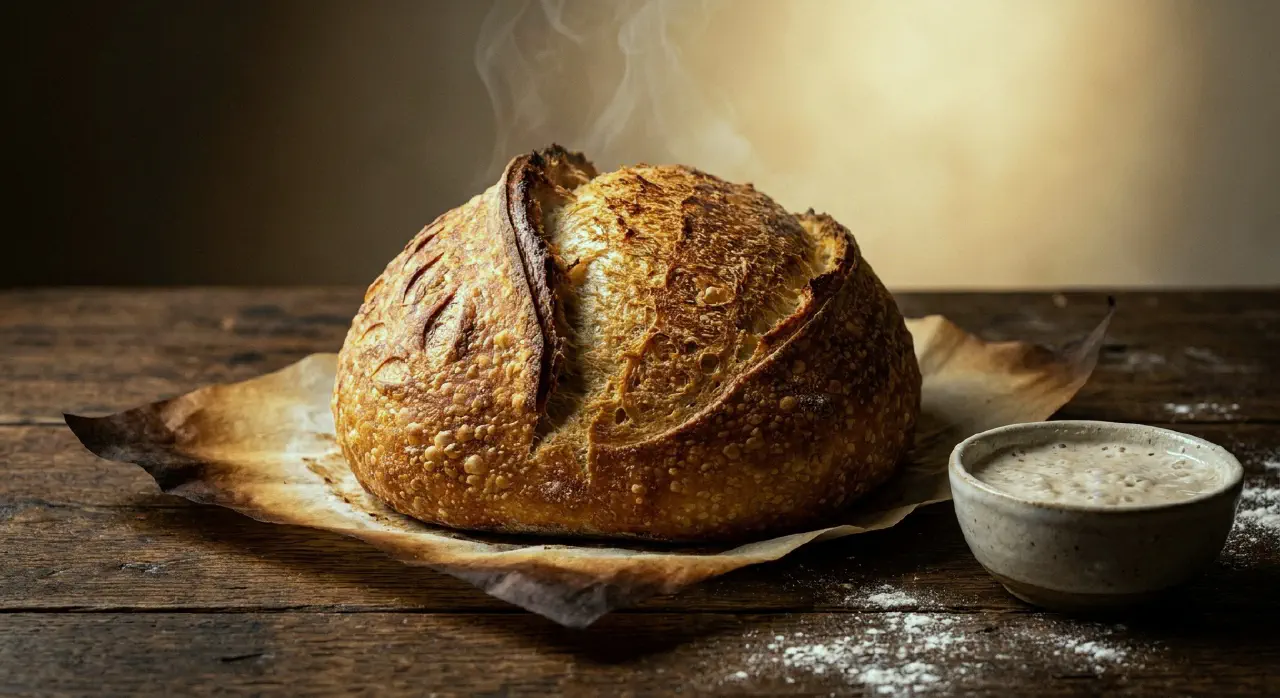
Leavening is the introduction of gas into dough or batter to make it light and porous. Three gas sources exist - biological (yeast), chemical (baking soda/powder), and physical (steam, mechanical aeration) - and most preparations combine two or more. The choice of leavening system shapes not just texture but flavor, timing, and the entire workflow of baking.
Biological leavening: yeast
Saccharomyces cerevisiae - baker’s yeast - metabolizes sugars to produce CO₂ and ethanol. In the oxygen-poor interior of dough, it ferments rather than respires, generating gas slowly over hours. This slowness is a feature: it allows time for gluten development, enzyme activity, and the accumulation of flavor compounds (organic acids, alcohols, aldehydes) that give bread its complexity.
Sugar sources: Yeast feeds first on free sugars in flour (~1–2%), then on maltose released by amylase enzymes breaking down damaged starch. Flour’s own enzymes are the primary sugar supply in lean doughs - added sugar isn’t necessary.
Temperature effects: Yeast activity roughly doubles with each 15°F (8°C) rise. Below 40°F (4°C), activity is negligible (useful for retarded fermentation). Peak activity occurs around 95°F (35°C). Above 140°F (60°C), yeast dies.
Three commercial forms: Cake/compressed yeast (70% water, most perishable, fastest acting), active dry yeast (dried, dormant, rehydrate before use), and instant dry yeast (finer granules, higher viability, mix directly into flour). At equivalent cell counts, performance is identical.
Yeast form conversion ratios (by weight):
| Form | Ratio | Example |
|---|---|---|
| Fresh (compressed) | 1.0 | 50 g |
| Active dry | 0.5 | 25 g |
| Instant | 0.33 | 17 g |
Fermentation timing rule of thumb: halving the yeast amount doubles the fermentation time. Starting reference point: ½ packet (25 g) fresh yeast in a standard loaf doubles in roughly 30 minutes at ~20°C.
| Fresh yeast | Primary fermentation | Secondary proofing |
|---|---|---|
| ½ packet (25 g) | ~30 min | ~20 min |
| ¼ packet (12 g) | ~60 min | ~40 min |
| ⅛ packet (6 g) | ~2 hours | ~60 min |
| 1/16 packet (3 g) | ~4 hours | ~80 min |
These values are from controlled timelapse experiments at room temperature (~20°C). Salt content, water temperature, flour batch, and ambient temperature all shift times. At ~24–26°C, fermentation runs noticeably faster.
Factors that modify fermentation speed (approximate, relative to control):
| Factor | Effect |
|---|---|
| High salt (2.5% vs 1.5%) | +1/3 longer |
| 1 tbsp vinegar in dough | 1/3 faster |
| Warm water (60°C, added carefully) | 2× faster |
| Vinegar + warm water combined | ~3× faster |
| Milk instead of water | ~1/3 slower (cold milk and fat inhibit yeast) |
| Sugar (1 tbsp) | slightly slower (osmotic effect at mixing) |
The vinegar effect is likely due to acidification loosening the gluten network and accelerating enzyme activity. The warm water effect is straightforward thermodynamics - yeast activity roughly doubles per 8°C rise in temperature. Use these multipliers to adapt fermentation time to your schedule, not to rush a recipe that benefits from a long, cold rise.
Pre-ferments and sourdough
Pre-ferments - poolish (equal flour and water), biga (stiff), pâte fermentée (old dough) - develop flavor and some gluten structure before the main mix. They provide organic acids and alcohols that improve bread flavor, dough handling, and keeping quality.
Sourdough cultures contain wild yeasts plus acid-producing bacteria (primarily Lactobacillus). The bacteria produce lactic acid (mild, yogurt-like) and acetic acid (sharp, vinegar-like) - their ratio, controlled by hydration and temperature, determines sourness character. Sourdough’s acidity weakens gluten somewhat, producing denser but more flavorful loaves with longer shelf life (acid retards staling and mold growth). See fermentation-overview for the broader microbial context.
Retarded fermentation
Chilling shaped dough to near-freezing (33–40°F) for 12–72 hours slows yeast dramatically while bacterial acid production continues at a relatively higher rate. The result: more complex flavor with minimal additional rise. Widely used in artisan bakeries and essential for brioche (firms the butter-rich dough for handling).
Chemical leavening
Chemical leaveners produce CO₂ from acid-base reactions - instantly, with no fermentation time. This speed makes them essential for batters and quick doughs that can’t hold gas long enough for yeast to work.
Baking soda (sodium bicarbonate)
Reacts with any acid to release CO₂. Common acid sources: buttermilk, yogurt, brown sugar/molasses, chocolate/cocoa (if not Dutch-processed), fruit juices, vinegar, cream of tartar. The reaction is immediate upon mixing - batters leavened with soda alone must reach the oven quickly.
Excess soda produces bitter, soapy flavors and an alkaline-yellow color. It also accelerates Maillard browning (useful in pretzels, deliberately alkaline-treated) and turns chocolate reddish and blueberries green.
Baking powder
A complete system: soda plus acid salt(s) plus starch (prevents premature reaction and adds bulk for measuring). The engineering lies in the acid components and their release timing:
| Acid salt | Release timing | Notes |
|---|---|---|
| Cream of tartar | Immediate (during mixing) | Natural, clean flavor; expensive |
| Monocalcium phosphate (MCP) | Immediate | Most common fast-acting acid |
| Sodium aluminum sulfate (SAS) | Heat-activated (~140°F) | Delayed release; can taste metallic |
| Sodium aluminum pyrophosphate (SAPP) | Slow after mixing | Moderate delay |
| Sodium acid pyrophosphate (SALP) | Heat-activated | Used in commercial baking |
| Dicalcium phosphate (DMP/DCPD) | Heat-activated | Slow release |
Single-acting powders contain only fast-release acids - all gas produced during mixing. Double-acting powders (the standard retail product) combine fast and slow acids: ~⅓ of CO₂ releases during mixing (stabilizes initial bubbles), ~⅔ during baking (provides oven rise). This two-stage design is forgiving - batters can sit briefly without going flat.
Historical leaveners
Potash and pearlash (potassium carbonate): The original chemical leaveners, made from wood ash. Strongly alkaline, harsh flavor - largely replaced by baking soda in the 19th century.
Hartshorn (ammonium carbonate/carbamate): Decomposes at 140°F (60°C) into CO₂ and ammonia gas - producing no water at all. The ammonia escapes during baking, leaving no off-flavor if the product is thin enough for complete gas escape. Perfect for very thin, crisp cookies and crackers; impractical for cakes or thick breads (trapped ammonia tastes terrible).
Physical leavening: steam and air
Steam: Water vaporizes at 212°F (100°C) and expands to ~1,600× its liquid volume. In puff pastry, steam generated between butter-separated dough layers is the primary lifting force - pushing hundreds of layers apart into distinct flaky sheets. In choux pastry, vigorous steam generation inflates the cooked batter into hollow balloons. In flatbreads, steam puffs thin dough (pita’s pocket is a steam cavity).
Mechanical aeration: Creaming butter with sugar traps air bubbles; whipping egg whites creates protein-stabilized foam. These pre-existing bubbles serve as nucleation sites for CO₂ from chemical or biological leavening - the leavener expands existing bubbles rather than creating new ones. This is why proper creaming matters in cakes: no initial bubbles, no fine crumb.
Combined systems
Most preparations use multiple leavening sources:
| Preparation | Primary leavening | Secondary |
|---|---|---|
| Bread | Yeast CO₂ | Steam (oven spring) |
| Puff pastry | Steam | Mechanical (folding traps air) |
| Croissants | Yeast CO₂ + steam | Lamination traps both |
| Cake (creaming method) | Chemical (baking powder) | Mechanical (creamed butter), steam |
| Angel food cake | Mechanical (whipped whites) | Steam |
| Pancakes | Chemical | Sometimes yeast or whipped whites |
| Choux pastry | Steam | Egg protein expansion |
See also
- gluten-science - how gluten traps and holds leavening gas
- bread-baking - yeast leavening in practice, oven spring
- fermentation-overview - the broader microbiology of fermentation
- pastry - steam leavening in puff pastry and choux
- cakes-batters - chemical leavening and mechanical aeration in cakes
- flatbreads-specialty - steam puffing in pita, alkaline browning in pretzels