Cheese
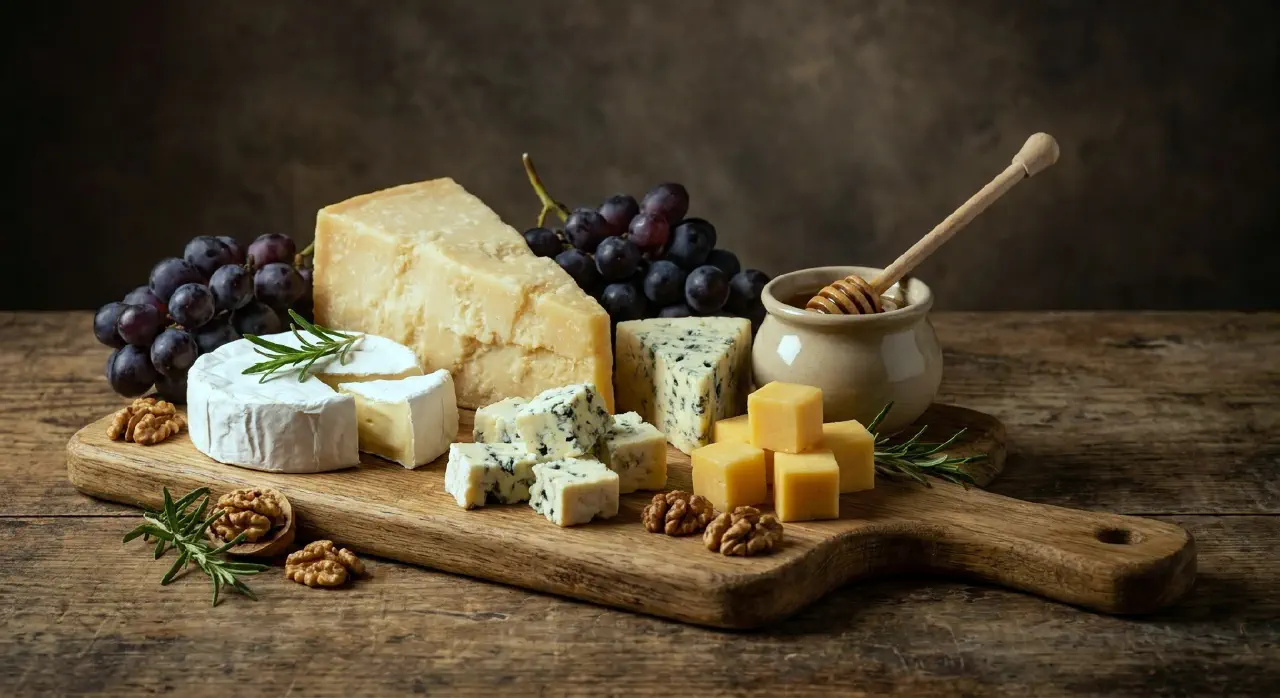
Cheese is milk made more concentrated, more durable, and more flavorful through controlled coagulation of casein proteins, removal of whey, and - in aged cheeses - prolonged enzymatic breakdown of proteins and fats. It is one of the oldest fermented foods, with archaeological evidence dating to ~2300 BCE, and one of the most diverse: France alone produces several hundred distinct varieties, each a product of local milk, climate, microbes, and tradition.
The cheesemaking process
Coagulation
Cheese begins by making milk’s casein proteins clump together into curds, separating from the liquid whey. Two fundamentally different mechanisms:
Acid coagulation: Lactic acid bacteria (or added acid) drop the pH below ~4.7, neutralizing the charges that keep casein micelles apart. The micelles clump into soft, fragile curds. Used for fresh cheeses - ricotta, cream cheese, chèvre.
Enzyme (rennet) coagulation: The enzyme chymosin cleaves specific bonds in casein, causing micelles to cross-link into an elastic, smooth gel. Works at neutral pH and produces firmer curds than acid alone. Temperature-dependent (best at 86–105°F/30–40°C). Used for most aged cheeses. Many cheeses use both methods in combination.
Curd handling
After coagulation, curd management determines the final cheese’s moisture and texture:
- Cutting: Smaller curd pieces lose whey faster, producing firmer cheese. Pea-sized for hard cheeses, walnut-sized for soft.
- Cooking: Gently heating curds (95–110°F/35–43°C) expels more whey. Higher temperature = firmer cheese.
- Pressing: Weight applied to expel remaining whey. Heavy pressing produces dense, hard cheeses (cheddar-style).
- Cheddaring: A specific technique where curd blocks are cut, stacked, and restacked while acid develops - producing cheddar’s characteristic texture.
Salting
Salt preserves, flavors, and draws moisture from the surface (helping rind formation). Methods: dry salting (sprinkled on curds), brining (submerging in salt water), or both. Feta lives in brine; Parmesan is dry-salted.
Aging (ripening)
The transformation from bland fresh curd to complex aged cheese happens through two enzymatic processes:
Proteolysis - enzymes from milk, rennet, and microbes break proteins into peptides and free amino acids. This produces savory, umami, and complex flavors. Glutamic acid (MSG) accumulates in aged cheeses - the same amino acid responsible for umami in soy sauce and tomatoes.
Lipolysis - lipase enzymes break fat into fatty acids, producing the sharp, pungent flavors characteristic of aged cheddar and blue cheeses.
Time is the single most important variable. Fresh cheese (days old) has simple, milky flavor. At 6 months, hundreds of flavor compounds have developed. At 2+ years (Parmigiano-Reggiano, aged cheddar), the complexity is extraordinary - and tyrosine crystals may form, producing the characteristic crunch.
Categories by texture and age
Fresh (unaged): High moisture (60–80%), mild, perishable. Ricotta, mozzarella, cream cheese. Soft-ripened (2–8 weeks): Surface molds (Penicillium camemberti) ripen from outside in. Brie, Camembert. Semi-hard (1–6 months): Moderate moisture, firm but flexible. Gouda, Gruyère, young cheddar. Hard (6 months+): Low moisture, concentrated flavor, crystalline texture possible. Parmigiano-Reggiano, aged cheddar, Comté. Blue (2–4 months): Internal Penicillium roqueforti creates veining, sharp pungency. Roquefort, Gorgonzola, Stilton.
Milk type matters
Cow, goat, sheep, and buffalo milks produce fundamentally different cheeses because of their different protein and fat compositions. Sheep milk (7.5% fat, 6% protein) yields rich, nutty cheeses like pecorino and Roquefort. Goat milk produces tangy, soft cheeses with distinctive flavor from its different fatty acid profile. Buffalo milk’s extraordinary richness (6.9% fat) is why mozzarella di bufala is a categorically different product from cow-milk mozzarella.
See also
- milk - the raw material, and the casein vs. whey distinction that governs coagulation
- salt - preservation, flavor, and rind formation in cheese
- fermentation-overview - the microbial processes that develop cheese flavor
- protein-denaturation - what happens to casein during acid and enzyme coagulation
- yogurt-and-fermented-dairy - the simpler side of milk fermentation