Protein Denaturation
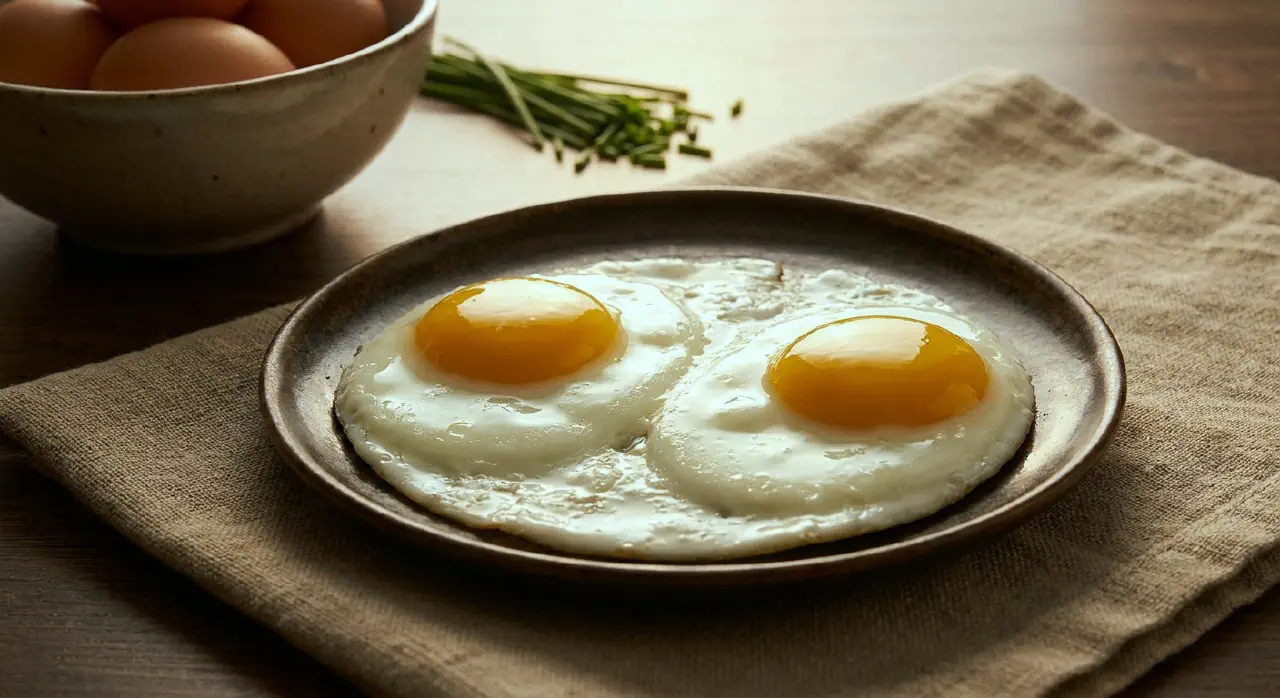
Protein denaturation is the undoing of a protein’s natural folded structure - the single most important chemical event in cooking. When you cook an egg, sear a steak, or make yogurt, you’re denaturing proteins. The change is mostly irreversible and transforms both texture and behavior.
What proteins look like
Proteins are long chains of amino acids (dozens to hundreds), folded into specific shapes held together by weak bonds - hydrogen bonds, van der Waals forces, and ionic attractions. Some proteins fold into compact globules (egg proteins), others form long helical fibers (collagen in meat). The folded shape determines what the protein does and how it behaves.
Two important structural categories:
- Globular proteins - compact, elaborately folded, often water-soluble. Egg white proteins, milk casein.
- Fibrous/helical proteins - long, extended, strong. Collagen, muscle fibers. These form the structural backbone of meat.
How denaturation works
When proteins encounter heat, acid, salt, mechanical force, or even air bubbles, the weak bonds maintaining their folded shape break. The protein unfolds from its compact form into an extended chain, exposing chemical groups that were previously hidden inside.
Causes of denaturation:
- Heat: Usually 140–180°F (60–80°C). The most common cause in cooking.
- Acid: Excess protons disrupt the bonds. How ceviche “cooks” fish.
- Salt: Ions cluster around charged protein groups, changing behavior.
- Mechanical action: Whisking, beating, kneading.
- Air interfaces: The drastic environment at a bubble surface unfolds proteins - the basis of egg foams and meringue.
From denaturation to coagulation
Denaturation is step one. Step two is coagulation: the unfolded proteins tangle with each other and bond, forming a three-dimensional network that traps water. This is what turns a liquid egg into a solid - the protein network divides the water into tiny pockets that can no longer flow.
Gentle coagulation produces delicate, moist textures: barely-set custard, perfectly poached fish. Excessive coagulation squeezes water out of the network: rubbery eggs, tough meat, curdled custard.
The practical lesson: proteins should be cooked to the point where they barely coagulate. Everything past that is overcooked.
Temperature thresholds (eggs as model)
Eggs are the clearest demonstration of staged protein coagulation:
| Protein | Coagulation temp | Effect |
|---|---|---|
| Ovotransferrin (12% of white) | 140–150°F / 60–65°C | White begins to set |
| Yolk proteins | 150–158°F / 65–70°C | Yolk thickens and sets |
| Ovalbumin (54% of white) | ~180°F / 80°C | White becomes dramatically firmer |
This staging explains why a soft-boiled egg can have a set white and runny yolk - the white’s heat-sensitive protein has coagulated, but the yolk hasn’t reached its threshold yet.
How ingredients shift coagulation temperature
This is one of the most useful principles in egg cookery:
- Dilution (milk, cream, water): Raises coagulation temperature. Proteins must be hotter and moving faster to find each other across greater distances. A custard (1 cup milk + 1 egg) thickens at ~175–180°F/78–80°C instead of ~160°F/70°C for an egg alone.
- Sugar: Acts as a diluent like water - surrounds proteins and raises the coagulation temperature.
- Acid (lemon juice, vinegar): Lowers coagulation temperature but produces a more tender result. The paradox: proteins that coagulate sooner (while still compact) can’t intertwine as tightly, so the network is looser.
- Salt: Like acid - neutralizes protein charges, makes them coagulate sooner but more gently.
The old myth that salt and acid “toughen” eggs is exactly backwards. Moroccan cooks have beaten eggs with lemon juice before long cooking for centuries to prevent leatheriness.
Enzymes: a special case
Enzymes are proteins too, and denaturation destroys their function - which can be either good or bad for the cook. Raw pineapple contains a protein-breaking enzyme that liquefies gelatin; canned (heated) pineapple doesn’t.
The tricky part: enzyme activity increases as temperature rises toward the denaturation point (roughly doubling with each 20°F/10°C rise). To minimize unwanted enzyme damage (browning, softening), heat food rapidly through the danger zone. To maximize beneficial enzyme action (meat tenderizing), heat slowly.
Fish proteins: the cold-water exception
Fish muscle proteins are adapted to cold water and coagulate at significantly lower temperatures than land animal proteins - roughly 20°F lower at every stage. Shrinkage begins at 120°F (50°C) vs 140°F for beef; major drying at 140°F vs 160°F. Fish collagen dissolves into gelatin at just 120–130°F (50–55°C), compared to 160°F+ for beef. This is why fish cooks in minutes and overcooks in seconds.
Overcooked fish never gets tough the way meat does - its weak collagen can’t create toughness, so the only symptom of overcooking is dryness. See fish-cooking for temperature targets. Cephalopods (squid, octopus) are the exception: their collagen is extensively cross-linked like land animal collagen, creating a brief-or-long cooking requirement.
See also
- eggs - the best model system for understanding protein behavior
- fish - cold-water protein adaptations and the 20°F gap
- fish-cooking - practical temperature targets for fish proteins
- starch-gelatinization - the carbohydrate analog of protein coagulation
- maillard-reaction - what happens when denatured proteins meet sugars at higher temperatures
- emulsions - protein denaturation is why overheated hollandaise breaks
- protein-structure - amino acid chemistry, folding levels, enzymes, the enzyme damage paradox
- water-science - hydrogen bonding with hydrophilic protein surfaces
- crust-engineering - browning and crust formation strategies
- quick-thawing - rapid protein denaturation effects during thawing
- precision-cooking - temperature precision techniques and tools