Cookware Materials
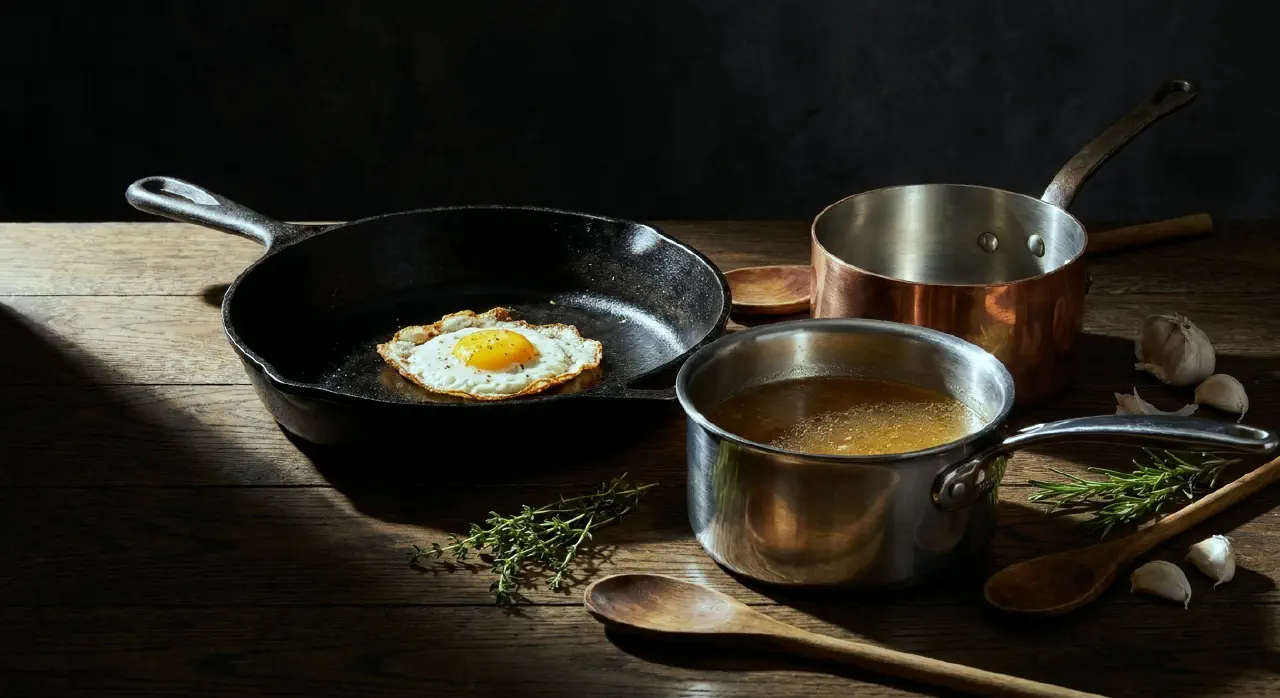
The material a pan is made from determines how it transfers heat to food - how fast it heats, how evenly it distributes energy across its surface, how quickly it responds to temperature changes, and whether it reacts with acidic or alkaline foods. The same electron-mobility mechanism that makes metals good electrical conductors makes them good thermal conductors, which is why all serious cookware is metal. But the metals differ enormously, and each involves tradeoffs between conductivity, reactivity, weight, and cost.
The conductivity hierarchy
| Material | Thermal conductivity | Reactivity | Notes |
|---|---|---|---|
| Copper | Highest | High (must be lined) | Best even heating; most expensive |
| Aluminum | Very high | Moderate (anodize or coat) | Restaurant standard; responds fast |
| Cast iron | Moderate | High (requires seasoning) | Exceptional heat retention; heavy |
| Stainless steel | Poor | Very low | Non-reactive; requires conductive core |
| Ceramics | Very poor (insulator) | None | Heat retention; fragile; uneven heating |
Copper
The best conductor - fastest response to temperature changes, most even heat distribution, finest precision. But copper oxidizes (green/black patina) and leaches into food at harmful levels, so it must be lined with tin (traditional, soft, needs periodic retinning) or stainless steel (durable but slightly reduces conductivity). Professional-grade material; high cost limits home use.
Aluminum
Excellent conductor, second only to copper, and far cheaper. Heats and cools rapidly, minimizes hot spots. The catch: aluminum reacts with acidic and alkaline foods - acids dissolve its protective oxide layer and can impart metallic taste; alkaline foods cause dark discoloration. Solutions: anodized aluminum (hardened oxide layer) and nonstick coatings. The dominant material in commercial kitchens for its performance-to-cost ratio.
Cast iron
Moderate conductor but exceptional heat retainer - once hot, cast iron holds temperature stubbornly, providing consistent, forgiving cooking. The high thermal mass (heavy weight) means slow heating but steady output. Iron is reactive with acidic and alkaline foods and rusts without protection.
Seasoning solves the reactivity and rust problems. Thin oil rubbed onto the surface and heated undergoes polymerization - the oil molecules crosslink into a hard, dark, non-stick polymer coating. Layers accumulate with repeated use, improving over time. This is essentially a homemade nonstick surface, maintained by regular cooking and occasional re-seasoning. Avoid prolonged soaking, dry promptly, oil lightly between uses.
Enameled cast iron coats the iron with a vitreous (glass-like) enamel layer - non-reactive, no seasoning needed, works with acidic foods. The tradeoff: enamel can chip, and the coating reduces the direct iron-to-food contact that builds fond.
Stainless steel
An iron-chromium alloy where chromium forms a self-healing oxide layer that resists corrosion. The most durable, lowest-maintenance, most chemically inert cookware metal - it never reacts with food, never needs seasoning, and looks good indefinitely.
The problem: stainless steel is a poor heat conductor, producing uneven heating and hot spots. The industry solution is cladding - sandwiching an aluminum or copper core between stainless steel layers. Multi-ply construction (tri-ply, five-ply) gives the non-reactivity and durability of stainless steel with the conductivity of the core metal.
Nonstick coatings
PTFE (Teflon): Synthetic polymer sprayed onto cookware, creating an extremely low-friction surface. Allows cooking with minimal oil and effortless release. Limitations: degrades above 400–500°F, damaged by metal utensils and abrasive cleaning, cannot develop fond for pan-sauces, and must eventually be replaced. Best for eggs, fish, pancakes - foods that stick persistently to uncoated surfaces.
Ceramic nonstick: A water-based alternative marketed as more environmentally friendly. Similar performance but generally less durable than PTFE.
Ceramics
Poor thermal conductors (electrons locked in bonds), slow and uneven heating, but excellent heat retention - ceramic dishes stay warm long after cooking. Non-reactive with all foods. Best for oven baking, serving, and specialized applications like Spanish cazuelas. Fragile - vulnerable to thermal shock and impact.
Choosing cookware
The choice depends on what matters most: copper for precision, aluminum for performance value, cast iron for heat retention and durability, clad stainless for versatility and ease, and nonstick for convenience with sticky foods. Most functional kitchens use a mix - cast iron and stainless for high-heat work, nonstick for eggs and fish, sheet aluminum for baking.
See also
- heat-transfer - conduction, convection, and radiation physics
- pan-frying - where pan material matters most
- deep-frying - oil as heat-transfer medium
- roasting-baking - oven materials and heat distribution
- pan-sauces - fond development requires reactive surfaces