Heat Transfer in Cooking
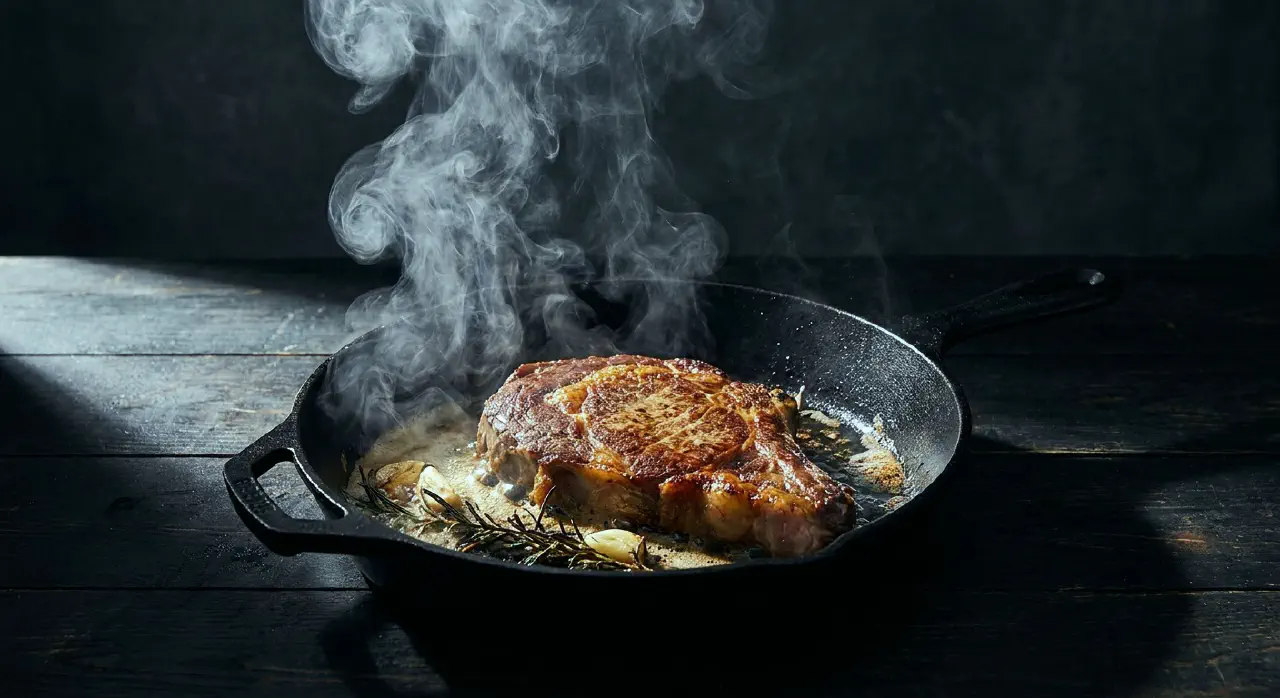
All cooking is heat transfer - getting thermal energy from a source into food. Three physical mechanisms do this work, and every cooking method is a particular combination of them. Understanding the three forms explains why different methods produce different results, why pan material matters, and why heating times vary with food size and shape.
Conduction: direct contact
Thermal energy passes from one particle to a nearby one through collision. The mechanism differs dramatically by material:
In metals, some electrons are loosely held and form a free-moving “gas” within the solid lattice. These mobile electrons carry energy rapidly from one region to another - the same electron mobility that makes metals good electrical conductors. Result: fast, efficient heat transfer. Copper and aluminum are the standouts (see cookware-materials).
In ceramics, electrons are locked in ionic or covalent bonds and cannot roam. Heat propagates only by vibration transfer between molecules - much slower and less efficient. Ceramics are thermal insulators, not conductors, which is why a ceramic dish retains heat long after a metal pan has cooled.
In food, heat travels from the outside surface toward the center by conduction. Because cellular structure impedes energy movement, foods behave more like insulators than metals - they heat slowly. The central challenge of cooking is heating food to the desired internal doneness without overheating the outer regions. The key variables are thickness (the primary factor - and the relationship is not linear), thermal diffusivity (how quickly temperature changes propagate), density, moisture content, and shape.
Convection: movement in fluids
Heated fluid becomes less dense, rises, cools, becomes denser, sinks - creating circulation patterns that distribute heat throughout the medium. Convection is more efficient than pure conduction because moving molecules carry energy faster than vibration can transfer it.
In water (boiling, simmering): circulation quickly brings the entire pot to a uniform temperature. In air (baking, roasting): hot air rises from heating elements, cooler air sinks, creating the circulation patterns that surround food in an oven. In oil (deep-frying): oil circulation carries heat efficiently to every food surface, and oil’s higher temperature capability (350–400°F vs. water’s 212°F) means faster energy delivery.
Radiation: electromagnetic energy
Energy travels as electromagnetic waves - no contact or intervening medium needed.
Infrared radiation (grilling, broiling): hot coals or electric elements emit infrared waves that directly heat the food surface. Radiation is directional - it heats primarily one side, which is why you flip food on a grill.
Microwave radiation (microwave-cooking): electromagnetic waves at a specific frequency interact with polar molecules (primarily water), causing them to rotate. The molecular friction generates heat from within the food - a fundamentally different mechanism from surface-in heating.
How cooking methods combine the three forms
No method uses a single form of heat transfer. Every cooking technique is a blend:
| Method | Primary | Secondary | Tertiary |
|---|---|---|---|
| Grilling | Radiation (infrared) | Conduction (grill grate) | - |
| Baking | Convection (air) | Radiation (oven walls) | Conduction (pan) |
| Boiling | Convection (water) | Conduction (water to food) | - |
| Pan-frying | Conduction (pan to food) | - | - |
| Deep-frying | Convection (oil) | Conduction (oil to food) | - |
| Steaming | Convection (steam) | Conduction (condensate film) | - |
| Microwaving | Radiation (microwave) | Conduction (molecule to molecule) | - |
The dry/moist divide
This is the master principle linking heat transfer to flavor. When food surfaces dehydrate in dry heat (oil, oven air, radiant heat), surface temperatures rise to 300–500°F - well above the thresholds for Maillard browning (~280°F) and caramelization (~330°F). When food is surrounded by water or steam, surfaces cannot exceed 212°F - too low for browning. This single fact explains why roasted, grilled, and fried foods are brown and intensely flavored while boiled and steamed foods remain pale and mild.
The exception: slow browning can occur in moist environments under alkaline conditions, high solute concentration, and extended time - egg whites simmered 12 hours turn tan, and balsamic vinegar goes nearly black over years of concentration.
See also
- cooking-temperatures - temperature/time relationships, the Arrhenius rule
- cookware-materials - how material conductivity affects cooking
- maillard-reaction - browning chemistry above ~280°F
- caramelization - sugar browning above ~330°F
- deep-frying - convection in high-temperature oil