Deep Frying
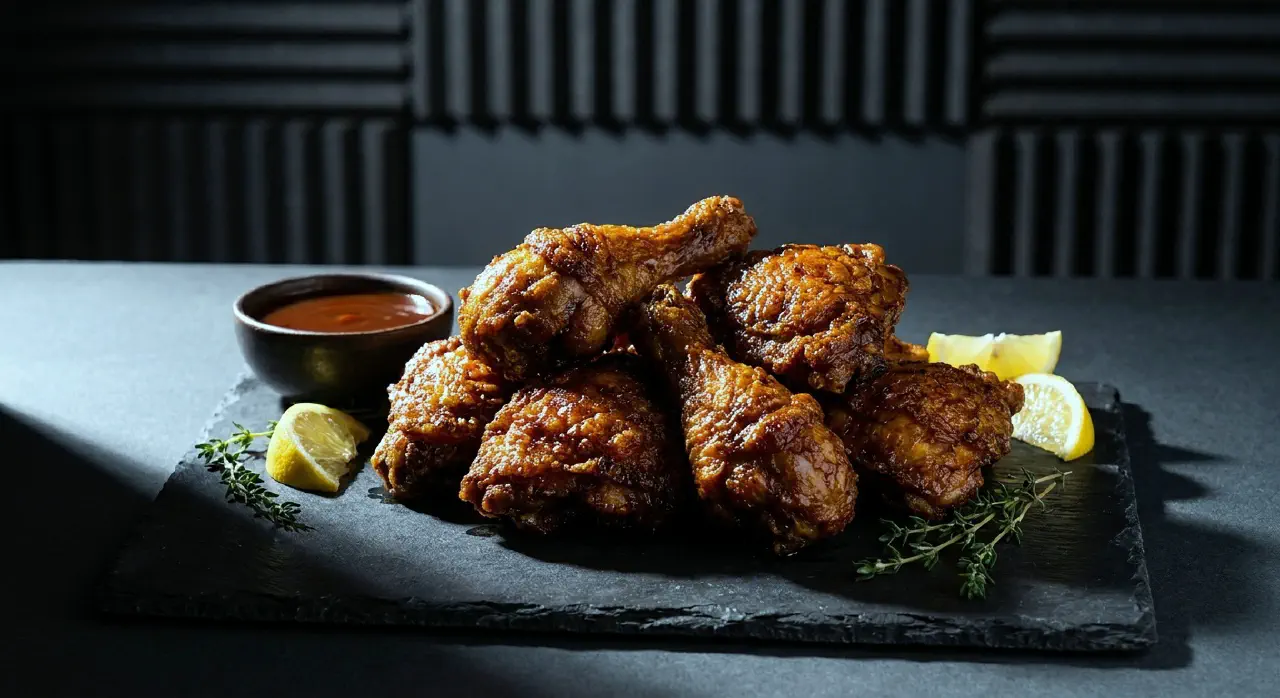
Deep frying is cooking food fully submerged in hot oil, typically at 325–375°F/163–190°C. It produces a uniquely satisfying contrast - a crisp, browned exterior and a moist, steamed interior - through a dynamic exchange between oil and water.
The mechanism: water out, oil in
When food enters hot oil, a rapid sequence begins:
- Surface water vaporizes - the food’s moisture flashes to steam on contact with oil far above water’s boiling point.
- Steam forces outward - the violent outward rush of steam is the vigorous bubbling you see. This steam pressure actually prevents oil from penetrating deeply into the food.
- The crust forms - as surface moisture departs, the dehydrated exterior crisps. Temperatures at the surface climb above 280°F/140°C, enabling Maillard browning. This is where deep-fried flavor and color develop.
- The interior steams - below the crust, the food’s interior never exceeds 212°F/100°C because it’s being cooked by its own steam. This is why a properly fried piece of fish is moist inside.
- Oil absorption happens after frying - most oil enters the food during cooling, not during frying. As the food cools, steam condenses and the pressure differential sucks oil into the surface pores. Draining immediately on a rack minimizes this.
The steam armor principle
The mechanism above can be summarized as a single concept: steam armor. As long as water inside the food is flashing to steam and pushing outward, oil cannot penetrate. The strength of this armor depends entirely on oil temperature - hotter oil means more vigorous steam production and a stronger barrier.
This reframes oil temperature, batch size, and even food moisture as aspects of the same physics:
Oil temperature: Below ~160°C, the steam armor is weak - oil seeps in and food becomes greasy. At 180°C, the armor is strong and reliable. At 190°C, it’s intense - ideal for thin items and maximum crispness.
Batch size: Adding food drops the oil temperature. If a batch drops the oil from 180°C to 170°C, the armor stays adequate. If it drops to 150°C, the armor collapses and every piece absorbs oil. Monitor the temperature dip - if it exceeds ~10°C, use smaller batches.
Food moisture: Wetter food produces more steam, which sounds beneficial, but the violent sputtering can be dangerous and the excess steam can cool the oil locally. Patting food dry before frying ensures controlled, even steam production.
Temperature bands
Rather than a single optimal temperature, deep frying has three useful bands, each suited to different foods:
Gentle (170°C/340°F): Slow crust formation, extended interior cooking. Best for par-cooking, large items, donuts, and pastries where the interior needs time to cook through before the surface over-browns.
Default (180°C/355°F): Strong bubbles, reliable crust. The workhorse temperature for most foods - standard fries, breaded items, general-purpose frying.
High-speed (190°C/375°F): Fast, intense browning. Best for thin items, tempura, and maximum crispness where the interior needs minimal cooking.
The starch paradox
Counterintuitively, higher frying temperatures produce less greasy food, not more. Starch coatings (breading, batter) need ~180–195°C to brown properly - they must first lose water (100°C), then undergo dextrinization (150–180°C), then finally Maillard-brown (180°C+). Below 180°C, the steam armor is weak and the starch stays pale, absorbing oil instead of crisping. This is why breaded fish should fry at 195°C, not 170°C - the higher temperature creates a crispier, lighter result. See cooking-temperatures for more on the starch browning sequence.
The double-fry technique
Many foods - french fries above all - benefit from two separate frying stages at different temperatures:
First fry (130–160°C, 5–8 minutes): This stage is not about crust formation. It cooks the interior through starch gelatinization and begins driving off moisture. The food emerges pale and slightly soft - this is correct. At this lower temperature, the steam armor is weaker, allowing more heat transfer into the interior without burning the surface.
Rest on a rack (minimum 5 minutes, or overnight refrigerated): Residual steam escapes as the food cools. The surface dries further. This drying is what makes the second fry effective.
Second fry (180–190°C, 2–3 minutes): The dry surface now crisps rapidly through Maillard browning - the already-cooked interior simply heats through. The higher temperature and dry surface combine to produce the crust that the first fry could not.
A single fry at 175°C for the full duration produces uneven results: the surface often overcooks before the interior softens fully. The two-stage process decouples interior cooking from exterior crisping. For the same reason, the double-fry also reduces acrylamide formation: the first fry stays below the peak acrylamide formation zone, and the short second fry limits total high-temperature exposure time.
The role of batters and breadings
A batter or breading is an engineered crust: it insulates the food interior while providing a surface optimized for crisping and browning. Flour and starch gelatinize and set, egg proteins coagulate and brown, and the outer surface dehydrates into a shell.
The batter also slows oil penetration - a thicker barrier between the oil and the food means less grease in the final product.
Fat absorption rates
Finished fries typically absorb 8–14% of their weight in oil. Improperly made or underdried fries can reach 20–30%. Most oil absorption occurs at the moment of removal and during cooling - not during the fry itself. While the food is in the oil, outward steam pressure limits oil penetration. When the food is removed and cools, steam condenses, internal pressure drops, and oil is drawn inward through surface pores.
Factors that increase absorption:
- Lower frying temperature (longer cook time, more pore time)
- Higher PUFA content in the oil (polyunsaturated fats break down faster, producing oxidation products that weaken the crust surface)
- Thinner cut (higher surface area relative to volume)
- Underdried surface before frying
The double-fry technique and thorough pre-drying both reduce oil uptake because a well-formed crust limits the number and size of surface pores through which oil can enter during cooling. Draining on a wire rack rather than paper towels also helps - paper traps steam under the food, which condenses and creates a local pressure that draws in more oil.
Oil selection
The choice of frying fat affects both flavor and stability:
Saturated and monounsaturated fats (beef tallow, lard, refined peanut oil) are thermally stable at frying temperatures. Tallow is approximately 50% saturated fat (primarily stearic acid) and 40% monounsaturated (oleic acid), with very low PUFA content. It has a smoke point around 220°C and can be reused across multiple frying sessions with minimal quality degradation. It also carries fat-soluble flavor compounds - lactones and lipid-derived volatiles - that transfer to the food’s surface during frying, contributing a savory, umami-adjacent character.
High-PUFA vegetable oils (canola, soybean, sunflower) break down more quickly at frying temperatures. Oxidation generates aldehydes and other volatile compounds that add off-flavors with each reuse. They are more economical and are now the standard in most commercial frying operations.
Practical guidelines: Use refined oils with smoke points well above 200°C. Avoid unrefined or extra-virgin oils, which smoke at lower temperatures and introduce off-flavors. Strain oil after each use; discard when it darkens significantly, smells rancid, or smokes at frying temperature.
Oil degradation
Frying oil degrades over time through oxidation and hydrolysis (reaction with water released from food). Degraded oil has a lower smoke point, develops off-flavors, and froths excessively. Oil can be reused several times but should be strained after each use and discarded when it darkens significantly, smells rancid, or smokes at frying temperature. High-PUFA oils degrade more quickly than saturated or monounsaturated fats - see seed-oils and lipid-chemistry for the underlying oxidation chemistry.
See also
- maillard-reaction - the browning chemistry that creates fried-food flavor
- starch-gelatinization - how batter and breading starches set into a crust
- wheat-flour - the structural basis of most batters
- cooking-temperatures - the Arrhenius rule and temperature decision framework
- vegetable-cooking - the steam blanket problem when frying vegetables
- fish-cooking - fish frying specifics, tempura technique, skin crisping
- heat-transfer - convection physics in oil
- cookware-materials - pot material, oil smoke points
- pan-frying - conduction-based shallow frying
- roasting-baking - oven dry heat alternative
- starch-browning - the browning process specific to starch coatings
- acrylamide - the health-relevant browning byproduct in fried starchy foods; reduced by double-frying and pre-soaking
- seed-oils - PUFA composition and oil stability in frying
- olive-oil - MUFA-dominant fruit oil; why its lower smoke point does not mean less safe for frying
- lipid-chemistry - oxidation pathways that degrade frying oil; smoke point vs. oxidative stability
- quick-thawing - rapid protein denaturation effects during thawing
- precision-cooking - temperature precision techniques and tools
- boilover-physics - why starch-thickened liquids boil over