Gelatin Gels
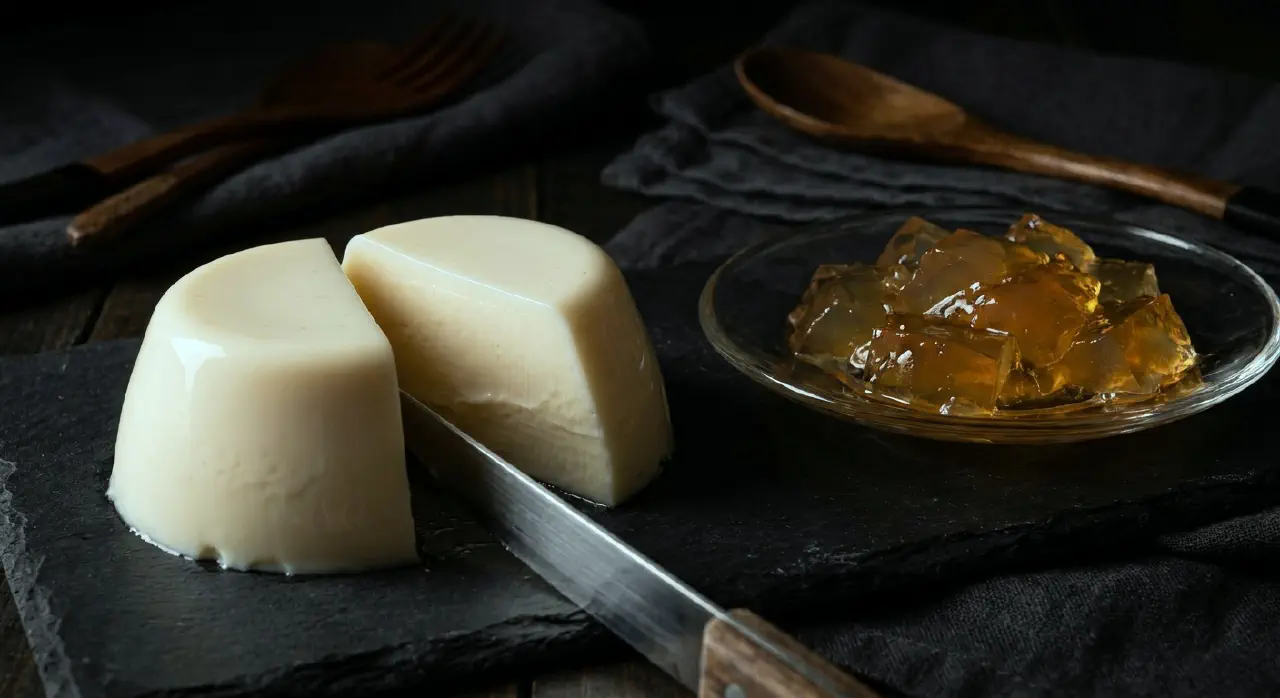
Gelatin is what makes a chilled stock set to jelly - collagen dissolved by heat, cooled into a three-dimensional protein network that traps water. It is the only common food gel that melts at body temperature, which gives gelatin-based preparations their characteristic melt-in-the-mouth quality. Carbohydrate gelling agents (agar, carrageenan, alginate, gellan) produce gels with entirely different textures and melting points, each suited to different culinary purposes.
Gelatin formation
The path from collagen to gel has three stages:
Extraction: Heating water with collagen-rich bones, skin, and connective tissue disrupts collagen’s triple-helix structure, releasing protein chains into solution. A standard 8-hour simmer extracts only ~20% of beef bone gelatin (see stocks-broths for extraction details). Extended heating or pressure-cooking extracts more but fragments chains into shorter pieces - smoother sauces, weaker gels.
Cooling: Below ~68°F (20°C), dissolved gelatin molecules slow enough to reform hydrogen bonds and hydrophobic associations with neighboring chains, building a three-dimensional meshwork.
Gel network: The meshwork traps water molecules - the result is a structure that appears solid but is mostly water. Acid slows gelation; sugar and dissolved salts can slightly affect gel strength.
Melting and setting
Gelatin’s defining feature is its melting point: ~93°F (34°C), right at body temperature. A gelatin gel is firm at room temperature but liquefies on the tongue, releasing flavor in a smooth rush. No carbohydrate gel replicates this sensation.
Setting requires refrigeration to below ~68°F (20°C); full firmness develops over 4–6 hours. Maximum strength is reached at about 12 hours.
Aspics: savory gelatin
An aspic is clarified meat or fish stock chilled to a transparent, amber jelly. Traditionally used to coat terrines, pâtés, and galantines - both for preservation and for the glossy elegance of a clear gel.
Gelatin concentration determines character:
| Concentration | Texture |
|---|---|
| 2–3% | Quivers, very delicate |
| 4–5% | Sets firmly, melts easily |
| ~6% | Holds shape well, still melts in mouth |
Natural stock gelatin produces a stickier, more stringy gel at high concentration than commercial gelatin, which has been further broken down for a cleaner mouthfeel. Weak stocks can be fortified with leaf or powdered gelatin - particularly useful for fish stocks, which produce inherently delicate gels because fish collagen melts at much lower temperatures (see stocks-broths).
Clarification uses the egg-white raft method described under stocks-broths. The trade-off: clarification removes some flavor molecules and gelatin along with the cloudiness.
Carbohydrate gelling agents
Four plant- and bacteria-derived gelling agents produce gels with characters unlike gelatin’s body-temperature melt.
Agar
Source: Red seaweed. Used in Asian cuisine for centuries.
Agar forms a very firm, somewhat brittle gel that melts only at ~90°C - far above mouth temperature. This high melting point made it revolutionary for microbiology (Robert Koch’s bacterial cultures, which would melt gelatin plates at incubation temperature). In the kitchen, agar gels hold their shape in warm rooms and can be diced, sliced, or cubed without collapsing. Too-high concentrations produce an unpleasantly rubbery texture.
Carrageenan
Source: Red algae. Long used in Chinese cooking and traditional Irish milk puddings.
Multiple purified fractions produce different textures - from brittle to elastic. Some forms are thermoreversible (they remelt with heat). Widely used in industrial food manufacturing as a thickener, gelling agent, and emulsion stabilizer.
Alginate
Source: Brown seaweeds.
Alginate’s unique property: it gels only in the presence of calcium ions. This is the basis of spherification in modern cuisine. A calcium-free alginate solution flavored and colored as desired is dripped or injected into a calcium solution; a thin gel membrane forms instantly around a liquid center, creating caviar-like beads or noodle-like strands. The interior remains liquid - a controlled, on-demand gelation impossible with any other agent.
Gellan
Source: Bacterial secretion (industrial discovery).
Gellan produces exceptionally clear, glossy gels that form in the presence of salts or acid. Excellent flavor release - the gel doesn’t mask taste the way denser gels can. Thermoreversible. Used in experimental and molecular cuisine for presentations where clarity and purity of flavor matter most.
Gelatin in sauces
At serving temperature (above its melting point), dissolved gelatin acts as a liquid thickener rather than a gel - it gives body to pan sauces and reduced stocks without any starchy heaviness. When the sauce cools, it sets to jelly - which is why a good demi-glace solidifies in the refrigerator but flows as a sauce when reheated. The concentration of gelatin during reduction is what gives jus and glace de viande their distinctive silky body.
See also
- stocks-broths - gelatin extraction, concentration, clarification
- pan-sauces - gelatin body in reduced sauces
- protein-denaturation - collagen melting and gelatin formation at the molecular level
- sauce-making - gelatin as one of six thickening strategies
- emulsions - gelatin as a stabilizer in emulsion systems