Stocks and Broths
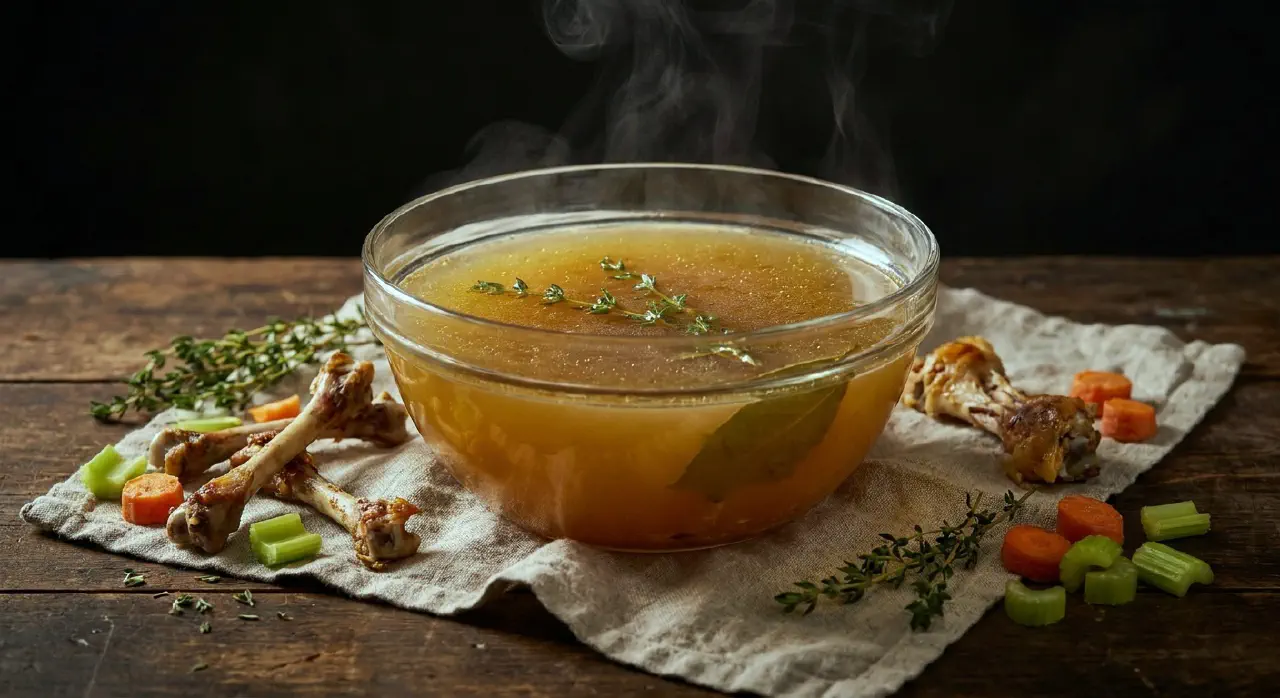
Stock is the liquid foundation of sauce making - water enriched with dissolved proteins, gelatin, minerals, and flavor compounds extracted from bones, meat, and vegetables. The distinction between stock (from Germanic “tree trunk” - basic supply) and broth (from 1000 CE Germanic “bru” - boiled) is largely historical; both are collagen extractions flavored by slow simmering.
Extraction science
Collagen in bones, skin, and connective tissue dissolves into gelatin when heated in water. The extraction is slow: a standard 8-hour simmer releases only ~20% of beef bone gelatin. The process has distinct phases:
- Initial heating: Scum forms from coagulating soluble proteins - skim off to maintain clarity
- Gentle simmer: After scumming, add vegetables, herbs, and wine; continue extracting at gentle bubble
- Straining: Through cheesecloth or fine strainer without pressing solids (pressing forces out cloudy particles)
- Chilling and defatting: Refrigerate until fat solidifies on surface, then lift off
Double and triple stocks: Using finished stock instead of water to extract fresh bones and meat produces exceptionally flavorful, gelatin-rich liquid. Extended extraction (up to 24 hours) pulls more gelatin from a single batch of bones.
Concentration: glace and demi-glace
Glace de viande (“meat ice/glass”): Stock reduced to 1/10 its original volume. Cools to a stiff, clear jelly at ~25% gelatin concentration. Intensely savory (concentrated amino acids), but with a somewhat flat aroma - volatile molecules have boiled off or reacted during the long reduction. Used in small quantities to lend flavor and body to finished sauces.
Demi-glace (“half-glace”): Stock reduced to 25–40% of original volume, often with tomato puree for color and flavor, supplemented with flour or starch (3–5% at final weight). The starch spares stock flavor from being boiled away and avoids the sticky consistency of very concentrated gelatin. This is the base for most classical French brown sauces. Now widely available frozen due to its tedious preparation.
Pan reduction alternative: Small quantities of stock reduced directly in the roasting pan after cooking meat. Repeated additions of stock, each cooked until browning begins before dissolving the next layer of fond, builds flavor through successive Maillard reactions. The high heat also fragments gelatin into shorter chains - producing a less sticky sauce that congeals more slowly.
Consommé and clarification
Consommé is the ultimate expression of stock: intensely flavored, amber-colored, completely clear, with delicate but distinct body. The clarification process uses egg white proteins as a biological filter:
- Finely chopped meat and vegetables stirred into cold stock with lightly whisked egg whites
- Brought slowly to simmer and held ~1 hour
- Egg whites coagulate into a fine cheesecloth-like mesh (the “raft”) that rises to the surface
- Convection carries cloudy particles upward into the raft, which traps them
- Clear liquid ladled from beneath, then strained
The trade-off: Egg white clarification removes not just particles but some flavor molecules and gelatin. Fresh meat and vegetables added during the process compensate - making consommé extremely expensive (as much as 1 lb meat per serving).
Chinese alternative: Finely chopped chicken meat stirred into stock twice in succession (no egg whites). The meat proteins themselves aggregate and trap particles.
Fish and shellfish stocks
Fish collagen is less cross-linked than mammalian collagen, melting at much lower temperatures: ~77°F (25°C) for warm-water fish (tilapia), ~50°F (10°C) for cold-water fish (cod). This means fish gelatin extracts at temperatures well below boiling and in much less time.
But fish gelatin is fragile: it readily breaks down with prolonged cooking, forming delicate gels that melt far below mouth temperature (70°F and lower). Recommended extraction: less than 1 hour at gentle simmer - longer cooking causes cloudiness from disintegrating bones and calcium salts, and destroys the fragile gelatin.
Squid and octopus have more cross-linked collagen than fish (parallel to cephalopod muscle), requiring prolonged heating at ~180°F (80°C) for significant gelatin extraction.
Commercial extracts
Justus von Liebig pioneered meat extract production: simmer scraps and bones, clarify, evaporate >90% of water. The finished product (~20% water, ~50% amino acids/peptides/gelatin, ~20% minerals) contains much of meat’s savory flavor. Pressure-cooking (275°F/135°C for 6–8 minutes) fragments gelatin so the concentrate isn’t unworkably thick. Water evaporation occurs mostly below 170°F to limit browning and keep the extract light. Modern variants preserve gelatin intact, sold as demi-glace or glace de viande.
See also
- sauce-making - the thickening taxonomy and classical sauce families
- pan-sauces - using stock for deglazing and quick reductions
- gelatin-gels - gelatin gel science, aspics, carbohydrate alternatives
- protein-denaturation - collagen melting and gelatin formation
- fish-cooking - fish collagen’s fragility and the 20°F gap
- meat-aging - collagen breakdown during aging vs. extraction
- maillard-reaction - browning reactions during stock reduction