Sauce Making
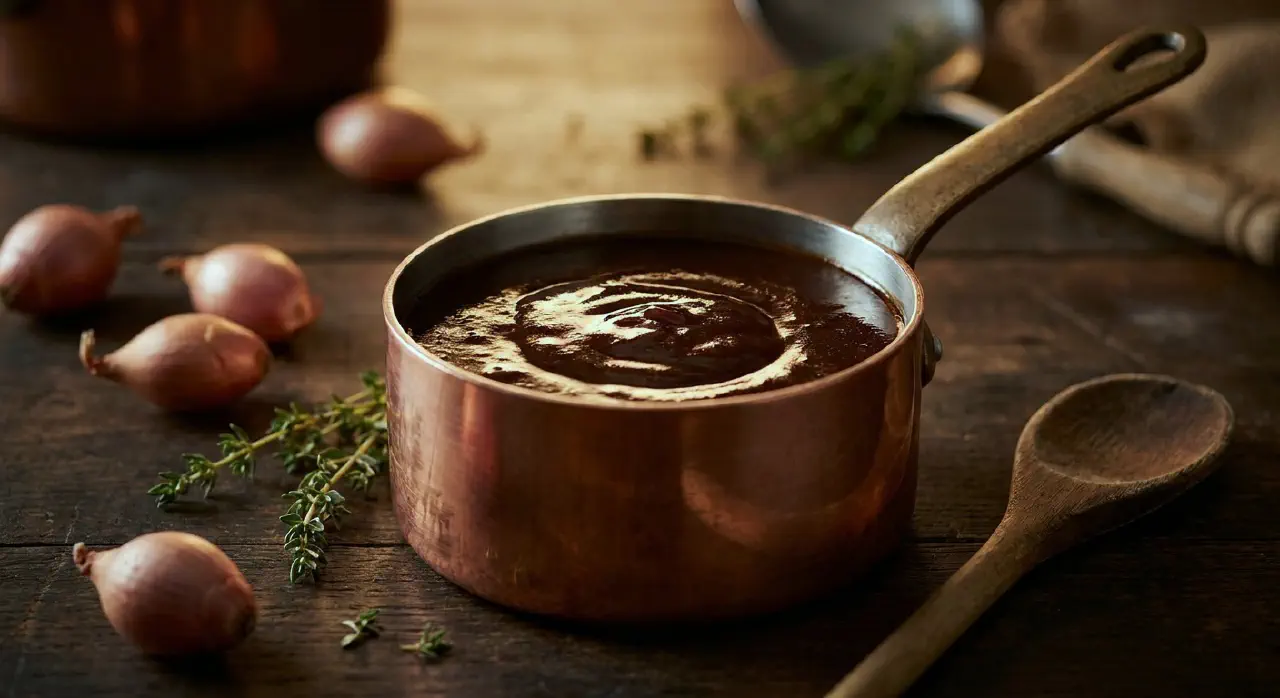
A sauce makes water seem less watery - giving it body, cling, and the ability to carry flavor across the surface of food. Every sauce in every tradition achieves this through one or more of six physical strategies: dissolving gelatin, swelling starch granules, coagulating egg protein, emulsifying fat droplets, suspending plant particles, or trapping gas bubbles in foam. Understanding this taxonomy makes the classical French system (and every other) a set of variations on knowable physics.
The thickening taxonomy
| Strategy | Mechanism | Examples |
|---|---|---|
| Gelatin/protein | Dissolved collagen forms 3D network when cooled | Stocks, aspics, demi-glace |
| Starch | Swollen granules + leaked amylose obstruct water flow | Roux sauces (béchamel, velouté, espagnole), gravy |
| Egg protein | Coagulated proteins form network trapping water | Custard sauces (crème anglaise), liaison, sabayons |
| Emulsified fat | Dispersed oil droplets crowd and thicken water phase | Mayonnaise, hollandaise, beurre blanc, vinaigrettes |
| Plant particles | Suspended solid fragments obstruct flow | Purees, pestos, salsas, spice pastes |
| Gas bubbles | Air or steam dispersed in liquid, stabilized by protein | Sabayons, foams |
Most sauces combine strategies: a pan sauce uses gelatin (from stock) + starch (optional roux) + emulsified fat (butter finish). A sabayon combines egg protein coagulation with gas bubble entrapment.
Flavor science
Sauce flavor has two components: taste (perceived on tongue - salt, sweet, sour, savory, bitter) and smell (perceived in upper nasal cavity - thousands of aromatic molecules, more soluble in fat than water). A satisfying sauce stimulates both; “something missing” usually means one taste or insufficient aroma.
Two critical principles:
-
Concentration. Sauces are eaten in small spoonfuls alongside food. A spoonful of sauce alone should taste too strong - it will be diluted by the food. Thickening agents reduce perceived flavor intensity, so seasoning must be checked after thickening.
-
Balance. Actively check for saltiness, sweetness, acidity, savoriness, and aroma. Correct deficiencies while maintaining overall harmony. A flat sauce usually needs acid; a harsh sauce needs fat or sweetness.
Consistency and appearance
The ideal sauce consistency is somewhere between solid and water - the luscious quality of ripe fruit that melts in the mouth. Fats provide persistent, moist fullness; thickeners give cling that prolongs flavor contact. Visual beauty signals care: vibrant color from parent ingredients, depth of tone from roasting or long cooking, attractive sheen or transparency.
Historical evolution
Sauce history is a sequence of thickening technologies. Roman sauces used pounded nuts, bread, liver, and egg yolks. Medieval cooks relied on toasted bread and almonds. The 17th–18th century shift to flour-and-butter roux and reduced meat broths created the French classical system. Carême (1784–1833) organized sauces into four mother-sauce families: espagnole (brown stock + brown roux + tomato), velouté (white stock + yellow roux), béchamel (milk + white roux), and hollandaise/mayonnaise (egg-emulsified, no stock). Escoffier’s 1902 Guide Culinaire lists nearly 200 sauces derived from these parents.
Nouvelle cuisine (1960s) rejected heavy flour-thickened sauces in favor of cream, butter, yogurt, vegetable purees, and light stocks. Contemporary cooking has expanded further: Asian dipping sauces, fruit and vegetable purees, molecular foams, and seaweed-derived gelling agents.
The classical starch-thickened sauces
Roux - a mixture of fat (usually butter) and flour cooked together - distributes starch particles evenly before liquid is added. The starch thickening curve follows a predictable arc: granules absorb water and swell → leak amylose molecules that form a 3D fishnet → continued heat fragments granules (thinning but refining texture) → cooling causes retrogradation (further thickening). See starch-gelatinization for the full science.
| Parent sauce | Base | Thickener | Key derivatives |
|---|---|---|---|
| Espagnole | Brown stock, tomato | Brown roux | Bordelaise, Madeira, Périgueux, Robert |
| Velouté | White stock | Yellow roux | Suprême, Allemande, Ravigote |
| Béchamel | Milk | White roux | Mornay (cheese), Crème, Soubise (onion) |
Gravy is the quick, last-minute version: deglazing liquid thickened with flour. Because starch granules don’t cook long enough to fully disintegrate, gravy has a slightly coarser texture than long-simmered classical sauces - hearty rather than suave.
See also
- stocks-broths - gelatin extraction, concentration, clarification
- pan-sauces - deglazing, fond, reduction, jus, finishing
- emulsion-sauces - mayonnaise, hollandaise, beurre blanc, vinaigrettes
- gelatin-gels - aspics, carbohydrate gelling agents, spherification
- condiments - cold sauces, salsas, pesto, fermented condiments
- starch-gelatinization - the science behind roux-based sauces
- emulsions - the physics of oil-in-water and water-in-oil dispersions
- custards - egg-thickened sauces (crème anglaise), liaison, sabayons