Leafy Greens
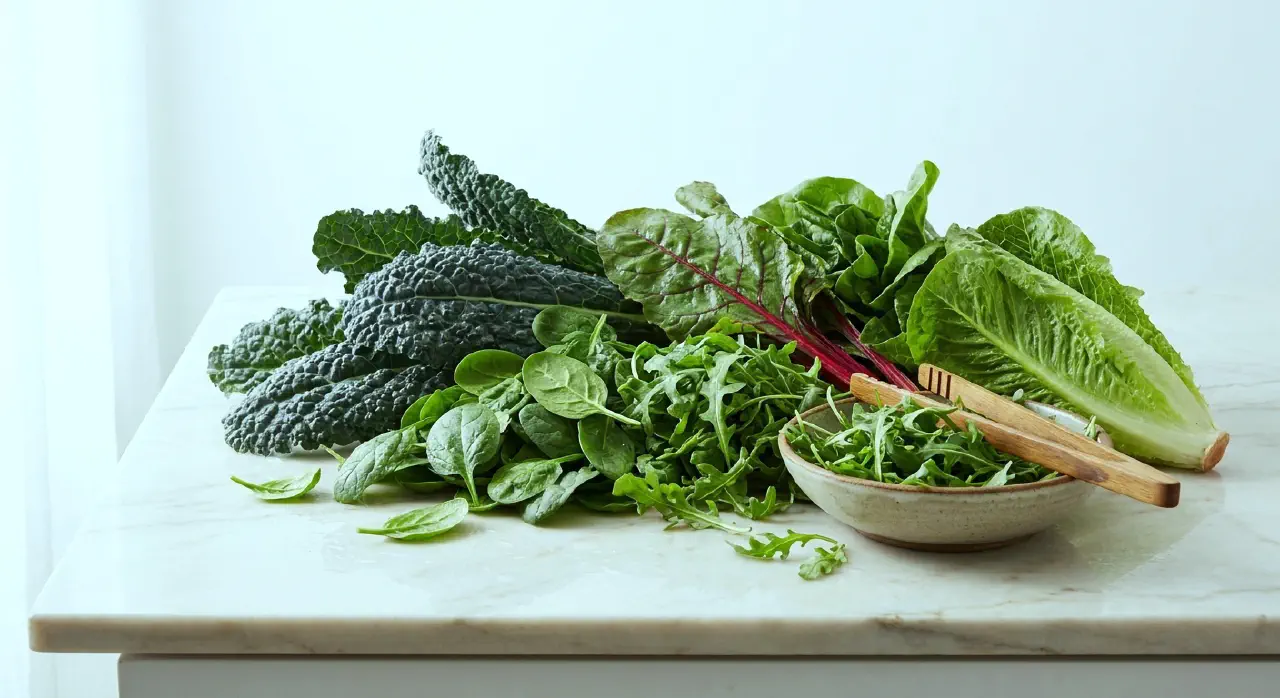
Leaves are the quintessential vegetable - a salad of raw greens is arguably the most primeval dish. Nearly all tender spring leaves in temperate regions are edible, and cultures worldwide have traditions of cooking leaves from weeds, root crops, and fruit plants alike. The science of leafy greens revolves around three concerns: the volatile “green” aroma, the management of bitterness, and the peculiarities of salad construction.
The “green” note
The fresh, grassy aroma of cut leaves comes from hexanol (“leaf alcohol”) and hexanal (“leaf aldehyde”) - 6-carbon molecules produced when cell damage frees enzymes that break apart long fatty-acid chains in chloroplast membranes. Cooking inactivates these enzymes and causes the products to react with other molecules, so the fresh green note fades and other aromas become prominent. This is why raw and cooked greens taste so different - the characteristic smell of a salad is literally a wound response.
Salad science
Leaf selection: Start with fresh, young leaves - least fibrous, most delicate flavor. Overgrown lettuce tastes almost rubbery from accumulated defensive compounds.
Cutting: A sharp knife ruptures fewer cells than tearing by hand (which requires squeezing). Damaged cells trigger off-flavors and darkened patches from enzymatic browning.
Hydration: Soak briefly in ice water to maximize cell turgor and crispness, then dry thoroughly - dressing won’t coat wet leaves, it just slides off and pools.
Dressing timing: Oil-based vinaigrettes should be added at the last minute. Oil wets the waxy leaf cuticle, percolates through air spaces, darkens the leaf, and makes it soggy. Chill vinaigrettes in the freezer briefly - viscous, cold dressings coat better than thin, runny ones. Water-based cream dressings penetrate less aggressively and tolerate advance dressing better.
Salt suppresses bitterness: Salads of bitter greens are traditionally paired with salty dressings and ingredients. Salt doesn’t merely balance bitterness - it actively suppresses the perception of bitter compounds on the tongue.
Lettuce family
Derived from the inedibly bitter weed Lactuca serriola (the Latin syllable “lac” means milk - referring to the defensive white latex that oozes from a freshly cut lettuce base). Cultivated for 5,000+ years. Mostly eaten raw in the West, but often shredded and cooked in Asia.
Varieties span a texture and flavor spectrum: Loose-leaf (open, tender), butter (soft, small midribs), batavian (crisp, dense), cos/romaine (elongated, prominent midribs), and crisphead/iceberg (tightly wrapped, brittle, pale). Iceberg triumphed in 20th-century America through shipping durability and refreshing crunchy-wet texture, despite lower vitamin and antioxidant levels - the head shields inner leaves from sunlight.
Stem lettuce/celtuce: Grown for its prominent, crisp stalk. Popular in Asia, where it’s stripped of leaves, peeled, sliced, and cooked.
Chicories and endives
Close lettuce relatives cultivated to provide a civilized dose of bitterness (the original lettuce bitterness from the terpene lactucin has been mostly bred out). Include endive, escarole, chicory, radicchio, and frisée.
Belgian endive (witloof): A double-grown chicory. Seeds planted in spring, plants defoliated in fall, taproots stored cold, then forced in darkness for a month to produce a tight, pale head with delicate flavor and crunchy-tender texture. Market exposure induces greening and harsh bitterness - use promptly. This is agricultural engineering at its most elaborate for a salad ingredient.
Radicchio: Tight round or elongated heads of red anthocyanin-pigmented leaves. Bitter but less harshly so than puntarelle or wild chicory.
Spinach and chard
Both belong to the beet family and both contain oxalates - calcium-binding compounds that can be troublesome in large amounts.
Spinach: Central Asian origin, brought to Europe by Arabs in the late Middle Ages. Valued for rapid growth, mild flavor, and tender texture when briefly cooked (volume reduces by three-quarters). Some varieties are tender enough raw; thick-leaved types are chewy and unsuitable for salads. Called cire-vierge (“virgin beeswax”) in French classic cuisine - it receives any impression without imposing its own taste. Excellent source of folic acid (first purified from spinach), vitamin A, and phenolic antioxidants.
Chard: Beet varieties selected for thick, meaty leaf stalks rather than roots. The brilliant yellow, orange, and crimson stalks get their color from betain pigments - the same water-soluble pigments as in beet roots, which stain cooking liquids and sauces.
Miscellaneous greens
Dandelion: Found on all continents. Bitter leaves often blanched before eating. The taproot produces repeated rosettes if left intact.
Amaranth (Chinese spinach): Earthy-flavored, rich in vitamin A, but 2–3 times the oxalate content of spinach. Boiling in copious water removes some oxalates.
Nettles: Stinging hairs contain histamine and other irritants. A quick blanch in boiling water disarms them entirely. Made into soup or stewed.
Purslane: Fat stems and small thick leaves combining tartness with mucilaginous smoothness. Notable for calcium, vitamins, and omega-3 fatty acid linolenic acid - unusual for a land plant.
Mâche (lamb’s lettuce): Small, tender, slightly mucilaginous leaves with a distinctive complex fruity-flowery aroma from esters and terpenes.
See also
- plant-biology - turgor pressure, air pockets in leaves, why greens shrink when cooked
- plant-color - chlorophyll, anthocyanins, betains, and enzymatic browning in cut greens
- plant-flavor - bitterness, tannins, and the phenolic compounds that drive salad flavor
- vegetable-cooking - cooking methods for greens, chlorophyll preservation
- cabbage-family - brassica greens (kale, collards, mustard greens, Asian cabbages)