Plant Biology
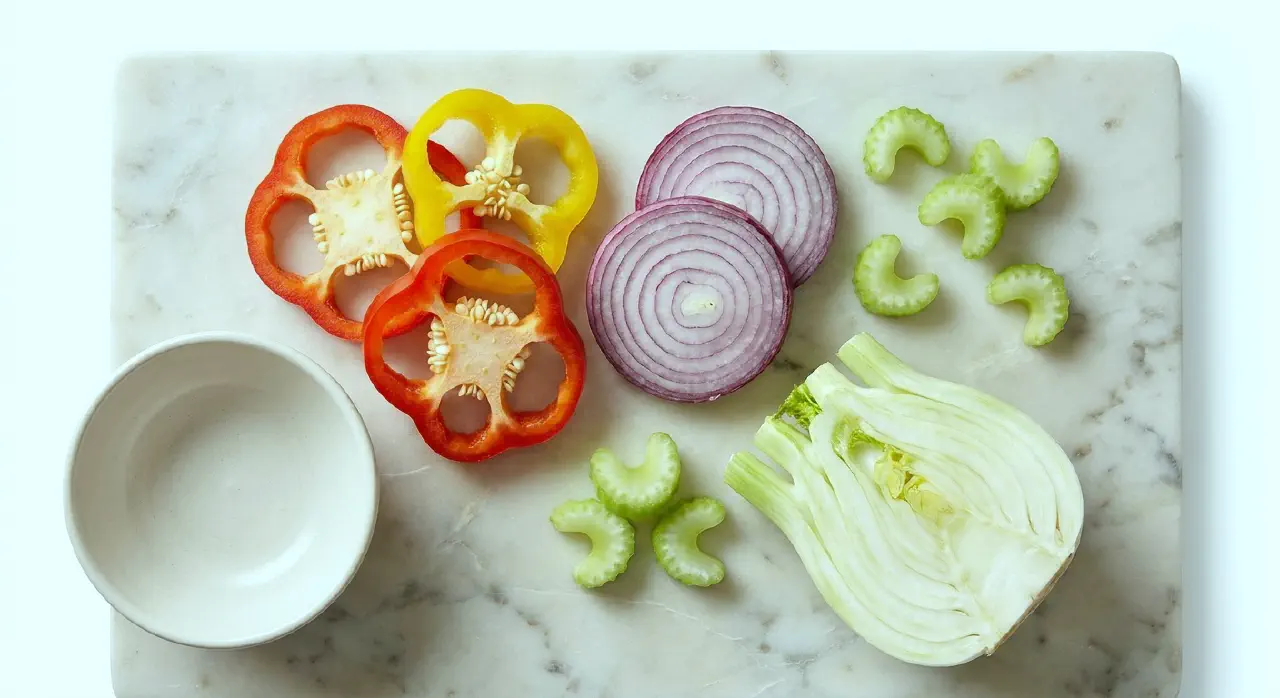
Plants are carbohydrate machines. Unlike animals, which build their tissues from protein and fat for movement, plants build from carbohydrates - cellulose for structure, starch for storage, sugars for energy. This fundamental difference explains why plant foods taste, cook, and behave so differently from meat: carbohydrates tolerate heat robustly, dispersing into tissue moisture at boiling temperature to create soft, succulent textures. There is no equivalent of the overcooked-tough steak - vegetables can only go too soft, never too tough.
The plant cell
A plant cell has several components that matter in the kitchen:
Cell wall: The defining structural feature that animals lack. Built from tough cellulose fibers embedded in a matrix of pectin and hemicelluloses - like rebar in concrete. The wall is strong, rigid, and its outer layers act as glue holding neighboring cells together. Pectin is the critical cooking variable: it dissolves above ~80°C, which is why vegetables soften when heated (see vegetable-cooking).
Vacuole: A large, watery chamber that often fills 90% of the cell’s volume. Contains sugars, acids, water-soluble pigments (including anthocyanins), enzymes, and defensive compounds. The vacuole is the flavor reservoir of the plant cell.
Chloroplasts: Found in leaf cells. Contain chlorophyll and carry out photosynthesis, converting CO₂ and water into glucose using sunlight. Also contain carotenoid pigments that protect the photosynthetic machinery.
Chromoplasts: In fruit cells. Concentrate yellow, orange, and red carotenoid pigments - the colors that signal ripeness.
Amyloplasts: In storage cells. Hold starch granules (long chains of glucose) - the plant’s energy bank.
Turgor pressure and crispness
When water is abundant, the vacuole swells and presses outward against the cell wall. Across thousands of cells, this mutual pressure reaches ~50 times atmospheric pressure. The result is the firm, rigid, crisp texture of fresh vegetables - when you bite through turgid cells, the walls break crisply and the cells burst, releasing juice.
When cells lose water, this supporting pressure disappears. Walls sag, tissue goes limp and flaccid. Chewing compresses the collapsed walls together rather than breaking through them - the texture becomes chewy rather than crisp. This is wilting, and it is fully reversible: soaking limp vegetables in water for hours allows cells to reabsorb water and reinflate. Cold enhances the effect - chilled cell-wall cement is stiffer, making cold vegetables snap more crisply.
Tough materials: cellulose and lignin
Not all plant texture is manageable. Two materials resist all normal cooking:
Cellulose: Chains of glucose linked in a configuration that prevents human enzymes from breaking them - and that resists all but extreme heat and chemicals. Cellulose is the most abundant plant product on earth (one-third of wood, nearly pure in cotton). In the kitchen, it appears as the gritty stone cells in pears, the stringy fibers in celery, and the tough vascular strands in broccoli stems. The only remedy is physical removal: peel, devein, or trim.
Lignin: The strengthening agent that literally defines wood. Most vegetables are harvested before appreciable lignin forms, but woody asparagus and broccoli stems are common encounters. Again, the only remedy is peeling away the lignified tissue.
Plant organs and their kitchen behavior
Different plant organs have different compositions, which determines how they cook:
Roots (carrots, parsnips, beets, sweet potatoes): Storage organs packed with nonfibrous tissue. Carrots store nutrients around a central vascular core (the less-flavorful woody center). Beets store in concentric layers.
Stems and tubers (asparagus, celery, potatoes, ginger): Conduct nutrients and provide support, so they tend toward fibrousness. Tubers (potato, yam) are swollen stem tips designed for reproduction - starch-packed storage organs. Rhizomes (ginger, sunchoke) are horizontal underground stems.
Leaves (lettuce, spinach, herbs): Specialize in photosynthesis. Thin, with 70% of their volume as air pockets that maximize light capture. This is why leafy vegetables shrink dramatically when cooked - heat collapses the spongy interior. Onion and garlic clove bases are actually swollen leaf bases that store water and carbohydrates.
Flowers (broccoli, cauliflower, artichokes): Reproductive organs, often brilliantly colored and aromatic. We eat them immature, before the flowers open.
Fruits (tomatoes, peppers, squash): Derived from the flower’s ovary, designed to be eaten - the plant wants animals to disperse its seeds. When ripe, fruits are flavorful and tender by intention.
Texture after cooking
When heat breaks down pectin in the cell walls, the texture trajectory depends on what fills the cells:
Sugar-filled vacuoles (ripe fruit): Produce a melting, succulent texture as walls dissolve and sugar solution oozes out.
Starch-filled amyloplasts (potatoes, unripe fruit): Produce a mealy, dry texture - the starch granules absorb water and swell, becoming moist but chalky, never juicy.
Water-filled vacuoles (most vegetables): Produce the soft-to-mushy gradient governed by the pectin cliff described in vegetable-cooking.
See also
- vegetable-cooking - the pectin cliff and practical temperature regimes
- plant-color - the four pigment families and how cooking affects them
- plant-flavor - sugars, acids, bitterness, tannins, pungency, and aroma families
- produce-handling - post-harvest deterioration, ethylene, and storage
- starch-gelatinization - how starch granules absorb water and swell
- cooking-temperatures - the Arrhenius rule and why small temperature errors compound
- carbohydrate-overview - cellulose, pectin, hemicelluloses as cell-wall materials; starch vs cellulose
- precision-jam - precision techniques for fruit preservation