Plant Color
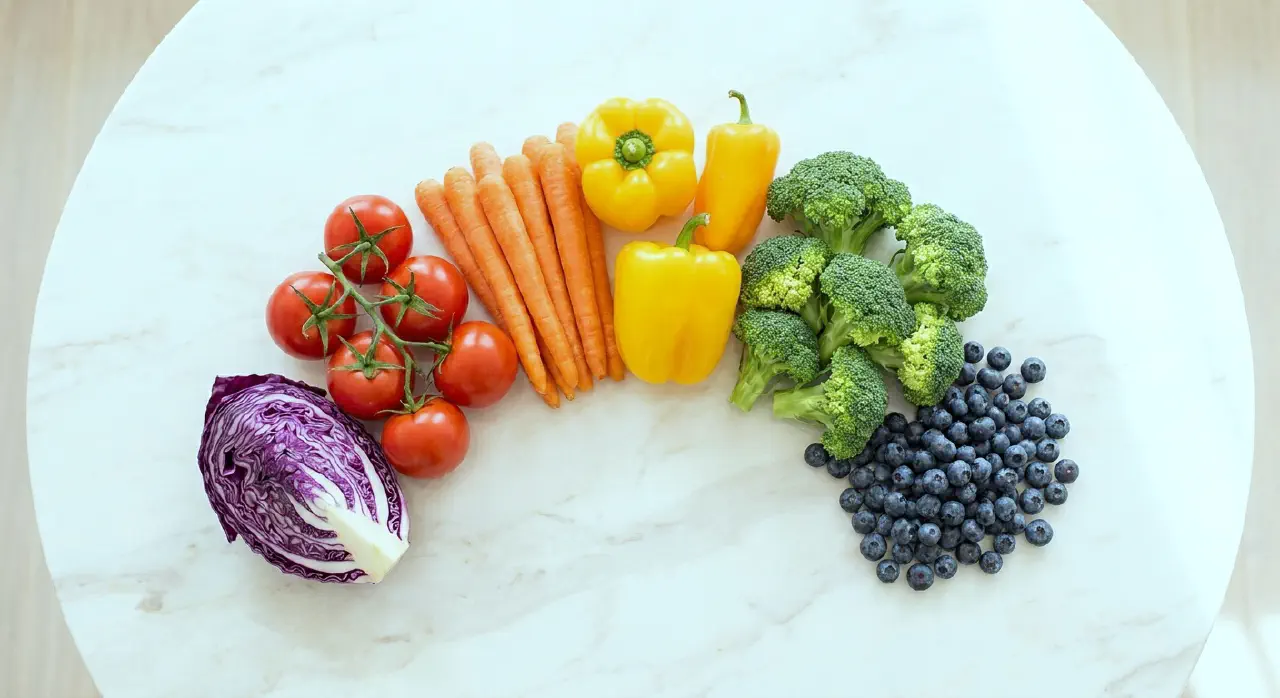
Plant pigments fall into four families, each with different chemistry, different locations in the cell, and different responses to cooking. Understanding these four families - and the enzymatic browning reaction that cuts across all of them - explains nearly every color change that happens between the garden and the plate.
The four pigment families
Chlorophyll (green)
The most abundant pigment on earth, responsible for harvesting solar energy in photosynthesis. Two forms exist: chlorophyll a (bright blue-green, dominant at 3:1 ratio) and chlorophyll b (more muted olive). Both sit in chloroplast membranes, anchored by a fat-soluble carbon tail, with a water-soluble ring structure centered on a magnesium atom - structurally similar to the iron-centered ring in myoglobin.
Fragility in the kitchen: Chlorophyll molecules are readily altered when their chloroplast membrane is disrupted by heat. Two changes occur. First, prolonged cooking strips the carbon tail, making chlorophyll water-soluble - it leaks into cooking liquid and becomes vulnerable to further damage. Second, heat or acid displaces the central magnesium atom, converting bright green to dull olive-grey. Both changes are accelerated by acid and enzyme action (chlorophyllase is most active at 150–170°F/66–77°C and destroyed near boiling).
Preservation strategy: Keep cooking times short, temperatures moderate, and pH neutral. An uncovered pot allows volatile acids to escape rather than concentrating in the liquid. The initial seconds of cooking actually intensify green - trapped gases escape and cell structures become translucent, giving a clearer view of the pigment.
Carotenoids (yellow, orange, red)
Named after carrots, these pigments absorb blue and green wavelengths. They include beta-carotene, lycopene (red in tomatoes), xanthophylls, and capsanthin (red in peppers). Structurally they are zigzag chains of ~40 carbon atoms resembling fat molecules - and like fats, they are fat-soluble and relatively heat-stable.
Carotenoids sit in two locations: in chromoplasts (the bright signal pigments of ripe fruits and flowers) and in chloroplasts (where one carotenoid accompanies every five chlorophylls, acting as antioxidant bodyguards for the photosynthetic system). In green vegetables, carotenoids are masked by chlorophyll - darker green means more carotenoids hiding underneath.
In the kitchen: Carotenoids barely change during water-based cooking. Color may shift slightly (carrots go from red-orange toward yellow) but stays bright. Oil-based cooking improves carotenoid availability for absorption. Cooking and drying can break carotenoid molecules into volatile fragments that contribute aroma notes of black tea, hay, honey, and violets.
About 10 carotenoids convert to vitamin A in the human intestinal wall, with beta-carotene the most important. This makes dark green and orange vegetables essential dietary contributors.
Anthocyanins (red, purple, blue)
Water-soluble phenolic compounds responsible for most red, purple, and blue colors in plants - berries, red cabbage, purple asparagus, radish skins. About 300 known anthocyanins exist; a given fruit typically contains a mixture of 12 or more. They live in the storage vacuole of plant cells (see plant-biology).
Vulnerability: Because they are water-soluble and stored in vacuoles, anthocyanins bleed readily into cooking liquid when cell structures break down. They are sensitive to pH (alkalinity shifts color toward blue), metal traces (cause strange off-colors), and heat. Purple asparagus and beans lose their color during cooking - the pigment dilutes to invisibility as cells break open.
Anthocyanins are valuable antioxidants with phenolic ring structures. Their related compounds, anthoxanthins (pale yellow, in potatoes and onions), are similarly water-soluble and pH-sensitive - often the source of unexpected off-colors in cooked pale vegetables.
Betains (red and yellow - beets and chard only)
Found in only a handful of species: beets, chard, amaranth, and prickly pear. About 50 red betains and 20 yellow betaxanthins exist; combinations produce the fluorescent-looking stems of novelty chard varieties.
Betains are water-soluble and sensitive to both heat and light, so they bleed during cooking like anthocyanins. Red betains contain a phenolic group and are good antioxidants; yellow betaxanthins lack it and are not. A harmless curiosity: the human body has limited ability to metabolize betains, so large beet or prickly pear doses can tint urine startlingly.
Enzymatic browning
The brown discoloration of cut apples, bananas, potatoes, and mushrooms is not a pigment family - it is a defense reaction that occurs when cell damage mixes three normally separated ingredients:
- Phenolic compounds (stored in the vacuole)
- Oxidizing enzymes (stored in the cytoplasm)
- Oxygen (from the air)
The enzymes oxidize the phenolics, which then bond into large, light-absorbing brown clusters. Biologically, this is plant chemical warfare: the reactive phenolics attack invader membranes and enzymes. The brown pigments are essentially spent weapons - similar to the melanin system that produces human sun-tanning.
Controlling browning:
Acid (lemon juice) slows enzyme activity - the most convenient kitchen method. Cold (below 40°F/4°C) slows it moderately. Cold water immersion limits oxygen access. Brief blanching (a few seconds in boiling water) destroys the enzymes outright. Sulfur compounds block the reaction by bonding to phenolics - this is why dried fruits are often sulfur-treated. Ascorbic acid (vitamin C) works as an antioxidant inhibitor.
Note that high cooking temperatures can encourage phenolic oxidation even without enzymes - cooked vegetable water sometimes turns brown on standing.
Evolutionary footnote
Only a handful of animal species have red-green color vision: tropical forest primates and our ancestors. Young tropical leaves are red with anthocyanins (which absorb excess solar energy); these young leaves are more tender and nutritious than mature green ones. Without red vision, primates couldn’t spot them - or carotenoid-colored ripe fruits - against the green canopy. Our pleasure in the colors of food was shaped by our ancestors’ hunger for red-tinged leaves and yellow-orange fruits.
See also
- plant-biology - cell structure, vacuoles, chloroplasts, and where pigments live
- plant-flavor - the phenolic compounds that cause both browning and astringency
- vegetable-cooking - practical color preservation strategies during cooking
- produce-handling - how post-harvest conditions affect pigment stability
- meat-flavor - myoglobin’s structurally similar ring-and-metal pigment system
- fruit-ripening - pigment changes during ripening (chlorophyll loss, carotenoid/anthocyanin expression)
- pome-fruits - anthocyanins in red apples, quince phenolic→anthocyanin transformation
- citrus - carotenoids, lycopene in grapefruit, anthocyanins in blood oranges
- berries - anthocyanin-rich fruits, pH-sensitive color shifts
- melons - lycopene in watermelon (richer than tomatoes), carotenoids in orange melons
- dried-fruits - betains in cactus pear, anthocyanins in pomegranate, browning during drying
- aromatic-seeds - saffron carotenoids (water-soluble crocin), turmeric curcumin (pH-sensitive color)