Vegetable Cooking
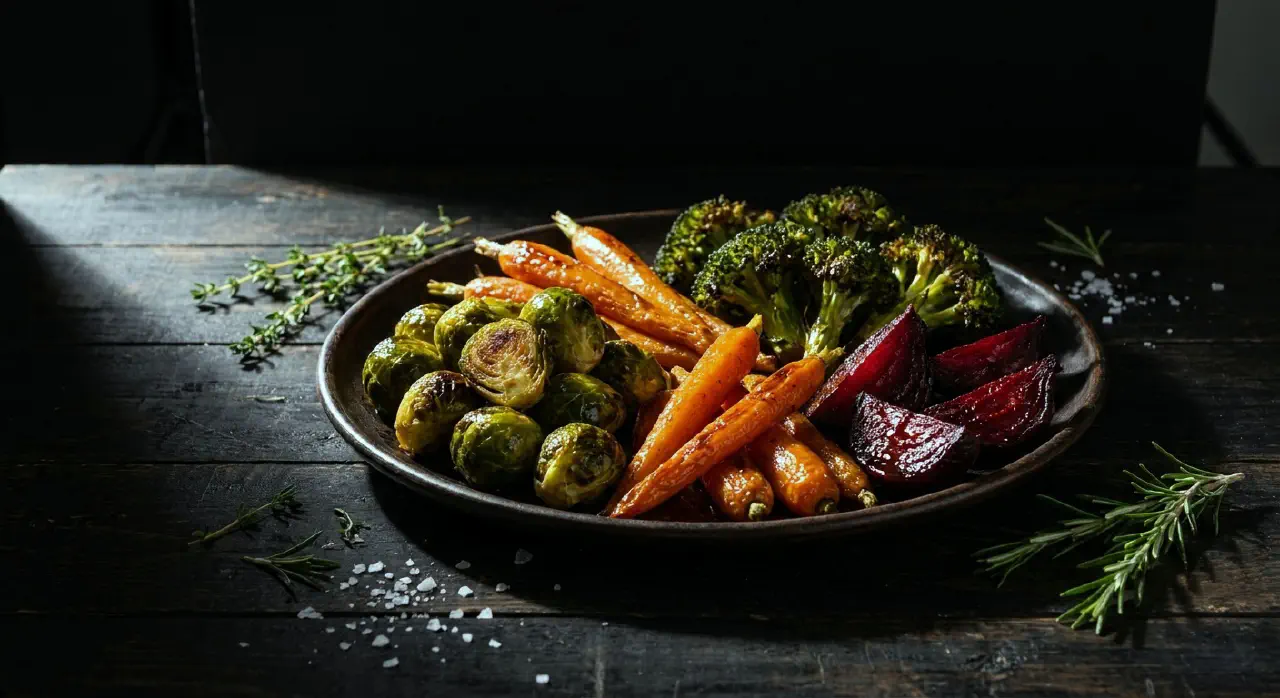
Cooking vegetables is, in principle, simpler than cooking meat - plant tissues are mainly carbohydrates, which tolerate heat better than proteins. But the simplicity is deceptive. Vegetables occupy one of cooking’s narrowest temperature windows: only 10°C separates “still crunchy” from “mush,” and both color and nutrients degrade rapidly with overcooking.
Why vegetables are forgiving - and unforgiving
Plant cell walls are built from cellulose fibers held together by pectin, a gel-forming carbohydrate. Unlike proteins, which tighten and expel water when heated, carbohydrates simply disperse into the tissue moisture, producing soft, succulent textures. There is no equivalent of the “overcooked steak” failure mode - vegetables don’t get tough, they get soft. The danger is going too far.
The unforgiving part is pectin. Below ~80°C, pectin is stable - vegetables stay crunchy even after hours at low temperature. At 84°C, pectin dissolves in a controlled way, producing the tender-crisp sweet spot. Above 90°C, dissolution accelerates dramatically, and the cell walls lose their integrity. This is the pectin cliff: a 10°C window that determines whether your carrots have bite or have become baby food.
The three temperature regimes
High heat: frying (190–195°C)
Frying vegetables at high temperatures produces charred exteriors with snappy, bright interiors. The key challenge is the steam blanket: below ~140°C, surface moisture creates a layer of steam that prevents oil from contacting the food. The vegetable steams rather than fries - it goes grey and soft, with no browning. Above 190°C, flash evaporation clears the moisture and allows Maillard contact with the surface.
Most vegetables fry well at 150°C (medium-high heat), but for proper browning, 190–195°C is the minimum. Dense root vegetables need slightly higher temperatures (160–165°C) than delicate greens. Mushrooms want maximum heat (200°C) to flash off their exceptionally high water content - at lower temperatures they simply stew in their own liquid.
Medium heat: poaching (87–95°C)
Poaching at just below boiling preserves color, flavor, and nutrients better than a full rolling boil. The standard temperature is 95°C - hot enough to soften pectin efficiently but below the point where chlorophyll degrades rapidly to olive-grey. Adding salt and a pinch of sugar to the poaching water enhances both flavor and color retention.
Cooking times vary widely by vegetable structure. Thin, delicate vegetables (asparagus tips, sugar snap peas) reach al dente in 2–4 minutes. Medium florets (broccoli, cauliflower) need 10–12 minutes. Regular green beans need a full 20 minutes for al dente - their cell walls are surprisingly robust.
Precision: sous vide at 84°C
The pectin sweet spot. At exactly 84°C, pectin dissolves slowly and controllably. Vegetables cooked at this temperature develop a tender-crisp texture that is uniform throughout - no gradient from soft exterior to crunchy center. The results hold well: vegetables can wait at temperature without overcooking.
Times at 84°C: carrots 45–90 minutes, parsnips 45–75 minutes, beets 90–120 minutes, corn 45–60 minutes, potatoes 60 minutes.
Color preservation
Plant pigments respond differently to cooking:
Chlorophyll (green) brightens in the first seconds of cooking as trapped gases escape and cell structures become translucent. But prolonged heat displaces the magnesium atom at the molecule’s center, dulling the color to olive-grey. Keeping cooking times short, temperatures moderate, and pH neutral preserves green best. An uncovered pot allows volatile acids to escape rather than concentrating them in the cooking liquid.
Carotenoids (yellow, orange, red) are fat-soluble and relatively heat-stable - they don’t leach into cooking water easily. Oil-based cooking methods (roasting, sautéing) actually improve carotenoid availability.
Anthocyanins (red, purple, blue) are water-soluble and vulnerable - they leach readily into cooking liquid and are sensitive to pH shifts and metal traces. Short cooking times and careful pH management are essential.
The nutrient trade-off
Every cooking method involves a trade-off between texture improvement and nutrient loss. Water-soluble vitamins and flavor compounds leach into cooking liquids during boiling and poaching. Steaming loses fewer nutrients (no immersion) but takes slightly longer. The practical solution: use cooking liquids in sauces or stocks rather than discarding them.
High-heat methods (stir-frying, roasting) preserve water-soluble nutrients better because cooking times are shorter and there’s no leaching medium - but the high temperatures degrade some heat-sensitive compounds. There is no perfect method; the choice depends on the desired outcome.
See also
- plant-biology - cell walls, turgor pressure, cellulose, and lignin - the structures cooking transforms
- plant-color - the four pigment families and how to preserve them during cooking
- plant-flavor - sugars, acids, bitterness, pungency, and the five aroma families
- produce-handling - post-harvest deterioration, ethylene, and storage before cooking
- cooking-temperatures - the Arrhenius rule and the decision tree framework
- starch-gelatinization - how starchy vegetables (potatoes, root vegetables) absorb water and thicken
- alliums - the sulfur chemistry of onions and garlic during cooking
- maillard-reaction - the browning reactions that occur at high-heat vegetable roasting
- deep-frying - the steam armor principle that governs fried vegetable texture
- precision-jam - precision techniques for fruit preservation
- precision-cooking - temperature precision techniques and tools