Mushrooms and Fungi
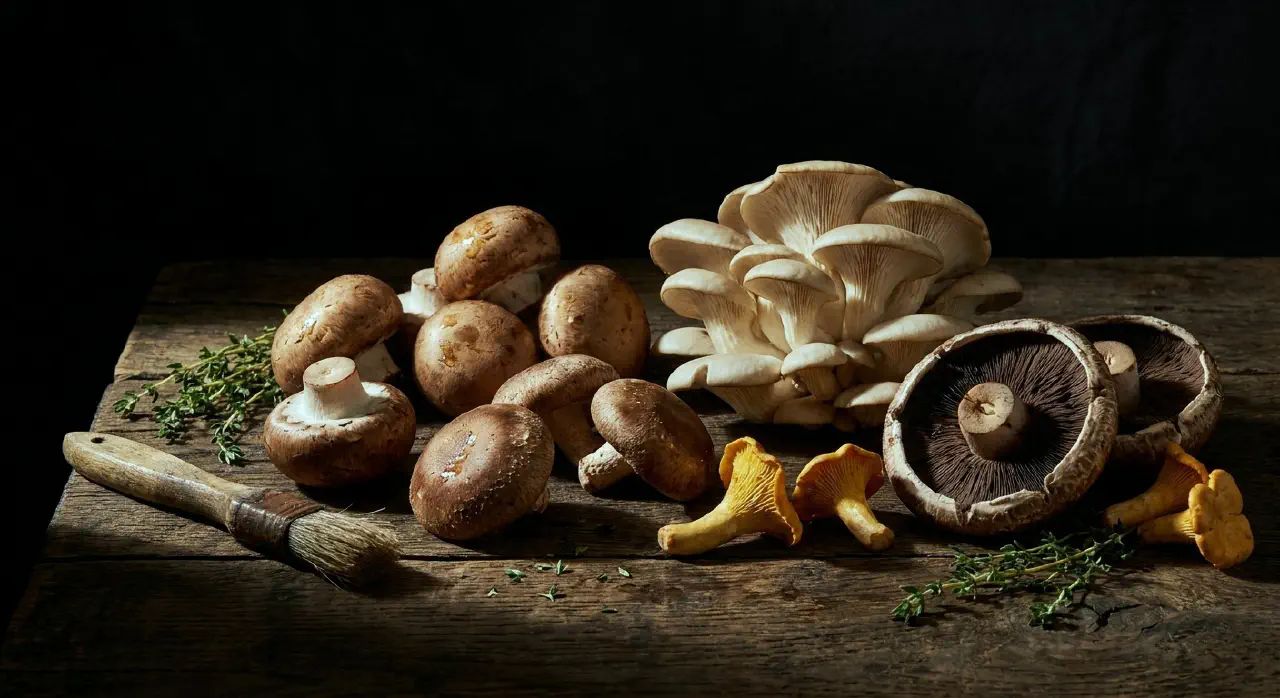
Mushrooms are not plants. They belong to a separate biological kingdom - Fungi - alongside molds and yeasts. They lack chlorophyll and cannot photosynthesize; instead, they live off other organisms’ substance. This fundamental difference gives them unique kitchen properties: chitin cell walls that never dissolve, extraordinary umami concentration, and flavor that intensifies with drying rather than fading.
Biology
What we eat is only the fruiting body - a small, ephemeral reproductive structure. The bulk of the organism lives underground as a fine network of fibers (hyphae) ramifying through soil: a single cubic centimeter can contain 2,000 meters of hyphae. When the underground mass accumulates enough energy, it organizes a dense growth of interwoven hyphae, pumps it up with water, and pushes through the soil surface to release spores into the air.
Three lifestyles
Saprophytic (most cultivated mushrooms): Feed on dead plant matter. White/brown button mushrooms apparently evolved alongside plant-eating mammals, thriving in partly digested, nutrient-rich dung - now replicated in artificial compost. Easy to cultivate; the Chinese raised shiitake on oak logs in the 13th century, and the French began button mushroom cultivation in the 17th century.
Symbiotic (boletes, chanterelles, truffles): Form partnerships with living trees, exchanging soil minerals for tree sugars. Difficult to cultivate - they need forests, not farms. This is why chanterelles and truffles remain expensive and largely wild-gathered.
Parasitic (corn smut/huitlacoche): Feed on living plants. The Mexican delicacy huitlacoche is a fungal infection of corn ears.
Chitin: why mushrooms don’t get mushy
Plant cell walls are built from cellulose, which dissolves partially during cooking (the pectin cliff). Mushroom cell walls are reinforced with chitin - the same carbohydrate-amine complex found in insect and crustacean exoskeletons. Chitin is insoluble in water, which means mushrooms never turn to mush with prolonged cooking. This unique structural property makes them the only “vegetable” you can braise indefinitely without textural collapse.
The exception: jelly and ear fungi contain unusual amounts of soluble carbohydrates and develop a gelatinous texture when cooked - prized in Asian cuisines for exactly this reason.
Flavor: natural MSG factories
Mushrooms are prized for rich, almost meaty flavor and their ability to intensify the flavor of everything around them. This comes from exceptionally high free amino acid content, especially glutamic acid (the active component of MSG). Shiitake mushrooms are additionally rich in GMP (guanosine monophosphate), a taste enhancer that synergizes with glutamate - each amplifies the other’s savory effect.
Fresh mushroom aroma
The characteristic smell of fresh common mushrooms comes from octenol (an 8-carbon alcohol), produced by enzymes acting on polyunsaturated fats when tissue is damaged. More octenol comes from gill tissues than from any other part - which means common mushrooms with mature, open caps are more flavorful than immature button mushrooms with closed caps. Brown varieties produce more flavor than white. A portobello is simply a brown mushroom allowed to mature 5–6 additional days to ~6 inches across - accounting for its intensity.
Diverse species aromas
Beyond octenol, the flavor range across species is remarkable: almond (a close button mushroom relative), cinnamon, pepper, garlic, pine needles, butterscotch, even shellfish notes. Shiitake’s distinctive aroma comes from lenthionine (a ring of carbon and sulfur atoms) created by enzymes when tissue is damaged. Lenthionine is maximized by the common practice of drying and then rehydrating shiitakes in warm water, and minimized by rapid cooking of fresh ones (which destroys the enzymes before they can act).
Drying: the great flavor intensifier
With the exception of chanterelles, oysters, and matsutakes, drying intensifies mushroom flavor - a combination of heightened enzyme activity during the early stages of dehydration and Maillard browning reactions between amino acids and sugars. Dried shiitakes and boletes (porcini) are prized specifically for the sulfur compounds that develop, producing meaty aromas absent from fresh specimens. Even home-dried button mushrooms are far more flavorful than their fresh originals, though they lose the fresh-mushroom octenol character.
Storage and handling
Mushrooms remain very active after harvest - they may even continue growing. At room temperature, they lose half their energy reserves within four days, converted to cell-wall chitin. Protein-digesting enzymes become active in the stalk, turning stalk proteins into amino acids - making older mushrooms slightly more savory but less texturally appealing.
Refrigerate at 40–45°F/4–6°C in loosely wrapped, moisture-absorbing packaging. Use promptly.
Washing: Despite cookbook warnings, mushrooms are already 80–90% water and absorb negligible additional moisture from a brief rinse. But wash immediately before cooking - washing damages surface cells and triggers browning enzymes.
Cooking
Slow, dry heat is optimal: it allows enzymes time to generate flavor before being inactivated, cooks out abundant water, and concentrates amino acids, sugars, and aromas. Mushrooms shrink considerably as water and air escape.
High heat for searing: Mushrooms want maximum temperature (200°C+) to flash off their exceptionally high water content. At lower temperatures they simply stew in their own liquid - going grey and soft instead of browning.
Truffles
Dense, knobby fruiting bodies of Tuber species that remain hidden underground, spreading spores by emitting musky, persistent aromas to attract animals (beetles, squirrels, deer) that eat them and disperse the spores in dung. Still gathered with trained dogs. Symbiotic with trees (usually oaks, hazels, lindens) - cultivation means planting a forest and waiting a decade or more for significant harvests. The Périgord region of France is renowned for black winter truffles (Tuber melanosporum).
See also
- maillard-reaction - the browning reactions that develop during mushroom drying and high-heat cooking
- plant-biology - contrast with plant cell structure: chitin vs. cellulose
- vegetable-cooking - mushrooms as an exception to the pectin-cliff model
- fish-flavor-freshness - parallel umami chemistry in seafood (glutamate, GMP synergy)
- shellfish-mollusks - bivalves share the glutamate-as-flavor-strategy