Shellfish - Mollusks
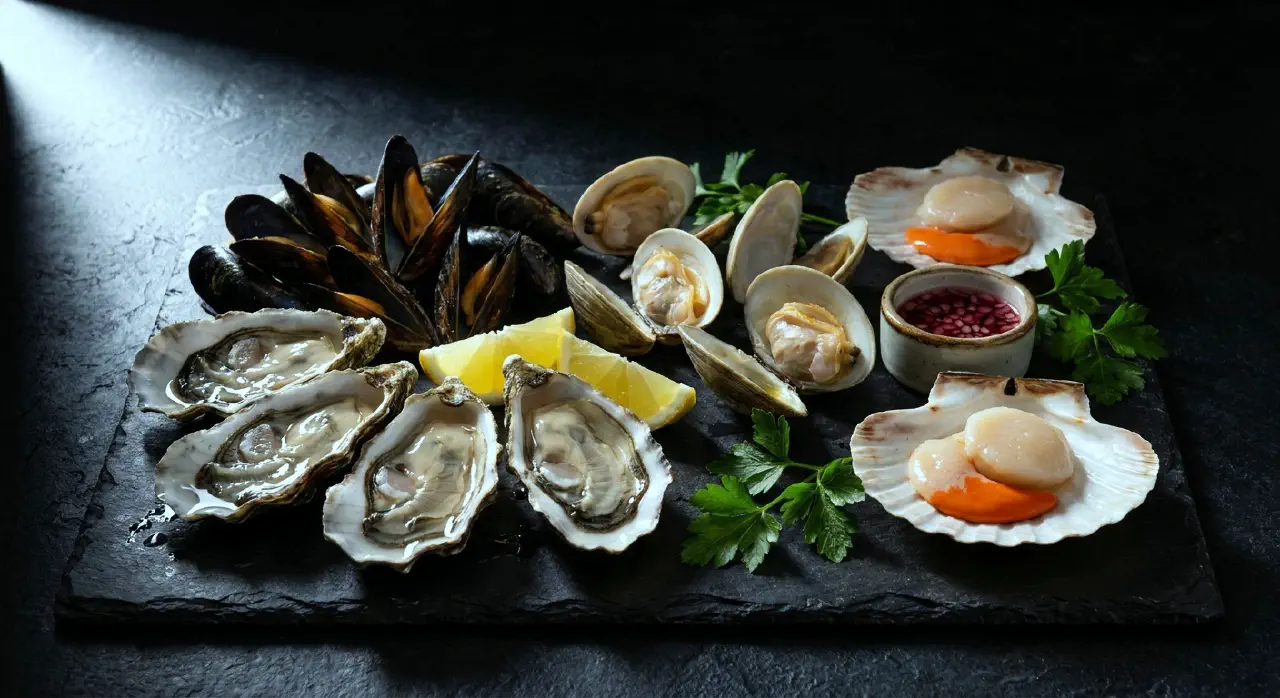
Mollusks are the strangest creatures humans eat, and among the most delicious. Shell mounds document human consumption 300,000+ years back. The phylum spans 100,000 species - double the number of all vertebrates - from millimeter snails to giant squid. All share three body parts combined in vastly different ways: a muscular foot, a complex organ assembly, and a versatile mantle that secretes shell material.
The Adductor Muscle System
Bivalves (clams, mussels, oysters, scallops) open their shells with a spring-like hinge ligament and close them with adductor muscles. These muscles have two functionally different portions:
The “quick” portion closes the shell rapidly - white, translucent, relatively tender, and the desired eating part. The “catch” portion holds the shell shut for hours using biochemical tricks that lock fibers in place with minimal energy. It’s among the strongest muscles known, reinforced with dense collagen, opalescent like tendon - and tough to eat unless cooked a long time.
In scallops, the small catch portion is usually cut away. In oysters, clams, and mussels, both portions are eaten whole.
Bivalve Flavor: The Glutamate Strategy
Bivalves take a fundamentally different osmotic approach than fish (which use TMAO) or crustaceans (which favor glycine). Bivalves rely almost entirely on amino acids - especially brothy glutamic acid - to balance external salinity. They also store energy as amino acids and glycogen rather than fat.
This makes bivalves naturally, intensely umami. Saltier water means more amino acid accumulation, which is why oyster flavor varies by geography and why “finishing” oysters in particular waters for weeks heightens their savoriness. Spawning depletes these amino acid reserves, making bivalves noticeably less tasty as spawning approaches.
Heat traps some amino acids in coagulated protein, reducing savoriness - one reason raw bivalves taste so full. Cooked mollusk aroma is dominated by dimethyl sulfide (DMS), formed from a sulfur compound accumulated from algae. DMS is also prominent in canned corn and heated milk, explaining why oysters and clams pair naturally with these ingredients in chowders and stews.
Cephalopods: Squid, Octopus, Cuttlefish
Cephalopods are “mollusks turned inside out” - highly mobile carnivores with the shell internalized as support structure. Their mantle has been transformed into a muscular body wall with extremely thin fibers (1/10 the diameter of fish fiber), dense flesh, and 3–5× more collagen than fish muscle. Crucially, this collagen is extensively cross-linked like land animal collagen, not weak like fish collagen.
This creates the brief-or-long cooking requirement. Lightly cooked (under 130°F): moist, almost crisp. At 140°F: collagen contracts, curling and squeezing moisture out - the rubbery zone. After prolonged simmering (1+ hour): collagen dissolves into gelatin, yielding silken succulence. Pounding can help disorganize and tenderize.
Unlike bivalves, cephalopods use tasteless TMAO (like fish) rather than free amino acids. Their flesh is less sweet and savory than other mollusks, and can turn fishy as bacteria convert TMAO to TMA.
Species Notes
Oysters: The sea’s tenderest morsels - the marine equivalent of penned veal. The shell-closing adductor is just 1/10 of body weight; over half the body is thin, delicate mantle and gills. Flavor depends heavily on home waters: salinity, plankton, temperature, and even tidal exposure shape taste. European flat oysters have a metallic note; Asian cupped oysters produce melon and cucumber aromas; Virginia oysters smell of green leaves. Live oysters can heighten flavor during refrigerated storage as anaerobic metabolism produces savory succinic acid.
Scallops: The only swimming bivalve. The large central adductor muscle serves as protein and energy storage, giving sweet taste from glycine and glycogen. Polyphosphate-treated scallops (plump, glossy white) are less flavorful and weep liquid when heated; untreated scallops are duller off-white with pink or orange tones. When sautéed, they develop rich brown crusts from amino acid/sugar maillard-reaction reactions.
Clams: Burrowing and siphoning musculature makes them fairly chewy. Hard-shell clams (littleneck, quahog) close completely. Soft-shell clams (steamers) always gape. Geoducks are the largest - 3 lb typical, neck up to 3 feet.
Mussels: Easiest mollusks to prepare. Tolerate some overcooking due to relatively small muscle tissue. Remove the byssus (“beard”) just before cooking. Cook in broad, shallow pan to remove early openers before they overcook.
Abalone: Extremely tough from collagen accumulated as energy reserve. Toughens badly above 120°F. Requires either very gentle cooking or prolonged simmering (several hours) to dissolve collagen into gelatin.
Sea urchins: Prized for golden reproductive tissues (15–25% fat, 2–3% savory amino acids). Used raw in sushi, scrambled into eggs in French cooking, or added to fish soups and sauces.
Handling and Selection
Live bivalves should close tightly when tapped - discard any that don’t. Store on ice under a damp cloth, never in pooled meltwater (fresh water kills marine creatures). Clams benefit from several hours in cold salt water (1/3 cup per gallon) to expel grit. Shells that don’t open during cooking may contain dead animals and should be discarded.
See Also
- shellfish-crustaceans - Shrimp, lobster, crab
- fish - Comparison with fin fish
- fish-flavor-freshness - TMAO chemistry, shared by cephalopods
- emulsions - Oyster and clam flavors in cream-based sauces
- protein-denaturation - Collagen behavior in cephalopods vs. fish
- fermentation-overview - Fermented shellfish products