Precision Rice
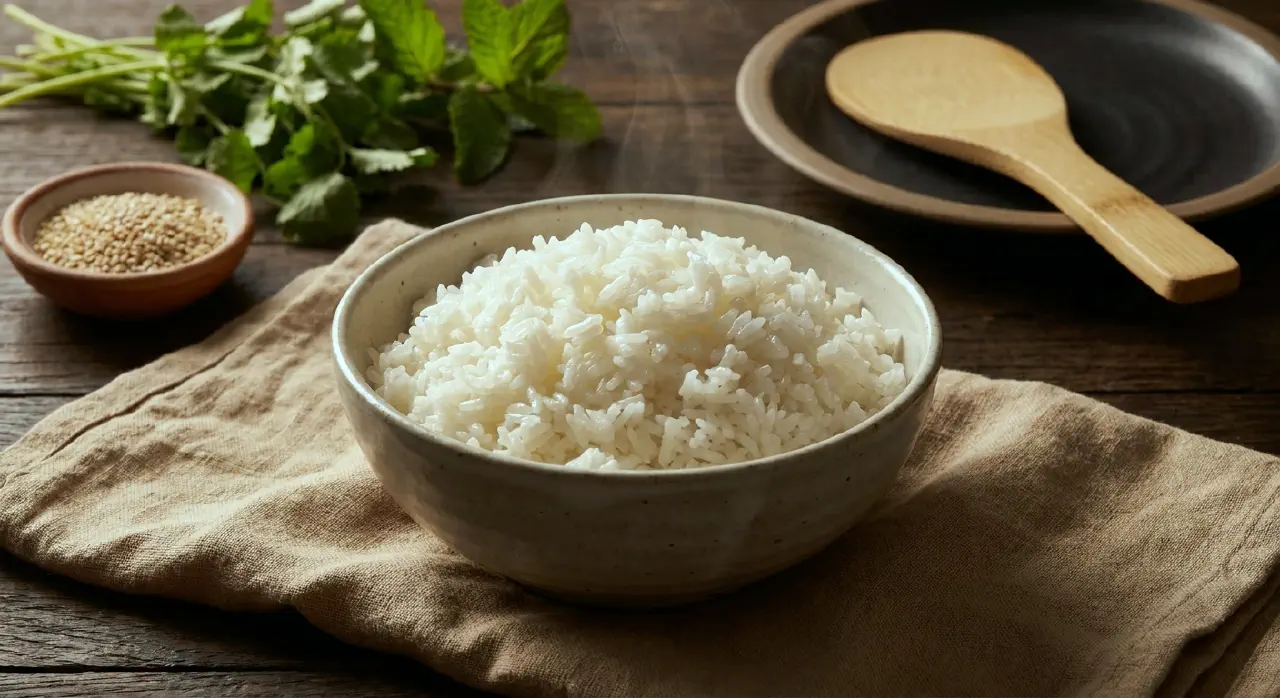
Rice cooking fails not from technique but from bad science. Once you separate what the grain absorbs from what escapes as steam, perfect rice becomes predictable. The key insight: all rice types need roughly 1:1 water by weight in a sealed system - everything above that is compensating for evaporation.
Starch Profiles
Rice texture stems entirely from its internal starch architecture. amylose (long, straight chains that resist tangling) produces fluffy, separate grains and appears in high concentrations in basmati and other long-grain varieties. amylopectin (branched starch molecules that tangle easily together) creates sticky, cohesive texture and dominates in sushi rice, glutinous rice, and short-grain types.
The practical result:
| Rice Type | Starch Profile | Texture |
|---|---|---|
| Basmati | High amylose | Separate, fluffy |
| Jasmine | Medium amylose/amylopectin | Slightly clingy, aromatic |
| Sushi/Grødris | High amylopectin | Sticky, cohesive |
| Glutinous | Nearly pure amylopectin | Very sticky, pudding-like |
Different textures come from internal starch architecture, not water requirements. All rice types hydrate at roughly 1:1 water-to-grain by weight.
The Evaporation Variable
In sealed systems (sous vide bags, sealed jars), rice hydrates perfectly at 1:1 water:rice by weight. In open pots, steam escapes - that lost water never reaches the grain. Cookbook ratios disagree wildly (1:1.5, 1:1.75, 1:2) because they hide two independent variables in one number: absorption (universal, ~1:1) and evaporation (varies by pot shape, lid type, heat intensity).
The doubling problem reveals this clearly: double the rice and water but keep the same pot - evaporation stays roughly constant because you’re losing the same shallow layer of steam. The second batch ends up too wet because evaporative losses don’t scale proportionally.
The Finger Rule
Level rice in pot, add water to just cover (meeting 1:1 absorption), then add one finger joint more water (a fixed evaporation buffer). This simple rule scales correctly: the extra depth stays constant regardless of rice volume, matching the physics that pots lose roughly the same shallow layer of steam regardless of how much grain sits below.
Rice Cooker Logic
Simple rice cookers use a magnetic switch that triggers at ~110-120°C. As long as liquid water exists, the pot bottom cannot exceed ~100°C because energy goes into steam production rather than temperature increase. Once water is absorbed and steam boils away, temperature climbs above 100°C and the switch trips to “keep warm.” Not clever engineering - just phase-transition detection.
Four-Phase Precision Method
Phase 1: Rapid Boil - Apply maximum safe power to bring water to a rolling boil. This phase is fast and straightforward.
Phase 2: Gentle Simmer - Reduce to ~300W (barely visible bubble percolation) and maintain 98-100°C. Steady low-intensity heat ensures even starch-gelatinization throughout the grain without violent boiling that creates uneven absorption.
Phase 3: 110°C Cutoff - Monitor temperature continuously. When it rises above 100°C, immediately cut heat. This signals that no free water remains and prevents bottom-frying of the grain layer.
Phase 4: Rest and Equilibrate - Hold at 65°C for ~1 hour. Moisture redistributes from wet outer grains to drier interior, surfaces dry slightly. Result: fluffier texture, less stickiness, uniform moisture throughout.
See also
rice, starch-gelatinization, carbohydrate-overview, precision-cooking, boilover-physics