Carbohydrates in Cooking
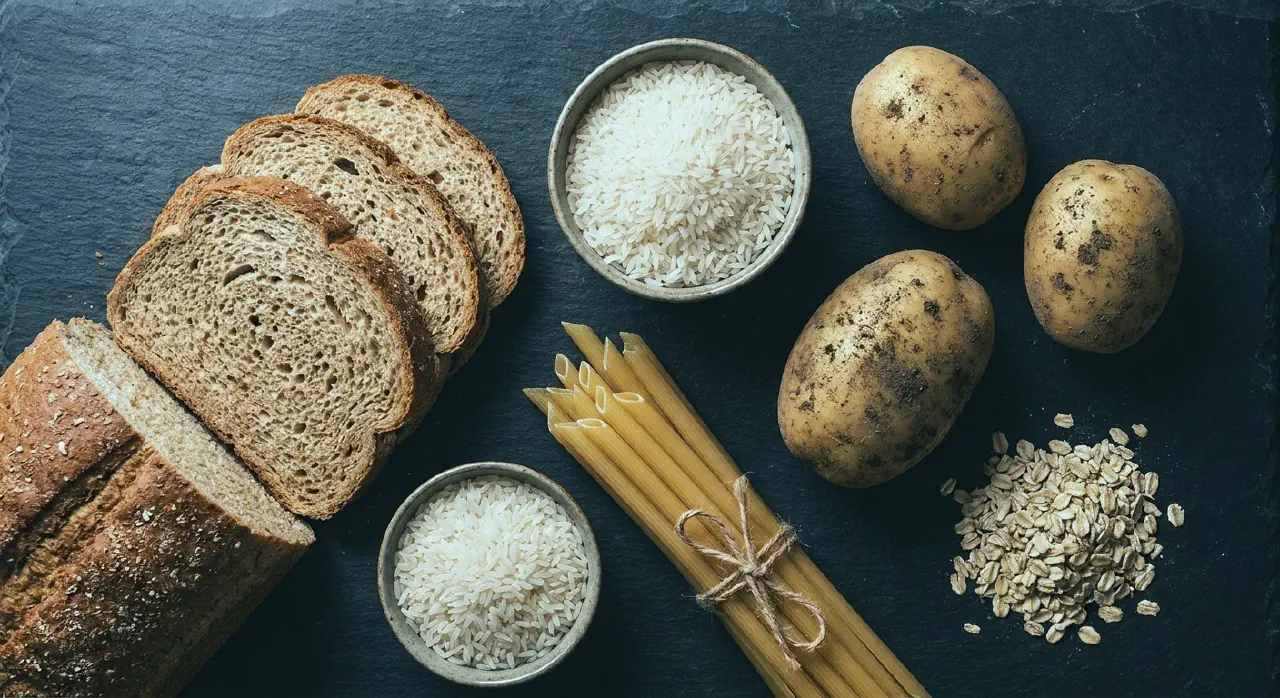
Carbohydrates - built from carbon, hydrogen, and oxygen - serve two purposes in the biological world: energy storage (sugars and starch) and structural support (cellulose, pectin). The cook encounters them at every scale, from the sweetness of a single glucose molecule to the indigestible fiber of a celery stalk. The remarkable fact is that the same glucose monomer, connected by different chemical linkages, produces substances with opposite cooking behavior - soluble starch that thickens sauces and insoluble cellulose that resists hours of boiling.
Sugars: simple carbohydrates
Sugars are the simplest carbohydrates, distinguished by carbon count and molecular arrangement. The 6-carbon hexoses (glucose, fructose, sucrose) are the most important to cooking - they taste sweet, participate in Maillard browning and caramelization, dissolve readily in water via hydrogen bonding, and serve as the energy currency of cells. See sugar-science for detailed coverage of the three kitchen sugars, sweetness perception, and crystallization.
Oligosaccharides: the flatulence problem
Oligosaccharides are 3–5 ring sugars - raffinose (3), stachyose (4), verbascose (5) - found abundantly in legume seeds. They’re too large to trigger human sweetness receptors and too complex for human digestive enzymes. They pass intact into the large intestine, where colonic bacteria digest them enthusiastically, producing carbon dioxide and other gases. This is the specific molecular cause of bean-related flatulence - not protein, not fiber, but undigestible short sugar chains.
Polysaccharides: the structural giants
Polysaccharides are sugar polymers - large molecules composed of hundreds to thousands of sugar units. Despite their size, they retain the hydrogen-bonding capacity of their component sugars, so many absorb water readily. Whether they dissolve depends on the strength of attractive forces between polymer chains.
Starch: the cook’s most important polysaccharide
Plants store energy as starch - compact, unreactive glucose chains packed into concentric-layered microscopic granules. Two configurations:
Amylose - completely linear glucose chains (thousands of units). More water-soluble, tends to form gels on cooling, responsible for the firm set of cooled sauces and the staling of bread.
Amylopectin - highly branched glucose chains. Creates the characteristic sticky, clingy texture of short-grain rice and waxy starches.
When heated in water, granules absorb water, swell, and release starch molecules (gelatinization). On cooling, amylose molecules rebond into a moist gel (retrogradation) - trapping water in a network that gives body to sauces and structure to cooled starchy foods. The amylose/amylopectin ratio is the master texture variable across all grains and starches (see seed-biology).
Glycogen: animal starch
Glycogen is the animal equivalent of amylopectin - more highly branched, a fairly minor component of muscle tissue. Its concentration at slaughter affects the meat’s ultimate pH, which influences texture and preservation.
Cellulose: the indigestible fiber
Like amylose, cellulose is a linear glucose chain - but a minor difference in the chemical linkage between glucose units makes it insoluble in water and indigestible to nearly all animals (ruminants and termites manage it only through gut bacteria). Cellulose fibers are laid down in cell walls as tiny reinforcing rods, analogous to steel bars in concrete. Cooking does not dissolve them - cellulose provides the irreducible structural backbone of all cooked vegetables.
Hemicelluloses and pectic substances
Made from a variety of sugars (galactose, xylose, arabinose), these polysaccharides fill the spaces between cellulose fibrils in cell walls like jelly-like cement. Unlike cellulose, they are partly soluble in water - their dissolution during cooking is what softens vegetables and fruits. Pectin is abundant enough to extract from citrus and apples, and when combined with sugar and acid, it gels into jams and jellies.
Inulin: the fructose polymer
A chain of fructose sugars (handful to hundreds per molecule) used for energy storage in the onion and lettuce families - especially garlic and sunchokes. Inulin acts as antifreeze (sugars lower the freezing point of cellular water). Like oligosaccharides, it’s indigestible by humans and feeds colonic bacteria, causing gas.
Plant gums: thickeners and stabilizers
Various complex plant carbohydrates serve as thickeners, gelling agents, emulsion stabilizers, and texture modifiers in manufactured and home-cooked foods:
Seaweed polymers - agar, alginates, carrageenans (see gelatin-gels) Tree exudates - gum arabic (Acacia), gum tragacanth Legume seeds - guar gum, locust-bean gum (carob) Bacterial fermentation - xanthan gum, gellan gum
Applications include ice-cream smoothness, sauce viscosity, baked goods moisture retention, and confection texture modification.
See also
- sugar-science - the three kitchen sugars, sweetness, crystallization, inversion
- starch-gelatinization - granule swelling, amylose leakage, retrogradation
- seed-biology - amylose/amylopectin ratios across grains
- plant-biology - cell walls, cellulose, pectin in living plants
- water-science - hydrogen bonding as the dissolving mechanism
- protein-structure - the other sensitive food molecule
- lipid-chemistry - the nonpolar family that carbohydrates contrast with
- gelatin-gels - seaweed gelling agents (agar, carrageenan, alginate)
- legumes - oligosaccharide flatulence, indigestible sugars